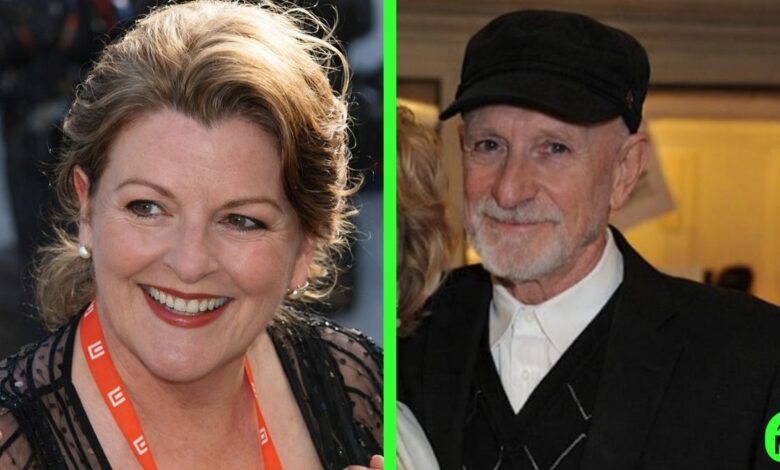
For more than four decades, Brenda Blethyn has occupied a distinctive place in British culture. Her performances—rooted in emotional precision rather than glamour—have earned her awards, widespread acclaim, and a rare kind of longevity. From internationally celebrated films to her defining role as DCI Vera Stanhope in Vera, Blethyn’s career has unfolded very publicly.
Running quietly alongside that public success is a private partnership that has lasted even longer. Michael Mayhew, her husband, has never sought celebrity and has rarely been visible beyond carefully chosen moments. He is not an entertainer, not a public commentator, and not a figure who trades in interviews. Yet his presence—steady, consistent, and deliberate—forms part of the architecture that has supported Blethyn’s work for decades.
This article examines Michael Mayhew’s life and role, drawing on verifiable facts and careful analysis. Where information is limited, the focus is not on filling gaps with invention, but on understanding what that privacy itself communicates.
Profile Summary
| Detail | Information |
|---|---|
| Full Name | Michael Mayhew |
| Relationship | Husband of Brenda Blethyn |
| Public Profile | Private individual |
| Profession | Former art director / graphic designer |
| Age | Not publicly disclosed |
| Residence | London (general, non-specific) |
| Children | None |
| Known Philanthropic Interests | Not publicly detailed |
| Social Media Presence | None publicly known |
Who Is Michael Mayhew?
Michael Mayhew is best known publicly as the long-term partner and husband of Brenda Blethyn, but that description alone understates his own professional life and the choices that define him. Mayhew spent over three decades working as an art director and graphic designer at the National Theatre, one of Britain’s most influential cultural institutions. His career unfolded behind the scenes, in an environment where visual storytelling supports performance rather than competes with it.
Unlike many spouses of high-profile actors, Mayhew has never attempted to convert proximity to fame into a public platform. His significance lies not in visibility but in continuity. The fact that his name appears so rarely in headlines is not an accident; it reflects a consistent pattern of discretion that has remained intact even as Blethyn’s public profile has grown.
The Private Life of Michael Mayhew
Michael Mayhew’s private life is notable not for secrecy in the dramatic sense, but for restraint. Public records and verified interviews show no attempt to curate a public-facing identity. He does not appear on social media, does not grant interviews, and does not participate in publicity cycles connected to his wife’s work.
This absence itself is meaningful. In an era when association with a celebrity often becomes a brand, Mayhew’s choice suggests a firm boundary between professional life and personal identity. His privacy appears to be maintained not only by avoidance, but also by structural choices—limited appearances, selective engagement, and a refusal to comment publicly. These are not signs of withdrawal but of intention.
Early Life and Background of Michael Mayhew
What is publicly known about Michael Mayhew’s early life is minimal and inferred primarily from his professional trajectory. His long tenure at the National Theatre indicates formal training and expertise in visual design, stage aesthetics, or graphic communication—fields that typically require both education and apprenticeship.
The absence of personal anecdotes or biographical detail suggests that Mayhew’s early life has never been positioned as part of a narrative for public consumption. Unlike entertainers, whose formative years are often revisited in interviews, his background remains contextual rather than documented. The key verifiable fact is professional: he built a sustained career within one of the UK’s most demanding creative institutions, implying consistency, competence, and trust.
Marriage and Partnership with Brenda Blethyn
Mayhew and Blethyn met in 1975 while working at the National Theatre. Their relationship developed long before Blethyn achieved widespread fame, which situates their partnership outside the usual pressures of celebrity culture. After a 35-year engagement, they married in 2010 in a small registry office ceremony in South London—an event that attracted attention mainly because of its understatement.
One of the most discussed aspects of their marriage is their decision to live in separate flats within the same building. This arrangement, as confirmed in interviews with Blethyn, reflects a shared commitment to autonomy rather than distance. It challenges conventional assumptions about intimacy while demonstrating a pragmatic understanding of personal space, particularly within a long-term partnership.
Michael Mayhew’s Role Behind the Scenes
Although Michael Mayhew has never publicly defined his role in the marriage, available evidence suggests emotional and structural support rather than managerial involvement. Blethyn has described him as honest, kind, and stabilising—qualities that align with the demands of a career marked by intense roles and long production schedules.
His professional background in theatre design also suggests a shared cultural language. Both partners emerged from the same institutional environment, one that values collaboration, preparation, and respect for craft. That shared foundation likely informs how they navigate success, pressure, and public attention—quietly, without theatrics.
Family Life: Raising the Next Generation
Michael Mayhew and Brenda Blethyn do not have children together, a fact they have consistently and openly stated without elaboration. As such, discussions of “raising the next generation” must remain grounded in what is known rather than assumed.
Instead of parenthood, the couple’s domestic life includes their dog, Jack, a cockerpoo frequently mentioned by Blethyn in interviews. While this does not substitute for children, it reflects a form of shared responsibility and routine that anchors daily life. Importantly, the absence of children has never been framed publicly as a deficit, but simply as a fact—treated with the same neutrality that characterises much of their private life.
Philanthropy and Community Engagement
There is no public record of Michael Mayhew engaging in philanthropic work under his own name, nor of high-profile charitable campaigns associated with the couple. This absence should not be interpreted as indifference. Instead, it aligns with a broader pattern: engagement without publicity.
Both Mayhew’s career in public theatre and Blethyn’s longstanding association with socially grounded storytelling suggest values oriented toward public culture rather than personal branding. Any charitable or community involvement that exists appears to be conducted privately, without press releases or formal recognition.
The Power of Privacy: Influence Without Publicity
Michael Mayhew’s life illustrates how privacy can function as a form of influence. By refusing to occupy public space unnecessarily, he reinforces the idea that not all meaningful contributions require visibility. His approach contrasts sharply with contemporary expectations, in which relevance is often measured by exposure.
This model of influence—quiet, stable, and long-term—has arguably enabled Blethyn to maintain a career free from scandal or overexposure. Privacy, in this context, becomes a shared resource rather than a personal shield.
Public Curiosity and Misconceptions About Michael Mayhew
One recurring misconception is confusion between Michael Mayhew and an American comic book artist of the same name. This error persists essentially because Blethyn’s husband does not maintain a public profile to counter it. Another misconception is that his low visibility implies passivity. Available evidence suggests the opposite: his choices appear active, consistent, and values-driven.
Public curiosity remains limited, partly because there is little to sensationalise. That restraint may be precisely why interest endures.
Legacy and Future
Michael Mayhew’s legacy will not be measured in awards or headlines. Instead, it will be inferred through endurance: a marriage spanning half a century, a career marked by longevity rather than self-promotion, and a life that resisted the gravitational pull of celebrity.
Looking ahead, there is no indication that this approach will change. If anything, it has become more firmly established with time.
Conclusion
Michael Mayhew occupies a rare position: adjacent to fame without being absorbed by it. His life, as far as it is publicly visible, reflects consistency, discretion, and a clear sense of boundaries. In supporting Brenda Blethyn’s extraordinary career, he has never attempted to become part of the story, yet his presence is integral to its stability.
In a culture that often equates visibility with value, Mayhew’s example offers a counterpoint. Influence does not always announce itself. Sometimes it simply endures.
Read this too:Claudia Jessie Net Worth: Career, Earnings, and the Value of a Low-Profile Star
(FAQs)
1. Who is Michael Mayhew?
He is a former art director at the National Theatre and the husband of actress Brenda Blethyn.
2. When did Michael Mayhew and Brenda Blethyn marry?
They married in June 2010 after a long-term relationship that began in 1975.
3. Does Michael Mayhew work in film or television?
No. His professional background is in theatre design and graphic work.
4. Do Michael Mayhew and Brenda Blethyn have children?
No, they do not have children together.
5. Why do they live in separate flats?
They have said the arrangement supports independence and personal space.
6. Is Michael Mayhew active on social media?
There is no publicly known social media presence.
7. Is he related to the American artist Mike Mayhew?
No. They are different individuals with the same name.
8. Does Michael Mayhew appear in public with Brenda Blethyn?
Only occasionally, and typically at low-key or professional events.