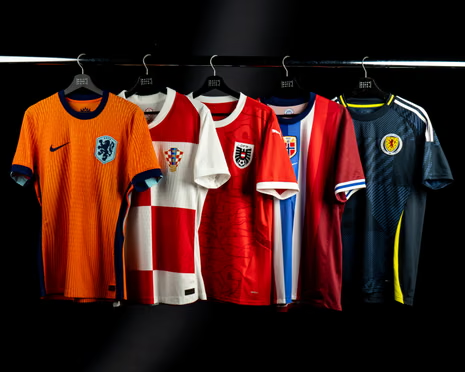
Watching old football matches on YouTube and seeing the players in what looked like pajamas with laced collars, if you thought that too, then you’re in good company. Over the last century and a half, football jerseys have changed drastically, evolving from very heavy cotton shirts that got quite heavy when wet to the modern, light and airy kits that footballers wear now.
Football shirts’ history is essentially the history of football. Each modification in style, fabric or logo gives you clues to how football was developing, who the audience was, and what the fans valued at that time.
The Earliest Shirts Weren’t Really Jerseys at All
Back in the days of the 1870s and 80s, when football was just starting to get organized in England, a matching team uniform was not a concept at all. Players used to wear whatever kind of long-sleeved cotton or wool shirts they had at home and if they were wearing colored caps or sashes, it was only to help teammates recognize each other.
The fabric was really uncomfortable. Just imagine playing football for 90 minutes wearing a thick cotton shirt that will have absorbed the rain, mud, and sweat by the time you finish playing. In the second half shirts could easily weigh twice as much as at kickoff. Players also had laced collars -thin strings tied at the neck- which remained in various forms up to the 20th century.
Eventually, it was decided that team colors should not be only a matter of a debatable point but a compulsory one. Clubs began to select particular tints to convey their brand and these colors regularly came from nearby schools, factories, or the favorite rugby teams of the founders. This is the main reason why many traditional football colors have some very strange explanations that have nothing to do with the city itself.
Numbers, Badges, and the Birth of Identity
Initially, for many decades of the game, players did not wear numbers. No one did. If you were watching from the stands, you simply figured out the identity of the players by recognizing their faces or seeing where they positioned themselves on the field.
The transition to using numbers in shirts started in the 1920s and 30s when English and Scottish teams first tried out numbered jerseys. The 1933 FA Cup Final between Everton and Manchester City is often referred to as a significant step as Everton was in numbers 1 to 11, and City was in 12 to 22. It took a while for everyone to embrace the idea, but after that, it became the norm.
Following the club crests. Initial badges were often just simple initials or a local emblem embroidered on the chest. Later on, they became quite detailed, showing anything from lions and ships to castles and cannons. Nowadays, a football shirt without a crest feels pretty much like a person without clothes, but for a long time, the shirt was the main means of identification in football.
Polyester Changes Everything
The 1970s marked a major change in jerseys, and the biggest change was the type of fabric used. Teams and manufacturers shifted from using cotton to polyester and synthetic fabric blends. The new materials were not only lighter and quicker drying but also didn’t become heavy and soggy like cotton by halftime.
With the change of materials, designs also became more adventurous. The late 70s and 80s witnessed some of the coolest (and sometimes funniest) football shirts ever. Thick stripes, wild patterns, huge collars pinstripes geometric prints -if you can think of it, some team probably wore it. Many of those designs are now considered retro classics, and replicas among football shirt collectors can fetch a high price.
Shirt sponsorship made its debut at almost the same time. It is commonly accepted that the German team Eintracht Braunschweig was the first club in the top division to have a commercial sponsor logo on their kit in 1973, and the concept caught on rapidly. Initially, supporters were opposed to it. The laymen believed it spoiled the appearance of the shirt. However, within ten years, sponsors were everywhere, and nowadays, a blank football jersey seems stranger than a branded one.
The Modern Era: Tight Fits, Tech Fabrics, and Collector Culture
Modern jerseys have little similarity to those old cotton shirts. The latest kits are made of fabrics that wick moisture, are designed to pull sweat away from skin; also, there are mesh parts under the arms that help with air circulation, and the shapes are such that they move with the player rather than flap around. Some high-level shirts are even made from recycled plastic bottles, something that would have amazed people in the 1970s.
Styles have also evolved. Jerseys were quite large and loose for a long period in the 90s and 2000s. Around the early 2010s, teams began providing a tighter “player issue” alongside a looser fan version, and slim fits became the standard.
At the same time, jersey culture exploded. Retro shirts became a huge part of fashion, not just football. Young fans today collect vintage kits the way people used to collect vinyl records, and online shops built entire businesses around tracking down classic designs or stocking current ones. If you’re hunting for shirts -current season, retro releases, or European club kits that aren’t easy to find locally -sites like soccerlord specialize in exactly that kind of thing.
Why Jerseys Matter More Than Ever
A football shirt is not simply sportswear. It indicates the place of your origin, the team you support, and in some cases, the person you were at one time in your life. People keep their old jerseys just as they keep their concert tickets or childhood photos, for instance.
If you go out in any city on the day of a football match, you will see that loyalty literally on the chests. A child with a Brazil shirt in Stockholm city, a person with a Liverpool outfit in the capital of Japan, the traditional Milan stripes in Buenos Aires – the football jersey is one of the few garments that manages to cross borders. For that reason, clubs nowadays spend a lot of time deciding on the design of the football gear, and fans get extremely excited, positively or negatively, with each new release of the kit.
The Shirt Keeps Evolving
The next generation of football jerseys is already here. Sustainable materials, smart fabrics, which could one day track players’ physiological data, and the local culture-inspired designs are some of the innovations giving the shirt a new dimension. At the same time, the nostalgia factor is making some clubs revive vintage shirts from the 80s and 90s because the fans cannot get enough of them.
The humble beginnings of the football jersey as a heavy cotton shirt with a laced collar has now positioned it as one of the most globally recognizable garments. No matter if your jersey visit is at the stadium, schooling, or simply a ball-hanging-out day in the park, you have become part of a narrative that goes back over a hundred years. Besides, the next spectacular jersey design is most likely right now lying on a designer’s desk, patiently waiting for its chance to become someone’s ultimate favorite.