The most interesting future for AI in children’s creativity may not be fully automated content. It may be a guided path from idea to object.
For the past decade, most children’s digital tools have lived almost entirely inside the screen. Kids could draw, watch, tap, answer, swipe, or play, but the creative result usually stayed digital. Even as AI entered the picture, much of the conversation centered on generated text, images, or tutoring-style interactions.
That is useful, but it is not the whole opportunity. The next wave of children’s creator-tech may be more physical than expected. Instead of asking AI to replace imagination, new tools can help children start with an idea, shape it through guided design, turn it into a 3D model, and then print something they can hold, use, test, gift, or play with. That shift changes children from content consumers into young makers.
The problem with passive creativity tools
Many creative apps for kids are designed to be fun, but they still keep the child inside the screen. A child may color a digital picture, dress up a virtual character, build a game world, or generate an image. The output often disappears into a saved file or the next swipe.
For families and educators, that creates a familiar problem. The child may be “creating,” but the experience can feel close to passive screen time if it never leaves the device. The stronger opportunity is to use digital tools as a starting point for real-world making — where AI helps a child move past the blank-page problem, guided design helps them shape simple choices, and 3D printing turns those choices into a physical object.
What is a creator-tech stack for kids?
A creator-tech stack for kids is a connected system that helps children move through four stages:
Idea → Design → Make → Play
Each stage solves a different problem, and the magic is in how they connect.
1. The Idea Layer: AI-assisted inspiration
Many children have big imaginations, but starting can still be hard. A blank screen or open-ended prompt can feel overwhelming, especially for younger kids. AI-assisted idea generation helps by offering starting points — a creature concept, a personalized toy theme, a simple variation. The value is not that AI does the creative work. It is that the child has something to respond to. A good AI tool for children should act as a creative prompt, not a creative replacement.
2. The Design Layer: game-style toy design
After the idea comes shape. Professional CAD was not built for children, and game-style toy design lowers the barrier without removing creativity. Instead of building from scratch, kids choose themes, parts, characters, or simple modifications. The design process becomes more like guided play than software training. Pick a vehicle shape. Add a name. Customize a character. Tweak a part. Small choices, but they give the child ownership.
3. The Making Layer: 3D printing
This is where the digital idea becomes physical. 3D printing gives creative technology a different kind of feedback — the print is not just a final product, it is also information. If a wheel does not roll well, the child can ask why. If a structure falls over, they can think about the base. That is design thinking in a natural, playful form.
4. The Play Layer: use, test, gift, improve
The most valuable part may come after printing. A printed object can become a toy, a game piece, a model, a gift, a story prompt. Children can use it, test it, or change it in the next version. That play layer is what separates a one-time print from a repeatable creative routine.
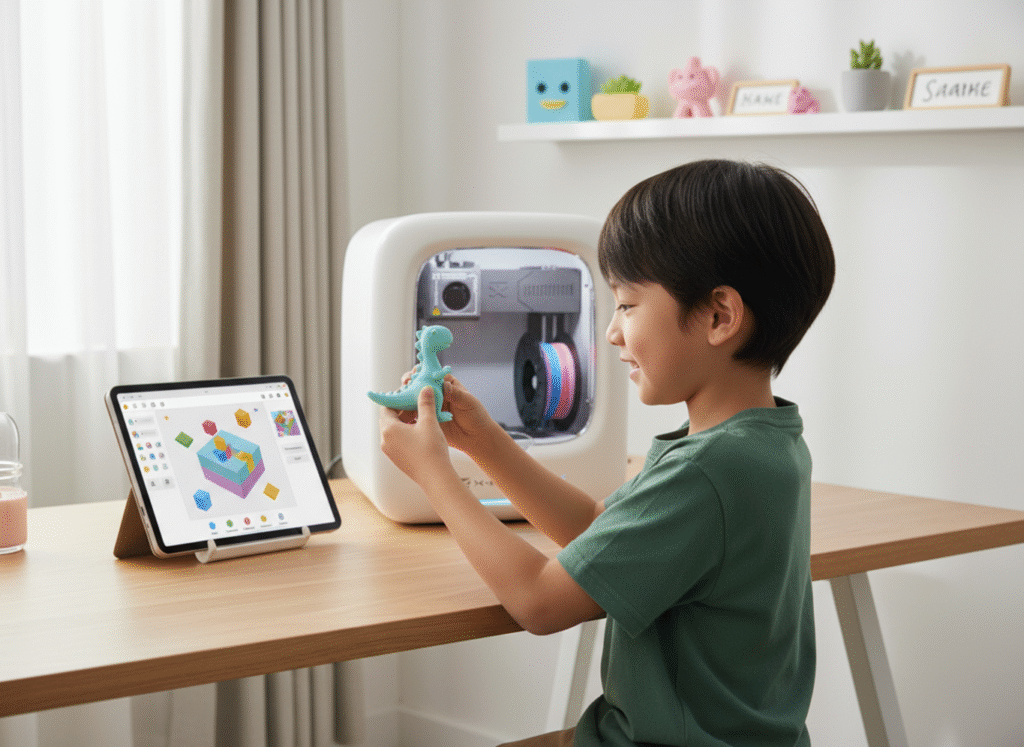
Alt text: A child holding a 3D-printed dinosaur figure beside a tablet showing a kid-friendly 3D design app, with a desktop 3D printer in the background.
AI should help children start, not do everything for them
One of the biggest concerns around AI and children is agency. If a tool does too much, the child becomes a passenger. The product may look impressive, but the learning value gets thin.
That is why the best AI-assisted creativity tools should not remove the child from the process. They should help children begin, then invite them to make choices. A useful AI feature might suggest an idea or help personalize a concept — but the child should still decide what to make, how it should look, what to change, and what to do with the result. “AI creates a toy for the child” is not the strongest version of the future. “AI helps the child start creating a toy” is much more meaningful.
Why physical output makes AI more meaningful
AI-generated content can be impressive, but most of it stays on a screen. Children may enjoy the result, but they do not interact with it physically, test it, or revise it through real-world use.
When AI-assisted ideas lead to 3D printing, the output becomes tangible. A child does not just see a digital animal — they hold it. They do not just imagine a race car — they test how it rolls. They do not just design a game token — they use it on family game night. That physical endpoint changes the value of the technology. When the output becomes physical, creativity gains consequences. The child can see whether the idea works, feel its shape, notice what to change, and improve the next version. That is a powerful way to make AI feel less abstract.
AOSEED as an example of a guided creator-tech ecosystem
A platform like AOSEED shows where children’s creator-tech is heading — not toward isolated AI apps or isolated hardware, but toward a guided workflow where children can imagine, design, print, and then play with what they create.
AOSEED’s app ecosystem is built around a three-stage creative path: AI-assisted idea generation and simple personalization, game-style toy design through themed mini apps, and beginner-friendly 3D modeling for structural builds, cartoon-style creations, and more custom projects. That structure gives children more than one entry point. A younger child might begin with simple toy personalization. An older child might explore custom modeling. A homeschool parent might use guided projects for a small-group STEM activity.
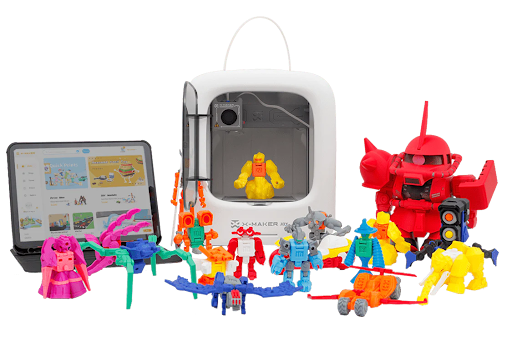
In that sense, AOSEED’s creator-tech ecosystem for young makers is not only about a printer. It connects hardware, app-led creation, project prompts, a Toy Library, and learning support. The broader category point is that kid-friendly creator-tech works best when the tools are connected. A child needs inspiration, design guidance, a way to make the object, and a reason to use it afterward.
On the design layer specifically, AI-assisted 3D design tools for kids can help children move from a general idea to a starting model without facing the empty-canvas problem. Themed mini apps let them build within a playful structure, and beginner modeling tools let them gradually take on more control as they become confident. That progression — simple choices, customization, small edits, structural thinking, original design — is how children move from guided play toward real creative confidence.
That is also why kid-friendly 3D printers built around guided creativity tend to be more compelling than hardware on its own. The printer is the last step of the stack, not the first.
Alt text: Top-down view of a tablet showing a 3D design app, a child’s pencil sketch, and a 3D-printed orange character figure on a wooden surface.
Why this matters for families and classrooms
For families, creator-tech offers a more purposeful version of screen use. The child may begin on a device, but the experience does not end there. It continues at the table, on the floor, in a story, in a game, or as a gift. That is easier for parents to understand. It is not just more screen time — it is a screen-assisted path into hands-on making.
For classrooms and homeschool environments, a 3D-printed object can make abstract ideas easier to discuss. Students can test a bridge shape, compare vehicle designs, or use printed objects as part of a lesson. Kid-friendly 3D printing supports STEM exploration, introduces design thinking, and helps children explore iteration. It does not guarantee learning outcomes or replace teachers. Its real value is more practical: it gives children a way to make ideas visible.
The future of kids’ creative tech is hybrid
The future of children’s creativity tools will not be purely digital. It will not be purely physical either. The strongest category may be hybrid: AI helps children start, game-style design helps them shape the idea, 3D printing helps them make it real, and play helps them test, share, and improve it.
That stack gives technology a better role in childhood creativity. As AI continues to enter homes and classrooms, the most meaningful tools will be the ones that preserve child agency — not the ones that simply generate more content for kids to consume. They will help young creators build something beyond the screen. That is why the new creator-tech stack for kids is worth watching.