Harmonia Rosales and Aldis Hodge: The Artist at the Center of a Brief but Memorable Public Collaboration

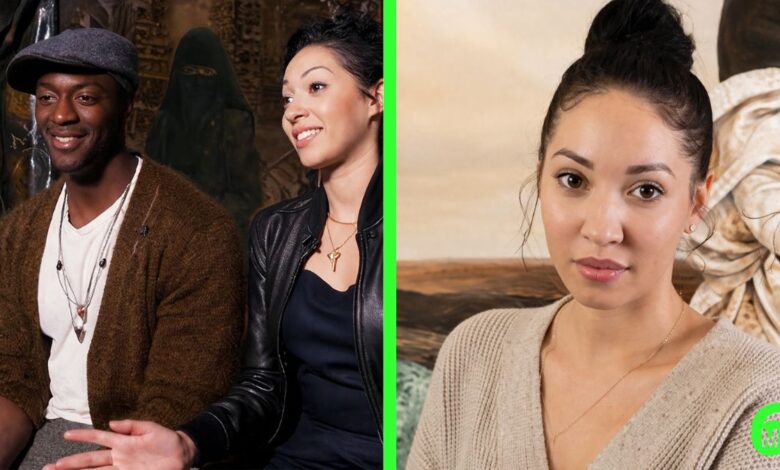
Aldis Hodge has built a widely recognized career as an actor, producer, designer, and visual artist, moving between Hollywood and fine art with unusual ease. In 2018, one of the most striking intersections of those worlds came through his collaboration with Harmonia Rosales, the Chicago-born, Los Angeles-based Afro-Cuban American painter whose work reimagines Western religious and classical imagery through Black female subjects and diasporic narratives. Their joint series, Through the Looking Glass, debuted at the LA Art Show and drew attention for its fusion of formal painting with urgent social commentary.
Though often searched as “harmonia rosales aldis hodge,” Rosales stands out as an accomplished contemporary artist, with significant museum exhibitions and a focused intellectual project examining race, beauty, religion, myth, and power. This article centers on Rosales’s own achievements and clarifies what is publicly known about her connection to Hodge.
Quick Bio
| Field | Details |
|---|---|
| Full Name | Harmonia Rosales |
| Relationship to Keyword | Artist publicly linked to Aldis Hodge through the 2018 collaboration Through the Looking Glass; period reporting also described them as dating |
| Public Profile | Afro-Cuban American painter known for reworking Renaissance and biblical imagery around Black women, Yoruba/Lucumí themes, and decolonial storytelling |
| Age | Born in 1984 |
| Residence | Based in Los Angeles, California |
| Children | Public interviews indicate Rosales is a mother; one interview references her daughter, and another references her two children |
| Known Interests / Public Themes | Black female empowerment, Afro-Cuban spirituality, mythology, representation, art history, education through art |
| Social Media / Public Presence | Official website and public-facing exhibitions, talks, interviews, and media coverage |
Who is Harmonia Rosales?
Harmonia Rosales is an Afro-Cuban American artist born in Chicago in 1984 and now based in Los Angeles. Her paintings draw on the visual language of the European Renaissance while recentering Black women and Afro-diasporic cosmologies. Museums and institutions have described her work as a challenge to Eurocentric beauty standards and inherited “master narratives” in art history. That framing matters because it places her work in a broader cultural debate, not just an aesthetic one. Rosales became widely known after The Creation of God circulated online in 2017, but her career has since expanded into museum exhibitions, public talks, and the 2023 touring exhibition Master Narrative. In the context of the search phrase harmonia rosales aldis hodge, her significance lies not merely in a reported romance or a single collaboration, but in the fact that she brought an already formed artistic vision into that partnership.
The Private Life of Harmonia Rosales
Rosales is public through her art, interviews, and ideas, not lifestyle disclosures. Her official profiles and coverage focus on her work and themes, not her domestic life. This helps explain why questions about her relationship with Hodge often spark curiosity rather than clarity: the public record is rich with information about her work and thought, but it includes only selective personal details. Rather than creating deliberate mystery, this reflects a professional boundary: Rosales prioritizes her art’s visibility while keeping much of her private life protected.
Early Life and Background of Harmonia Rosales
Public biogrPublic biographies consistently identify Rosales as Chicago-born, Afro-Cuban American, and based in Los Angeles. Interview materials describe a practice shaped by Afro-Cuban culture, Yoruba or Lucumí religious traditions, biblical stories, and classical antiquity. Interview-based coverage also ties her art to her experience of racial ambiguity and exclusion, including her own reflections on not fitting neatly into the categories others expected. That background is not incidental. It helps explain why her paintings are so invested in rewriting inherited images of holiness, femininity, and civilization. Instead of treating Western painting as untouchable, Rosales treats it as a language that can be revised. The result is a body of work grounded in biography, but not reduced to autobiography.
Collaboration and Reported Relationship with Aldis Hodge
What is firmly documented is this: Rosales and Aldis Hodge collaborated on the series Through the Looking Glass, which was presented by Simard Bilodeau Contemporary at the 2018 LA Art Show. The process involved both artists contributing original artwork: Rosales focused on conceptualization and painting, while Hodge contributed to design elements and thematic development. The show materials described the works as large-scale paintings born of “introspective cultural perception,” designed to prompt viewers to confront their reactions to imagery associated with unfamiliar cultures and communities. Contemporary reporting in The Hollywood Reporter and The Guardian also described Rosales and Hodge as a couple at that time. What is not firmly documented in the reliable public sources I found is a confirmed marriage between them. That distinction matters because search traffic often blurs “worked together,” “dated,” and “married” into a single, inaccurate story. The stronger and safer claim is that they were publicly linked through both art and period reporting of a romantic relationship in 2018.Harmonia Rosales’s Role Behind the Scenes
Rosales’s “behind the scenes” role is not as a celebrity’s companion, but as the intellectual authority behind major artistic works. Museum materials emphasize her efforts to decolonize the artistic canon and create shared visual narratives. This also reflects her function in collaborations, such as with Hodge: she contributes a developed worldview, not just support. In fact, her collaboration with Hodge continued the social messages of her established practice, which had been well established before their joint project.
Family Life: Raising the Next Generation
Rosales has confirmed that motherhood is central to her art. Profiles describe her as a single mother and artist, emphasizing her encouragement of strong identity in her children. Her daughter specifically inspires her work. Thus, Rosales’s art not only critiques representation but also intervenes in what children absorb and believe. By replacing canonical white figures with Black women, she offers images where Black children see themselves as dignified, beautiful, and sacred—a direct extension of her artistic philosophy.
Philanthropy and Community Engagement
There is limited public reporting that brands Rosales primarily as a philanthropist in the conventional sense of the term ‘celebrity’. However, there is robust public engagement through museums, lectures, artist talks, and educational conversations. She has participated in events at institutions including the Getty, the University of Chicago, Mount Holyoke, the Pérez Art Museum Miami, and museums connected to her touring exhibitions. That kind of presence is not charity in a narrow sense, but it is civic work. Rosales’s practice repeatedly enters educational spaces where art becomes a tool for discussing beauty, religion, race, gender, and historical omission. In her case, community impact is most visible in pedagogy, exhibition-making, and the public circulation of alternative narratives.
The Power of Privacy: Influence Without Publicity
Rosales stands apart from the celebrity culture that often overshadows artists. Her visibility is rooted in her work, not her relationships, allowing her paintings to challenge ideas of domination, divinity, race, femininity, and memory without tabloid distraction. Privacy enables her art to remain central—on museum walls, in talks, and within evolving critical discussions.
Public Curiosity and Misconceptions About Harmonia Rosales
The biggest misconception about the keyword harmonia rosales aldis hodge is that Rosales’s identity can be reduced to a romantic label. All later online claims about marriage are equally reliable. They are not. The strongest reporting supports a 2018 collaboration and contemporary descriptions of the pair as dating. Beyond that, the record becomes much less solid, and later internet summaries often recycle one another without direct confirmation. At the same time, another misconception runs in the opposite direction: that Rosales is obscure except for her connection to Hodge. That is also false. By 2023, her work had been the subject of a major touring exhibition, and museum sources place her in institutional collections across the United States. The public curiosity is understandable; the reduction is not.
Legacy and Future
Rosales’s legacy is already taking shape around a durable question: who gets to occupy the center of civilization’s most treasured images? Her answer, again and again, is Black women. That answer has moved from a viral moment to sustained institutional recognition. Her official exhibition history shows continued visibility through 2024, 2025, and 2026, including presentations at major museums and art spaces, while her 2025 book project, Chronicles of Ori: An African Epic, signals an expansion from painter to author-storyteller. These developments suggest an artist moving beyond controversy into canon formation of her own. If future readers arrive through the phrase harmonia rosales aldis hodge, the fuller record points them to something larger: an artist whose work has outgrown the search term that first led them there.
Conclusion
Harmonia Rosales is best understood not as a private satellite in someone else’s orbit, but as a consequential artist whose work has reshaped conversations about race, gender, beauty, spirituality, and art history. Her documented connection to Aldis Hodge is real and culturally memorable: they collaborated on Through the Looking Glass, and reputable 2018 coverage described them as dating. But the more lasting story belongs to Rosales herself. Her paintings challenge some of the most durable images in Western culture and ask who has been excluded from them, who has been misrepresented by them, and what repair might look like. In an age that rewards oversharing, Rosales has allowed the public to know her largely through exhibitions, interviews, and ideas. That choice has not made her less significant. It has made the work easier to see for what it is: serious, ambitious, and historically alert.
(FAQs)
1) Who is Harmonia Rosales?
Harmonia Rosales is an Afro-Cuban American artist born in Chicago in 1984 and based in Los Angeles, known for paintings that recast classical and biblical imagery around Black women and diasporic themes.
2) How is Harmonia Rosales connected to Aldis Hodge?
They collaborated on the 2018 LA Art Show series Through the Looking Glass, and major 2018 coverage described them as dating at the time.
3) Were Harmonia Rosales and Aldis Hodge married?
I did not find a reliable public source confirming their marriage. Public reporting supports a collaboration and a reported dating relationship in 2018.
4) What is Through the Looking Glass?
It is the collaborative series Rosales and Hodge presented at the 2018 LA Art Show, intended to provoke reflection on cultural perception, bias, and social response.
5) What is Harmonia Rosales best known for artistically?
She is especially known for reimagining canonical Western imagery through Black female figures, including the widely discussed work The Creation of God.
6) Is Harmonia Rosales a mother?
Yes. Public interviews describe her as a mother, and coverage links motherhood to the themes and motivations in her art.
7) Has Harmonia Rosales had major museum exhibitions?
Yes. Her work has appeared in museum exhibitions including Master Narrative and in institutions such as the Memphis Brooks Museum, Spelman Museum of Fine Art, and others listed in museum sources.
8) Why do people search “harmonia rosales aldis hodge” so often?
Because the collaboration and reported relationship generated interest, but the phrase often obscures that Rosales has an independent, well-documented career as a contemporary artist.