A few years ago, most home workouts followed a simple pattern.
You picked a routine, followed a video, and repeated the same exercises week after week. Progress depended largely on consistency—and a bit of guesswork.
In 2026, that model is changing.
Artificial intelligence is quietly reshaping how people train at home—not by replacing workouts, but by changing how they are guided, adjusted, and improved over time.
From Static Workouts to Adaptive Training Systems
Traditional home workouts are static.
You follow a fixed plan, regardless of how your body feels that day. Whether you’re tired, progressing faster than expected, or struggling with a movement, the routine doesn’t change.
AI introduces adaptability.
Instead of rigid programs, training becomes part of an adjustment loop—where intensity shifts based on performance, exercises adapt when fatigue appears, and progress is tracked continuously without interrupting the session.
This creates a more responsive system that mirrors how professional coaching works.
How Real-Time Feedback Is Changing Movement Quality
One of the most significant changes AI brings is feedback.
In a gym, a coach can correct form or suggest adjustments. At home, that feedback is often missing.
AI-driven systems are beginning to fill that gap.
Using motion tracking or camera-based analysis, these systems can identify incorrect form, suggest subtle corrections, and guide movement tempo in real time, all while the workout is happening.
This improves movement quality and reduces the risk of injury—without requiring external supervision.
How AI Turns Home Training Into a Data-Driven System
A common misconception is that AI makes fitness more complex.
In reality, it removes decision pressure.
Instead of guessing what to do next, users follow structured guidance based on their own data—previous workouts, recovery patterns, and performance trends all feed into the system.
This creates a form of automated decision-making.
Rather than manually planning sessions, users operate within a training system that continuously refines itself.
The Shift From Guesswork to Structured Progress
One of the biggest challenges in home fitness has always been progression.
Without feedback, it’s easy to repeat the same workouts without improvement or increase intensity too quickly.
AI introduces a controlled progression model.
It adjusts training load gradually, balances effort with recovery, and ensures that progress follows a sustainable path instead of relying on trial and error.
This transforms training from reactive to structured.
What This Looks Like in a Real Home Setup
In practice, AI doesn’t require a complete transformation of your environment.
Most systems are designed to work within existing setups.
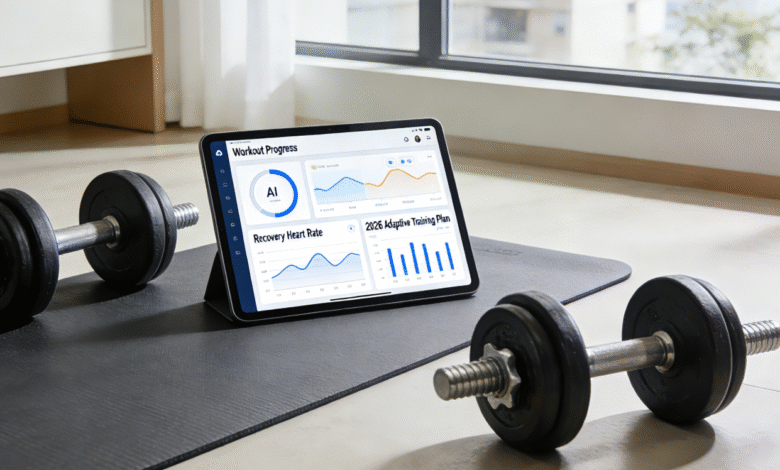
A typical home training setup might involve a small open space, a tracking device, and a few adaptable tools.
For example, using an adjustable dumbbell alongside AI-guided routines allows resistance to be adjusted based on real-time recommendations, without breaking the flow of the workout.
This combination keeps training efficient while maintaining flexibility.
Why Simplicity Still Matters in an AI-Driven Environment
Even as technology evolves, one principle remains important: simplicity supports usability.
AI doesn’t replace this—it reinforces it.
The most effective setups are still those that require minimal preparation, allow quick transitions, and fit naturally into daily routines.
This is why home gym equipment continues to play a key role.
AI can guide decisions, but the physical environment must still support action.
The Role of Personalization in Long-Term Results
One of the most valuable aspects of AI in fitness is personalization.
No two individuals progress at the same rate, and no single program works for everyone.
AI systems adapt continuously—responding to performance, adjusting difficulty, and evolving as the user improves.
This creates a training experience that feels tailored rather than prescribed.
Reducing the Mental Load of Training Decisions
Planning workouts, tracking progress, and deciding what to do next can become overwhelming—especially for beginners.
AI simplifies this by handling the logic behind training.
Users are given clear next steps, structured sessions, and automatic adjustments, reducing the need to think through every decision.
This allows them to focus on execution rather than planning.
A New Balance Between Technology and Physical Training
The integration of AI into home fitness isn’t about replacing effort—it’s about improving how that effort is directed.
Technology provides structure and feedback, while physical training delivers results.
Together, they create a more efficient system—one that adapts in real time rather than relying on fixed plans.
Conclusion: Smarter Training Without Added Complexity
AI is not making home fitness more complicated—it’s making it more precise.
By introducing adaptive feedback, automated decision-making, and structured progression, it allows users to train more effectively within their own environment.
And when combined with practical tools like an adjustable dumbbell and well-designed home gym equipment, this approach creates a system that supports long-term improvement.
As this shift continues, home fitness is becoming less about following routines—and more about training intelligently within systems that continuously adjust to how people actually live.