Sheffield has always been a city that makes things. From the steel mills of the Don Valley to the aerospace components rolling out of the Advanced Manufacturing Park, the city’s identity is built on industry. That tradition has not faded – it has evolved. Today, Sheffield’s manufacturing sector is valued at over £1.4 billion, and major investment continues to flow in, with new facilities, expanded logistics operations and a growing workforce driving activity across sites in Tinsley, Attercliffe and beyond.
But with that growth comes pressure. More vehicles. More workers. More movement. And in warehouses and factories where forklifts and pedestrians share the same floor space, the margin for error is razor thin.
Is your warehouse floor doing enough to keep people safe?
The statistics for the UK’s transportation and storage sector are stark. The fatal injury rate sits at nearly 2.5 times the all – industry average, and being struck by a moving vehicle remains the single most common cause of death in the sector. Forklift – related incidents alone result in around 1,300 hospitalisations every year across the UK.
None of that is abstract to anyone who has worked on a busy factory floor. The loading bay. The narrow aisle between racking. The corner a pedestrian rounds at the same moment a forklift reverses. These are the pinch points that floor marking exists to manage – and they are precisely the places where faded, inconsistent or absent markings create risk.
Sheffield’s industrial sites are no different from anywhere else in this regard. Older buildings in areas like Shepcote Lane and Attercliffe were not always designed for the volume or type of traffic they now handle. Sites that have expanded, reconfigured or simply kept operating without a marking review are quietly accumulating risk they may not have formally assessed.
What do UK regulations actually require?
The Workplace (Health, Safety and Welfare) Regulations 1992 place a clear duty on employers to ensure that pedestrians and vehicles can circulate safely. That is not a vague aspiration – it is a legal requirement, and floor marking is one of the most direct and cost – effective ways to meet it.
The Management of Health and Safety at Work Regulations 1999 go further, requiring employers to conduct risk assessments and put measures in place to protect employees. For warehouse and factory environments, the Health and Safety Executive’s guidance document HSG76 sets out specific expectations around site layout, traffic management and the visual separation of pedestrian and vehicle routes.
When inspectors visit sites, they look for evidence that these separations exist and are maintained. Worn – out markings, inconsistent colour coding or layouts that no longer reflect actual traffic flow can all become problems during an inspection – and more importantly, before one.
What good floor marking actually looks like
Effective floor marking is not complicated, but it does require planning and consistency. Pedestrian walkways need to be clearly defined using a consistent colour throughout the site – typically white or green – so that anyone new to the building can read the space quickly and move safely without being briefed on every detail.
Forklift lanes are usually marked in yellow, with directional arrows to control flow and reduce the risk of head – on encounters in tight spaces. Hazard zones around electrical panels, racking uprights and machinery use high – visibility striped patterns to warn people away. Loading bay areas need markings that define where vehicles stop, where goods are staged and where pedestrians must not stand.
Colour choices are not legally prescribed, but consistency across the site is non – negotiable. If green means pedestrian walkway in one section, it cannot mean something different in another. Mixed signals create confusion, and confusion creates accidents.
For facilities undergoing layout changes – new racking installations, additional loading doors, automated equipment – marking systems need to keep pace. A plan drawn up two years ago may no longer reflect how the space is actually used.
Why Sheffield sites are reviewing their marking now
Investment in Sheffield’s manufacturing and logistics sector means sites are changing. New tenants are moving into older buildings. Distribution operations are scaling. Facilities that were originally built for one purpose are being adapted for another.
DBL Logistics, based on Tinsley Park Road, has expanded its warehouse capacity significantly in recent years to meet growing pallet demand. Operations across the Lower Don Valley – an area Sheffield City Council is actively regenerating through its Darnall, Attercliffe and Tinsley Neighbourhood Development Framework – are seeing new activity. The Sheffield City Region has attracted major names in national distribution, drawn by its M1 access, available sites and logistics workforce.
All of that activity means more vehicles, more workers and more complexity on the ground. Sites that have not reviewed their floor marking systems in several years are likely operating with layouts that no longer match how the building is actually being used.
Businesses looking to manage that risk – whether ahead of an HSE inspection, as part of a fit – out or simply because markings have faded beyond usefulness – are increasingly turning to specialists in line marking in Sheffield who can assess, plan and deliver systems suited to the specific demands of industrial environments.
Does the material matter?
It does, significantly. Tape – based systems are quick to apply but struggle to survive sustained forklift traffic, heavy pallet loads and regular cleaning. In a low – traffic corridor they may perform adequately, but on the floor of a busy distribution centre they tend to lift, curl and fade faster than expected.
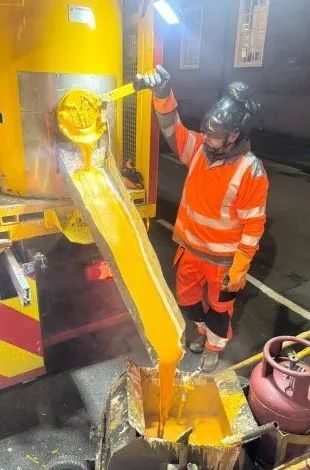
Paint – based systems – particularly UV – cured or two – part epoxy formulations – offer far greater durability. Thermoplastic markings are more resilient still and can be applied quickly with minimal disruption to operations. Permanent line marking, unlike tape, becomes part of the floor surface rather than sitting on top of it, which is why it holds up better under the mechanical stress of warehouse environments.
The right choice depends on traffic volume, surface condition and how often the layout is likely to change. But the principle is consistent: markings that are difficult to see are often worse than no markings at all, because they create uncertainty about where the safe routes actually are.
Training reinforces what markings communicate
Floor marking sets the framework. Training makes it work. New staff, visiting drivers and temporary workers all need to know what the colour coding means, which zones are restricted and how traffic flow is managed across the site.
Induction briefings should cover the site’s marking system specifically, not just generic health and safety content. When layouts change, existing teams need to be updated rather than left to interpret new markings against old habits. Supervisors play a part too – reinforcing correct behaviour, flagging worn or damaged markings and making sure visiting drivers are briefed before they enter the building.
A well – marked site with a well – informed workforce is demonstrably safer than either element on its own.
Sheffield’s industrial future is being built now
Sheffield’s manufacturing heritage has always been about making things that last. The same principle applies to the systems that keep people safe inside the buildings where that work happens. Floor marking is not a cosmetic exercise – it is a functional safety measure, a compliance tool and an operational asset all at once.
Sites that get it right protect their workers, pass inspections with fewer issues and operate more efficiently. Those that let markings fade or fail to update them when layouts change are storing up risk that tends to surface at the worst possible moment. For Sheffield businesses operating across the city’s expanding industrial areas, a proper floor marking review is a straightforward investment in the safety and productivity of the facility – and the people working in it.