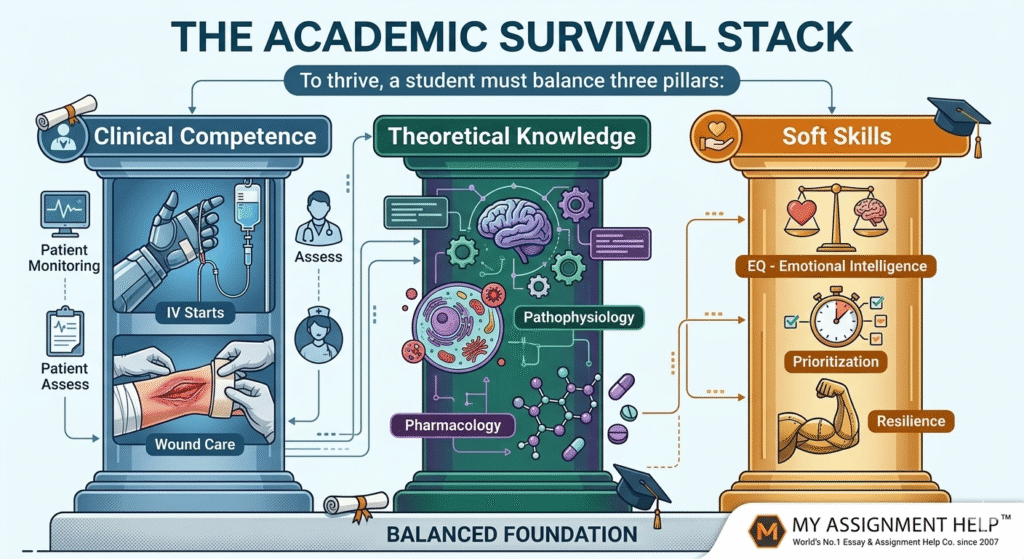
The transition from a high-achieving nursing student to a competent clinician is often described as a “baptism by fire.” While your textbooks provide the foundational knowledge of pathophysiology, pharmacology, and anatomy, the clinical environment demands a secondary set of “invisible” skills. These are the competencies that differentiate a student who simply passes exams from one who thrives in the high-stakes, fast-paced world of modern healthcare.
In the United States, the healthcare landscape is shifting toward more complex patient populations and integrated care models. According to the American Association of Colleges of Nursing (AACN), the modern nurse must be as adept at emotional intelligence and systems thinking as they are at clinical procedures. Mastering these five non-textbook skills will not only help you survive your clinical rotations but will also set the stage for a distinguished professional career.
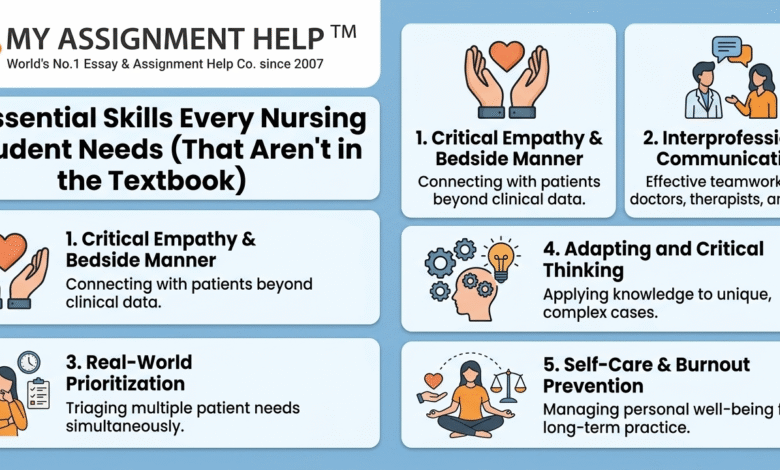
1. The Art of “Prioritization Triage”
In a classroom setting, you are often presented with one patient case study at a time. In a bustling hospital in New York or a clinic in Texas, you will face four, five, or six patients simultaneously, each with competing needs. Textbook learning teaches you what to do, but it rarely teaches you which to do first when everything feels urgent.
Learning to rank tasks based on the ABCs (Airway, Breathing, Circulation) is the start, but true prioritization involves anticipating the “next move.” For instance, recognizing that a stable patient’s discharge paperwork is a higher priority than a routine dressing change because it frees up a bed for a critical ER admission is a skill learned through experience.
Navigating the complexities of clinical documentation and care plans can be overwhelming for many students. If you find yourself struggling to balance your practical shifts with the heavy demand of academic papers, seeking a professional nursing assignment writing service can provide the structural guidance needed to maintain your GPA while you focus on these hands-on skills.
2. Radical Emotional Intelligence (EQ) and De-escalation
A textbook can define “therapeutic communication,” but it cannot fully prepare you for a grieving family member’s anger or a patient’s refusal of life-saving medication. Emotional intelligence in nursing is the ability to perceive, control, and evaluate emotions—both your own and your patients’.
Data from the Occupational Safety and Health Administration (OSHA) indicates that healthcare workers are at a significantly higher risk of workplace violence. Developing the skill of de-escalation—using a calm tone, open body language, and active listening—is a vital safety tool. It involves recognizing the “fear behind the fury” and responding with clinical empathy rather than defensive reaction.
3. Mastering the “Political” Landscape of the Unit
Every hospital unit has its own culture, hierarchy, and unspoken rules. Success in nursing depends heavily on interprofessional collaboration. You aren’t just working with other nurses; you are working with physicians, respiratory therapists, social workers, and floor technicians.
Understanding the “soft power” within a unit—knowing which veteran nurse to ask for help or how to present a patient concern to a busy attending physician—is a skill of diplomacy. Effective communication in these high-pressure environments requires brevity and the use of standardized tools like SBAR (Situation, Background, Assessment, Recommendation).
For many students, the administrative and academic burden of their degree leaves little room for social and professional integration on the floor. When the workload becomes a barrier to your clinical growth, simply saying “i need help with my homework” to a trusted academic support provider can create the breathing room necessary to observe and learn these vital social dynamics.
4. Technical Resourcefulness and “Workaround” Awareness
Textbooks assume that every piece of equipment is brand new and every supply closet is fully stocked. Reality is different. A skill every nurse needs is the ability to troubleshoot. Whether it’s a finicky IV pump that won’t stop beeping or finding a creative (and safe) way to reposition a bariatric patient when the lift is broken, resourcefulness is key.
However, there is a fine line between resourcefulness and a “workaround” that compromises safety. A 2021 study published in the Journal of Patient Safety highlighted that while workarounds are common, they often bypass crucial safety checks. The skill here is learning how to be efficient within the bounds of evidence-based practice and hospital policy.
5. Self-Preservation and Compassion Fatigue Management
The most dangerous thing a nursing student can ignore is their own mental health. Textbooks mention “self-care” in a single paragraph, but in practice, it is a survival mechanism. Compassion fatigue and burnout are reaching record levels in the US nursing workforce.
Developing a “clinical skin”—the ability to be empathetic without absorbing the patient’s trauma—is an essential skill. This involves setting boundaries, practicing mindfulness, and recognizing the early signs of burnout, such as irritability or emotional exhaustion. A nurse who cannot care for themselves eventually becomes a nurse who cannot safely care for others.
Key Takeaways
- Clinical Triage: Prioritization isn’t just about the patient’s health; it’s about the flow of the entire unit.
- De-escalation: Emotional intelligence is a safety skill that prevents workplace violence and improves patient outcomes.
- Interprofessional Diplomacy: Your relationship with the broader healthcare team is as important as your clinical knowledge.
- Troubleshooting: Resourcefulness is required, but it must never come at the expense of established safety protocols.
- Boundaries: Self-care is a professional responsibility, not a luxury.
Frequently Asked Questions (FAQ)
Q: How can I improve my prioritization skills as a student?
A: Start by using your “brain sheet” effectively. At the start of your shift, identify the one task for each patient that must happen to keep them safe, and work backward from there.
Q: What is the most common “soft skill” nurses lack?
A: Conflict resolution. Many nurses are excellent at caring for patients but struggle with direct communication when a disagreement arises with a colleague.
Q: Are nursing assignment services helpful for clinical learning?
A: Yes. By outsourcing the heavy lifting of formatting and research for theoretical papers, students can dedicate more mental energy to their clinical rotations and hands-on skill development.
Q: How do I handle a “difficult” patient without getting overwhelmed?
A: Use the “Pause” method. Before entering the room, take a three-second breath to reset your nervous system. Remember that the patient’s behavior is usually a symptom of their condition or stress, not a reflection of you.
Author Bio: Dr. Helena Vance, DNP
Dr. Helena Vance is a Senior Clinical Consultant and Lead Academic Strategist at MyAssignmentHelp. With over 15 years of experience in Acute Care and Nursing Education, Dr. Vance has transitioned from the bedside to helping the next generation of nurses navigate the complexities of their degrees. She specializes in bridging the gap between theoretical nursing models and real-world clinical application. When she isn’t auditing content for E-E-A-T compliance, she mentors nursing students across the US and UK on professional development and career longevity.
References & Data Sources:
- American Association of Colleges of Nursing (AACN). (2024). The Essentials: Core Competencies for Professional Nursing Education.
- OSHA. (2023). Guidelines for Preventing Workplace Violence for Healthcare and Social Service Workers.
- Journal of Patient Safety. (2021). The Impact of Workarounds on Patient Safety: A Systematic Review.
- National Institutes of Health (NIH). (2022). Understanding Compassion Fatigue in Nursing Students.