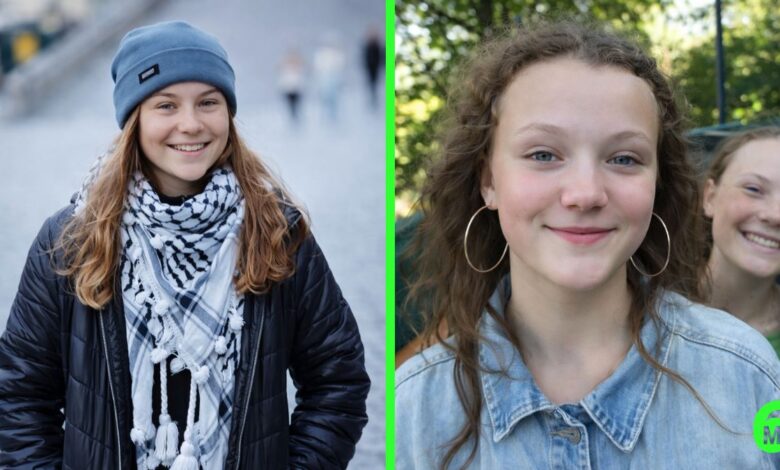
Greta Thunberg became one of the most recognisable activists of her generation after launching her school strike in Stockholm in 2018, a protest that grew into the international Fridays for Future movement. She has since remained a highly visible public figure, with her climate advocacy later expanding into broader political causes, including outspoken support for Palestinians.
Her younger sister, often searched as Beata Thunberg, occupies a very different place in public life. Reliable public sources more often identify her as Beata Ernman or Beata Andersson, and the record around her is far smaller, more fragmented, and more entertainment-focused than the intense documentation that surrounds Greta. What is publicly verifiable shows a young Swedish performer with roots in a creative family, stage experience in Stockholm, and a public identity that has increasingly been framed on her own artistic terms rather than through climate activism.
Beata Thunberg Quick Bio
| Key fact | Verified detail |
|---|---|
| Full name | Public sources identify her as Beata Mona Lisa Ernman Andersson; some also note she was formerly styled Ernman-Thunberg. |
| Common search name | “Beata Thunberg” is a common search phrase because she is Greta Thunberg’s sister, but coverage more often uses Beata Ernman or Beata Andersson. |
| Relationship | Younger sister of Greta Thunberg. |
| Birth | Born 3 November 2005 in Stockholm, Sweden. |
| Age | 20 as of March 18, 2026, based on the published birth date above. |
| Public profile | Singer, actress, and musical performer. |
| Residence | No precise residence is reliably published; public reporting places her in Sweden, with documented performances in Stockholm. |
| Parents | Daughter of opera singer Malena Ernman and actor Svante Thunberg. |
| Children | No publicly verified information indicating she has children. |
| Known philanthropic interests | No separate, well-documented philanthropic portfolio for Beata herself is evident in reliable public sources. The family, however, is publicly associated with climate advocacy through Greta and the family memoir. |
| Social media presence | A public Instagram presence associated with her performer identity appears in search results, though platform details are not consistently documented in news coverage. |
Who is Beata Thunberg?
Beata Thunberg, often referred to as Greta Thunberg’s younger sister, has a public identity beyond that label. Verified sources and cultural listings describe her as a young Swedish performer from a family deeply rooted in the arts: her mother, Malena Ernman, is an opera singer, and her father, Svante Thunberg, is an actor. Public records show Beata entered the cultural sphere early, notably through the Stockholm musical Forever Piaf, where she appeared with her mother. She is also credited as a co-author of the family memoir, which presented the Thunbergs and Ernmans to readers not only as public figures but also as a family navigating pressure, diagnosis, art, and activism. Taken together, these public records portray someone visible enough to attract curiosity, yet selective about keeping much of her personal life private.
The private life of Beata Thunberg
Beata’s public profile is distinctly limited, and this limitation is not a shortcoming but a defining element of her story. Whereas Greta’s activism has led to sustained global attention, Beata is chiefly documented when her artistic activities intersect with media or familial interest. The available reliable sources confirm her identity, family relationships, stage work, and contributions to a family-authored book, but her personal biography remains largely unelaborated. This clear contrast is significant: in a culture quick to turn public figures’ relatives into public property, Beata’s carefully managed record establishes a strong boundary between her work and her private life. Her public presence centres on specific projects rather than ongoing personal disclosure.
Public knowledge of Beata’s background centres on her family. Born in Stockholm in 2005, three years after Greta, she grew up in a household shaped by performance, media, and, later, activism. Malena Ernman’s opera and cabaret career laid a strong artistic foundation for the family before Greta gained international recognition. Accounts of the family memoir show Beata was not a peripheral figure; she was a credited contributor to the book about family crisis, neurodivergence, and the climate emergency. This established her as part of the family’s public narrative early, not just a tabloid footnote. Still, what is publicly known offers an environment and context rather than a detailed private chronology. Eata Thunberg and Greta Thunberg: a sibling relationship in public view.
Because the keyword is tied to Greta, the most accurate relationship to analyse is siblinghood, not romance or marriage. Greta’s rise to global prominence in 2018 changed the meaning of the family surname almost overnight. She became internationally known for her school strike outside the Swedish parliament, and that visibility quickly drew attention to her parents and siblings as well. In public coverage, Beata is often introduced as “Greta Thunberg’s sister” before being recognised as a performer in her own right. This framing creates tension, visible in later reports describing Beata adopting her mother’s surname in public and building a distinct entertainment profile. Whether one sees this as branding, self-definition, or a way to reduce comparison, the pattern is clear: Greta’s fame created a reference point, and Beata’s professional image is often described in terms of distinguishing herself from it.
Beata Thunberg’s role behind the scenes in a famous family
Public evidence does not support grand claims about Beata as a strategist, organiser, or political actor behind Greta’s activism. It does, however, support a more modest reading: she belongs to a family whose public life is both collective and individual. The memoir Scener ur hjärtat / Our House Is on Fire was presented explicitly as a family work, and its publication shaped public understanding of the Thunberg-Ernman household as a unit facing both personal and planetary concerns. Beata’s role is best understood not through invented influence but through documented participation in a shared family narrative. She is less a hidden operator than a family member whose emotional and cultural life became part of public conversation because of Greta’s activism and Malena’s openness.
Family life and the making of a public narrative
The Thunberg-Ernman family is often portrayed as both public and private. Books, interviews, and reporting have disclosed some elements of family life, but these disclosures remain selective. Beata is visible enough to be named and discussed, yet her everyday life remains mostly private. This suggests the family uses publicity to support art or causes rather than to reveal their personal lives. In Beata’s case, this balance provided visibility but also emphasised selective disclosure. The public knows her career and background, but many biographical details stay private.
Public causes, values, and what can actually be verified
This is where careful sourcing is crucial. Greta’s activism is well documented, and the family memoir ties their story directly to climate issues. Public sources do not identify Beata as a major activist, nor do they show a separate charitable portfolio under her name. Factually, it is narrower and more reliable to say she is publicly linked to a family whose climate engagement became globally influential, and that she contributed to the published family narrative about crisis, diagnosis, and responsibility. This does not justify projecting Greta’s full political program onto her. The honest reading is that Beata’s public presence is chiefly artistic. Any stronger claims about her political or philanthropic agenda exceed the current public record.
The power of privacy: influence without publicity
Privacy can be authorship. For Beata, it maintains proportion in a family shaped by intense public attention. Greta’s life has been interpreted, praised, attacked, and politicised globally. A nearby sibling in the public eye can be drawn into the glare or step aside. Reports suggest Beata chose the latter. Her image centres on stage work, performance, and style, not constant commentary. She isn’t invisible; she’s visible on her own terms. In celebrity culture, where relatives become supporting characters, that choice is powerful. It keeps a person present without being constantly narratable. Public curiosity and misconceptions persist about Beata Thunberg.
The first misconception is the name itself. People often search for “Beata Thunberg,” but public sources more often identify her as Beata Ernman or Beata Andersson, with older formulations noting Ernman-Thunberg. The second misconception is that she is simply a non-political mirror image of Greta. The record is thinner than that slogan suggests. What is documented is her artistic work, not a fully developed counter-identity built around public statements against activism. Some media reports describe distance from Greta’s controversies, but the stronger, safer conclusion is simply that Beata has pursued a separate career in the arts. The third misconception is that scarcity of information invites embellishment. It does not. With a private-leaning public figure, restraint is not a weakness in biography; it is accuracy.
Legacy and future
Beata Ernman’s legacy is still being formed, and that is another reason to resist overstatement. She is only 20, and the verified public record so far points to performing arts, family collaboration, and careful public distance rather than to a long résumé of standalone institutions, causes, or headline-making declarations. Still, there is already a recognisable pattern. She emerged from a family known globally for activism and nationally for performance, and she has thus far leaned toward the artistic inheritance. Her appearance in Forever Piaf was not incidental background noise; it was a visible professional credit in a major Stockholm production. If she continues to build a career, her public identity may become easier to describe without Greta as the first point of reference. For now, the most accurate summary is that her significance lies in her having remained adjacent to fame without being consumed by it.
Conclusion
Beata Thunberg, more accurately identified in public records as Beata Ernman or Beata Andersson, stands at an unusual crossroads of family, art, and public fascination. She is connected to one of the most famous activists in the world, yet the verifiable record around her remains comparatively restrained. That restraint is not an absence of story. It tells us that she has built her visible identity around performance rather than political spectacle, around selected appearances rather than constant disclosure. Public sources confirm a young Swedish singer and actress, a contributor to the family memoir, and a performer linked to Forever Piaf in Stockholm. Beyond that, careful biography has to honour the boundary between curiosity and proof. a media culture that rewards overstatement, the most honest portrait of Beata is also the strongest: a developing artist from a famous family, present in public life, yet still largely entitled to her own scale of privacy.
Read this too:Matt Danzeisen and Peter Thiel: A Fact-Based Look at a Private Life Beside a Very Public Billionaire
(FAQs)
1. Who is Beata Thunberg?
She is Greta Thunberg’s younger sister; public sources more often refer to her as Beata Ernman or Beata Andersson and identify her as a Swedish singer and performer.
2. What is Beata Thunberg’s real name?
Public records list her as Beata Mona Lisa Ernman Andersson. Some sources also note an earlier public form, Ernman-Thunberg.
3. How old is Beata Thunberg?
She was born on 3 November 2005, which makes her 20 on March 18, 2026.
4. Is Beata Thunberg also a climate activist?
Reliable public coverage does not document her as a major public activist on the scale of Greta. Her documented public work is mainly artistic.
5. What is Beata Thunberg known for professionally?
She is known as a singer, actress, and musical performer, including her role in Forever Piaf in Stockholm.
6. Did Beata work with her mother, Malena Ernman?
Yes. Public listings for Forever Piaf describe Beata as the younger Piaf and Malena Ernman as the older Piaf.
7. Was Beata involved in the family book about Greta and the climate?
Yes. She is credited as one of the authors of Our House Is on Fire / Scener ur hjärtat.
8. Why do some articles call her Beata Ernman instead of Beata Thunberg?
Because public reporting often uses her maternal surname in connection with her artistic identity, while searchers still commonly associate her with Greta’s surname.