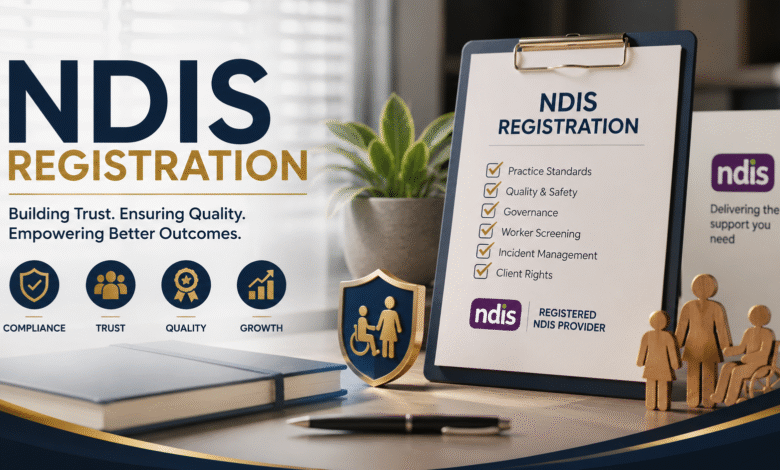
The decision to pursue NDIS registration shapes everything that follows. For new providers, allied health professionals, small care businesses, and entrepreneurs entering the disability support sector, it is far more than a regulatory requirement; it is the commercial and operational foundation on which a credible, sustainable provider business is built.
NDIS registration isn’t something you can realistically circle back to when the timing feels right. Providers who build scalable, resilient operations are those who treat it as the first serious business decision, not an eventual milestone to address once everything else feels settled. The providers who delay tend to pay for it in ways they didn’t anticipate.
Unregistered Providers Are Competing With a Hard Ceiling on Growth
Some providers choose to work exclusively with self-managed and plan-managed participants, bypassing NDIS registration entirely. That pathway is legal, but it carries a structural ceiling that limits growth in ways that compound steadily over time.
Registered providers can access agency-managed participants, who make up a substantial portion of the total NDIS participant pool. They receive referrals from support coordinators who default toward registered organisations when placing participants in higher-risk support categories. They can also deliver supports that require registration, including behaviour support, specialist disability accommodation, and high-intensity daily activities that remain entirely off-limits to unregistered operators, regardless of their clinical experience or service quality.
For small to mid-sized care businesses with genuine growth ambitions, remaining unregistered is a deliberate choice to cap your own addressable market. The short-term administrative convenience rarely justifies that long-term commercial limitation.
What the Registration Process Reveals About How Your Business Actually Operates
Here’s what most providers only realise partway through the process. And once they do, it changes how they think about running their organisation, not just how they approach compliance.
The audit, whether verification or certification, doesn’t simply check whether your policies exist. It requires you to demonstrate that your governance, workforce practices, incident management, and quality improvement systems function at an organisational level, not just exist in a document. For allied health professionals transitioning from individual clinical practice to running a registered NDIS provider business, this is often a confronting revelation. Building those systems forces genuine clarity about where operational gaps exist and what needs to be embedded before you scale.
Disability service providers expanding into new registration groups encounter the same dynamic. Policies written for one support category don’t automatically satisfy the Practice Standards for another. Going through NDIS registration thoroughly makes your organisation measurably stronger, not just compliant on paper.
Registration Builds a Competitive Position That Marketing Cannot Replicate
Registration is a differentiator. Not in a marketing sense, in a practical, referral-generating sense that directly affects how your pipeline develops month to month.
Support coordinators prioritise registered providers for complex supports. Local area coordinators direct participants toward registered organisations by default. Participants and their families, increasingly well-informed about their rights and choices, look for registration as a baseline indicator of accountability and quality. Entrepreneurs entering the NDIS space sometimes believe that genuine service quality alone builds a sustainable referral base, and it certainly helps, but in a competitive market, registration is what gets you into consideration before anything else is assessed.
For new NDIS providers building their reputation from the ground up, NDIS registration is the credential that makes every subsequent form of trust-building more effective. That pattern holds across every provider type and every region in Australia. There is genuinely no substitute for it.
| Provider type | Key reason to prioritise registration |
| New NDIS providers | Baseline credentials for referrals and market entry |
| Allied health professionals | Formalises the transition from individual to organisational practice |
| Disability service providers | Unlocks higher-risk, higher-value support categories |
| Entrepreneurs entering the NDIS | Establishes credibility and competitive positioning early |
| Small to mid-sized care businesses | Removes the ceiling on your addressable participant pool |
Starting Later Always Costs More Than Providers Expect
The registration process from initial lodgement through to receiving formal confirmation typically takes three to six months, depending on your support categories and how well-prepared your documentation is at submission.
Providers who defer NDIS registration while building their participant base frequently discover that the supports most requested by existing clients require registration they don’t yet hold. That gap creates real and immediate operational pressure, either declining participants you aren’t authorised to support, or operating in grey areas that carry genuine compliance risk and reputational exposure for your business.
Starting early, with documentation built correctly from the outset, means your registration is in place before operational demand forces the issue. Getting specialist support to navigate the process properly the first time reduces the timeline considerably and eliminates the cost of addressing non-conformances or resubmitting underprepared audit documentation. The initial investment is always smaller than the cost of resolving problems midway through.
Conclusion
NDIS registration is not a bureaucratic formality; it is the commercial and ethical foundation every serious provider should pursue deliberately and early. It expands your market access, validates your operational standards, and positions your business to serve the participants who need quality support most. For any provider genuinely committed to building something that lasts, registration is where that commitment begins.