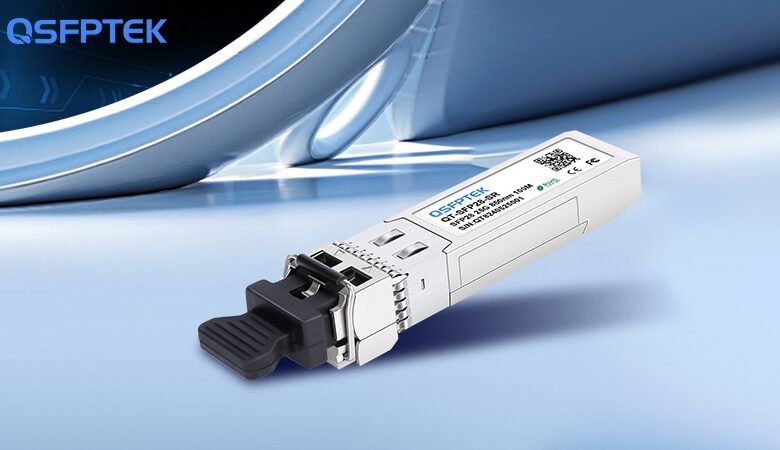
As artificial intelligence workloads continue to scale, modern data centers are rapidly evolving into highly specialized GPU clusters. These environments are designed to handle massive parallel computations, where thousands of GPUs collaborate to train large-scale models. In such architectures, network performance is no longer just important, it is critical. Among the many components enabling efficient communication, 25G SR optical modules play a surprisingly vital role in optimizing east-west traffic within GPU fabrics, particularly in InfiniBand and RoCE-based deployments.
The Importance of East-West Traffic in AI Clusters
Unlike traditional enterprise applications that rely heavily on north-south traffic, AI training workloads generate predominantly east-west traffic. This refers to data exchanges between servers, GPUs, and storage nodes within the data center. Distributed training frameworks, such as those used for deep learning, require constant synchronization of parameters and gradients across multiple nodes. As a result, low latency, high throughput, and minimal packet loss become essential network characteristics.
In GPU clusters built on InfiniBand or RoCE, achieving these characteristics depends heavily on the underlying physical layer. While high-speed interconnects like 100G or 200G links are often used for spine-layer connectivity, 25G links remain widely deployed at the access and aggregation layers due to their cost-effectiveness and sufficient bandwidth for short-range communication.
Why 25G SR Modules Matter
25G SR modules are designed for short-distance transmission over multimode fiber, typically supporting distances up to 70m on OM3 fiber and 100m on OM4 fiber. In AI clusters, where server racks are densely packed within the same row or adjacent rows, these distances are more than adequate.
One of the key advantages of 25G SR modules is their low latency. By leveraging VCSEL technology, these modules enable fast signal transmission with minimal delay, which is crucial for time-sensitive GPU synchronization tasks. In addition, 25G SR modules offer lower power consumption compared to higher-speed optics, helping data centers maintain energy efficiency in high-density deployments.
Another important factor is scalability. AI clusters often adopt a leaf-spine architecture, where each leaf switch connects to multiple GPU servers. Using 25G SR modules at the leaf layer allows operators to scale out the number of nodes without significantly increasing costs. This makes it easier to expand clusters incrementally as computational demands grow.
Integration with InfiniBand and RoCE Architectures
In InfiniBand-based GPU fabrics, SFP28 SR modules are commonly used in scenarios where HDR or NDR speeds are not required across all links. For example, management networks or auxiliary data paths can rely on 25G connectivity. Similarly, in RoCE-based Ethernet fabrics, 25G SR modules are often deployed for top-of-rack switching, connecting GPU servers to aggregation switches.
The use of RDMA technologies further enhances the effectiveness of 25G SR links. By bypassing the CPU and enabling direct memory access between nodes, RDMA reduces latency and CPU overhead, allowing 25G links to deliver performance that exceeds what traditional Ethernet would achieve at the same speed.
Optimizing Deployment for Maximum Efficiency
To fully leverage 25G SR modules in AI clusters, careful network design is required. This includes selecting the appropriate fiber type (OM3 vs. OM4), ensuring proper cable management, and minimizing signal degradation through clean and well-maintained connectors. Additionally, enabling features such as Priority Flow Control (PFC) and Explicit Congestion Notification in RoCE environments can help maintain lossless network conditions.
Monitoring tools that provide real-time insights into link performance, such as Digital Diagnostic Monitoring, are also essential. These tools allow operators to detect potential issues, such as temperature fluctuations or signal degradation, before they impact training workloads.
Conclusion
While much of the attention in AI networking is focused on ultra-high-speed interconnects, 25G SR modules continue to play a foundational role in GPU cluster design. Their balance of cost, performance, and efficiency makes them an ideal choice for short-reach, high-density environments where east-west traffic dominates. By integrating 25G SR modules strategically within InfiniBand and RoCE architectures, data center operators can build scalable, high-performance AI clusters capable of meeting the demands of next-generation workloads.