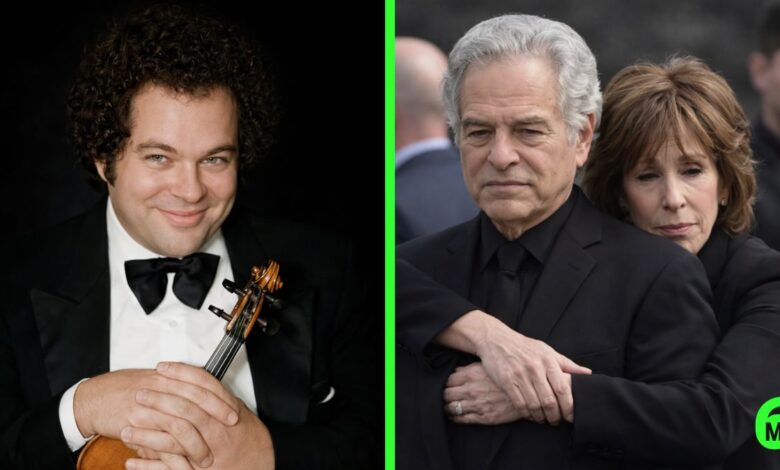
Itzhak Perlman is one of classical music’s best-known violinists, a conductor, teacher, Grammy winner, and Presidential Medal of Freedom recipient. His name is associated with virtuosity, resilience, and a career spanning decades of performances, recordings, television, and teaching.
Toby Perlman occupies a selective public space—not as a celebrity spouse, but as a musician and educator known for institutional work. A violinist, founder of The Perlman Music Program, and advocate for arts education, she is defined publicly less by confessional interviews than by her achievements in music and education. This makes her an unusual and interesting biographical subject. Her record reveals a life shaped by music, family, teaching, and the choice to let her work speak louder than publicity.
Toby Perlman Quick Bio
| Key Detail | Information |
|---|---|
| Full Name | Toby Lynn Friedlander Perlman |
| Relationship | Wife of Itzhak Perlman; married January 5, 1967 |
| Public Profile | Violinist, educator, founder of The Perlman Music Program |
| Age | Not clearly confirmed in the public sources reviewed |
| Residence | New York City / New York; The Perlman Music Program is based on Shelter Island, New York |
| Children | Five children |
| Known Philanthropic Interests | Music education, arts advocacy, mentoring young string players |
| Social Media Presence | No major public-facing personal social media profile was identified in the public biographical sources reviewed |
Who is Toby Perlman?
Toby Perlman is best understood not simply as Itzhak Perlman’s wife, but as a musician-educator whose public identity is tied to building cultural infrastructure. She appears in public records as a Juilliard-trained violinist, a native New Yorker, and the founder of The Perlman Music Program, the organisation most closely associated with her name. That program, founded in 1994, has become a significant training ground for gifted young string players, with a faculty led by Itzhak Perlman and a stated emphasis on both rigour and a nurturing environment. Publicly, that is where Toby Perlman’s significance comes into sharpest focus: not in celebrity coverage, but in institution-building. Her biography is thinner in the usual sense of personal details, yet richer in evidence of sustained work. The result is a profile defined less by self-promotion than by long-term contribution.
The Private Life of Toby Perlman
Toby Perlman’s life is public in outline and private in texture. The broad facts are known: she is married to Itzhak Perlman, they have five children, and they have lived in New York while building a family deeply tied to music. Beyond that, the public record grows quieter. That silence is meaningful in itself. In an era when many family members of major cultural figures become brands, commentators, or media presences in their own right, Toby Perlman’s public footprint remains anchored to work rather than exposure. The available sources emphasise program-building, advocacy, and appearances connected to music education. They do not present a cultivated celebrity persona. That does not make her invisible; it makes her selective. Her privacy seems less like absence than discipline, a pattern consistent with a life centred on teaching, family, and stewardship rather than self-display.
Early Life and Background of Toby Perlman
Limited public details exist about Toby Perlman’s early life, but certain facts are confirmed: her birth name is Toby Lynn Friedlander, she is a native New Yorker, and a Juilliard violinist. A significant biographical detail from the Academy of Achievement notes she met Itzhak Perlman in 1963 at a summer camp concert, placing her early in a serious musical environment. The public record lacks stories about her childhood or non-musical schooling, setting boundaries for her biography. Toby Perlman can be reliably described as an early-established, trained musician rooted in New York.
Marriage and Partnership with Itzhak Perlman
The marriage is both a personal and professional history. Public sources place their wedding on January 5, 1967, following a meeting several years earlier at a summer music festival. That timeline matters because it shows a partnership formed not after fame had fully crystallised, but during the years in which Itzhak Perlman was still becoming the artist the wider world would come to know. Over time, their public partnership acquired another dimension through teaching and mentorship. The Perlman Music Program presents them not just as husband and wife, but as collaborators in a philosophy of musical development that values community, care, and high standards together. Public appearances and honours reinforce that reading. When Yale awarded Toby and Itzhak Perlman the Sanford Medal in 2025, it honoured them jointly for distinguished service to music and music education. That kind of recognition suggests a marriage that has become, in institutional terms, a shared cultural project.
Toby Perlman’s Role Behind the Scenes
“Behind the scenes” can sound passive, but in Toby Perlman’s case, it appears to mean organisational leadership. The Perlman Music Program is not a symbolic attachment to a famous name; it is an active educational enterprise founded by Toby Perlman in 1994 and described by the organisation as a place for young string players of rare talent to develop within a supportive community. Her own biography on the program’s site frames this as the “second chapter” of her life, and emphasises her role as a speaker and advocate for arts education. That wording matters. It points to labour that is administrative, philosophical, and public-facing in a specific way: recruiting belief, sustaining mission, and building an environment where others can thrive. In famous artistic families, unseen work often disappears behind the performer’s spotlight. Here, the public record is enough to say that Toby Perlman’s contribution is not peripheral. It is structural.
Family Life: Raising the Next Generation
The publicly confirmed facts of family life are simple but revealing. Toby and Itzhak Perlman have five children, and at least one of them, Navah Perlman, built a major musical career of her own as a concert pianist and chamber musician. That does not prove a private family ethos on its own, but it does show that music in the Perlman household was not merely a profession performed elsewhere; it became part of the family’s generational fabric. Public descriptions of PMP also emphasise human development alongside technical training, with concern for “the whole person” integral to the program’s design. It would be careless to turn that directly into claims about parenting that no source states. But it is fair to note continuity: the family’s public-facing institutions and its musical lineage both suggest that excellence, mentorship, and a close artistic community have been longstanding values in the Perlman orbit.
Philanthropy and Community Engagement
Toby Perlman’s clearest philanthropic signature is music education. The Perlman Music Program exists to identify and train exceptionally talented young string players, and its public mission stresses mentoring, support, and long-range development rather than one-off prestige. That is a form of philanthropy in practice: building access, scholarship, instruction, and artistic community over time. Toby Perlman’s own biography also describes her as a panellist and guest speaker advocating for the arts and education. Meanwhile, Itzhak Perlman’s public work includes disability-access advocacy, giving the family’s public footprint a broader humanitarian frame. It would be too much to collapse all of these strands into a single unified doctrine, but the overlap is striking. Where some public couples are known for gala visibility, the Perlmans are more convincingly read through the institutions and causes attached to their names: musical training, educational stewardship, and accessibility.
The Power of Privacy: Influence Without Publicity
Privacy is often mistaken for marginality. In Toby Perlman’s case, the opposite seems true. The limited supply of personal detail has not prevented public influence; it may have sharpened it. The sources that do exist return again and again to the same themes: founding, teaching, advocating, and building. There is very little noise around them. That gives her public identity an unusual coherence. She is not overexplained to the public, so the work itself becomes the biography. For readers accustomed to celebrity storytelling, that can feel incomplete. But there is another way to read it. In cultural life, some figures shape the field by occupying the microphone; others do it by shaping the room in which talent grows. The documented history of PMP strongly supports placing Toby Perlman in the second category. Her influence is easier to trace through students, institutions, and honours than through publicity cycles.
Public Curiosity and Misconceptions About Toby Perlman.
Public curiosity about Toby Perlman often begins with the question: Who is the wife behind the violin legend? This is understandable but incomplete, as it reduces her role to a relationship. In reality, she was a trained violinist and later founded an internationally respected music program reflecting her initiative. Another misconception is that privacy equals limited achievement; often, the opposite is true for institution-builders. For Toby Perlman, public records are minimal in gossip but substantial in educational impact. That distinction is worth noting.g.
Legacy and Future
Toby Perlman’s legacy is already visible. It lives in The Perlman Music Program, in the educational culture that program describes, in the students it has trained, and in the joint recognition she and Itzhak Perlman received from Yale for service to music and music education. Legacy here is not abstract. It has a campus, a curriculum, a community, and a philosophy. The future of that legacy will likely be measured not by an expansion of Toby Perlman’s celebrity, but by the durability of the institutions and values associated with her name: excellence without cruelty, mentorship without theatrics, seriousness without emotional austerity. Those qualities are visible in the public descriptions of PMP’s mission. For a figure who has remained largely private, that is a substantial public inheritance.
Conclusion
Toby Perlman is not a mystery in the sensational sense. She is something rarer: a public figure whose work is easier to verify than her mythology. The record shows a trained violinist, a native New Yorker, the longtime wife of Itzhak Perlman, the mother of five children, and the founder of a major music education program that has shaped young artists for decades. It also shows restraint. Many articles about spouses of famous performers slip into projection, sentimentality, or idle speculation. Toby Perlman’s life resists that treatment. What can be said with confidence is already enough to matter. She helped build an institution, sustained a musical family, and earned recognition at the highest level of music education. In that sense, her role has never been merely quiet. It has been foundational.
Read this too:Harlene Rosen: The Private Woman in Woody Allen’s Earliest Public Story
(FAQs)
1. Who is Toby Perlman?
Toby Perlman is a violinist, educator, and founder of The Perlman Music Program. She is also the wife of violinist and conductor Itzhak Perlman.
2. What is Toby Perlman known for professionally?
She is best known publicly for founding The Perlman Music Program in 1994 and for advocating for arts education.
3. When did Toby and Itzhak Perlman get married?
Public sources place their wedding on January 5, 1967.
4. How did Toby Perlman meet Itzhak Perlman?
According to the Academy of Achievement, she met him in 1963 at a summer camp concert.
5. How many children do Toby and Itzhak Perlman have?
They have five children.
6. Where do Toby and Itzhak Perlman live?
Public biographies place them in New York City, while The Perlman Music Program is based on Shelter Island, New York.
7. Did Toby Perlman receive major public honours?
Yes. In 2025, she and Itzhak Perlman received Yale School of Music’s Sanford Medal for distinguished service to music and music education.
8. Why is there relatively little public information about Toby Perlman?
The public record about her centres mainly on music, education, and institutional work rather than celebrity-style personal coverage. That reflects the nature of the available sources reviewed.