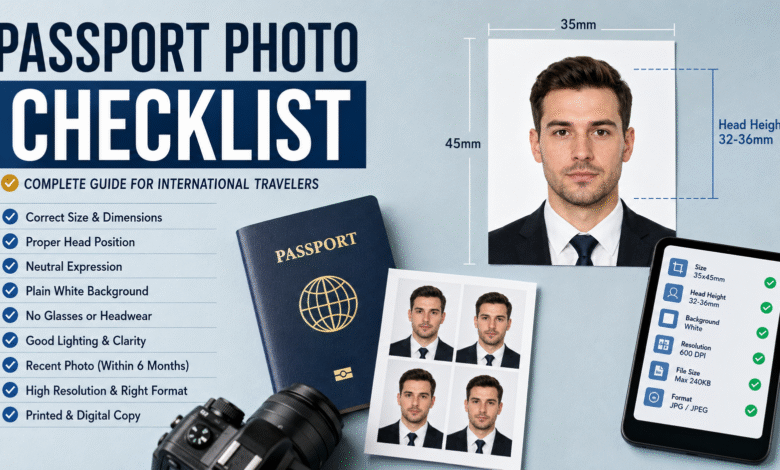
Frequent travellers learn to treat the passport photo as a recurring task rather than a one-off. Between passport renewals, visa applications, residence permits, student cards, and international driving permits, most people who travel regularly need a compliant photo several times a decade.
Approached systematically, it takes about twenty minutes. Approached casually, it produces a rejection letter. Here is a checklist that covers the whole process.
Before You Start: Confirm the Specification
Every checklist begins with the same step, and it is the one most often skipped.
- Identify the exact document you are applying for
- Find the issuing authority’s official page for photo requirements
- Note the dimensions — 2×2 inches for the US, 35x45mm for most ICAO countries
- Note the head height range and eye position
- Note the background colour — usually white, occasionally light grey
- Check whether digital, printed, or both formats are needed
- Check the file size and resolution limits for online submission
Requirements change. Use the current official page, not a saved PDF from a previous application.
Setting Up the Shot
You do not need a studio. You need a plain surface, daylight, and some distance.
- Choose a plain, unpatterned wall in white or very light grey
- Stand at least one metre away from it to avoid casting a shadow
- Face a window for even, natural light
- Turn off the flash
- Mount the phone or camera at eye level — held low, it distorts facial proportions
- Have someone else take the shot, or use a timer and a stable surface. Arm’s-length selfies bend the geometry of the face
- Shoot from roughly 1.5 metres away and crop afterwards
Appearance Check
- Neutral expression, mouth closed
- Both eyes open and clearly visible
- Head straight, not tilted or turned
- Hair back from the face; nothing covering the eyes or eyebrows
- No glasses
- Head coverings only for religious or medical reasons, with the full face visible
- Everyday clothing in a colour that contrasts with the background
- Minimal jewellery near the face
Formatting and Verification
Once you have a usable frame, the technical work starts. Cropping by eye is where most home-made photos fail, because head height tolerances are measured in millimetres.
Working from a service like 2x2PassportPhoto.com, or from a printed template with the measurements marked, removes the guesswork from this stage — the crop is applied against the published dimensions rather than estimated. Whichever method you use, verify these before moving on:
- Overall dimensions match the destination’s specification
- Head height falls inside the stated range
- Eye line sits within the required band
- The face is centred horizontally
- Background is uniform, with no shadow or gradient
- No filters, beauty modes, or retouching have been applied
- Resolution meets the minimum, and the file is under the size cap
Printing
If a physical copy is required:
- Use photo-quality paper, matte or glossy as specified
- Print at full colour, no scaling — “fit to page” silently resizes the image
- Print at least two copies; many applications need duplicates
- Do not cut photos apart if the form asks for an uncut sheet
- Do not sign, staple, or paperclip the photo unless explicitly instructed
- Store flat, not folded, in a rigid envelope
Timing and Storage
- Photos must generally be taken within the last six months
- Never reuse the image from a previous application — agencies compare against the file copy
- Allow two weeks between taking the photo and submitting, in case of rejection
- Keep the digital original in cloud storage; future applications may need a different crop of the same shot
- Note the date taken alongside the file
For Families
Applications for children carry extra rules worth checking in advance.
Infants may have their eyes closed in some jurisdictions but not others. Nobody else may appear in the frame, which rules out a supporting hand. Photographing a baby lying on a plain white sheet, shot from directly above in daylight, tends to work better than any attempt at a seated portrait. Children’s passports also expire faster — often every five years — so the task recurs sooner than for adults.
The Short Version
If you remember nothing else: check the official specification for the country you are applying to, shoot in daylight a metre from a plain wall, keep a neutral expression, verify the head height against the published measurements, and leave yourself two weeks of margin.
Most photo rejections are not close calls. They are shadows, smiles, glasses, and crops that missed by a few millimetres — all avoidable in the twenty minutes it takes to do the job properly the first time.