Coming home after a stay in hospital brings a mix of relief and uncertainty. The ward had wide corridors, hoists in every room and staff a few steps away. Your house has none of that, and the gap between the two can feel wider than expected during the first week back. Doorframes seem narrower, bathrooms seem smaller, and familiar rooms suddenly need working out again.
The good news is that most of the difficulty comes down to problems you can identify and solve, one at a time. This guide covers how to assess your home, choose sensible equipment, move between rooms, handle transfers, work on standing where it applies, involve the people around you, and keep making headway once things settle.
Assessing Which Rooms Cause the Most Difficulty
Take a slow pass through the house and note exactly where movement stalls. Common trouble spots include internal doorways under 750mm, thresholds between rooms, thick carpet that drags on castors, tight turns at the bottom of stairs, and bathrooms where there is no space to bring a chair alongside the toilet. Write down the specific problem rather than a general note, so “cannot turn to face the sink” instead of “kitchen is awkward”. That level of detail is what makes solutions obvious later.
Your injury level and whether the injury is complete or incomplete will shape what matters most. Someone with a C6 injury will focus heavily on reach, grip and hoisting, while someone with a lower thoracic injury may be looking at wheelchair clearance and independent transfers. A home visit from a physiotherapist gives you an objective read on all of it, and services such as Clearcut Physiotherapy can assess your home layout alongside your current function. Specialist input from neurological physiotherapy also helps you separate changes that are genuinely needed from ones that are simply nice to have.
Setting Up Equipment That Matches Your Level of Function
Equipment works best when it is matched to what you can already do rather than bought speculatively before you know. Transfer boards, bed levers, grab rails, perching stools, threshold ramps and profiling beds all serve narrow purposes, and buying the wrong version wastes money and space. Grab rails in particular need to be positioned around your actual transfer technique, not fitted where they look tidy.
Practising with equipment at home is a different experience from trying it in a clinic, so give yourself a fortnight of real use before deciding anything is permanent. Occupational therapists can arrange trials through community services, and many suppliers offer loan periods. Keep a note of what feels unstable or awkward during that time and raise it at your next appointment.
Moving Safely Between Rooms and Through Doorways
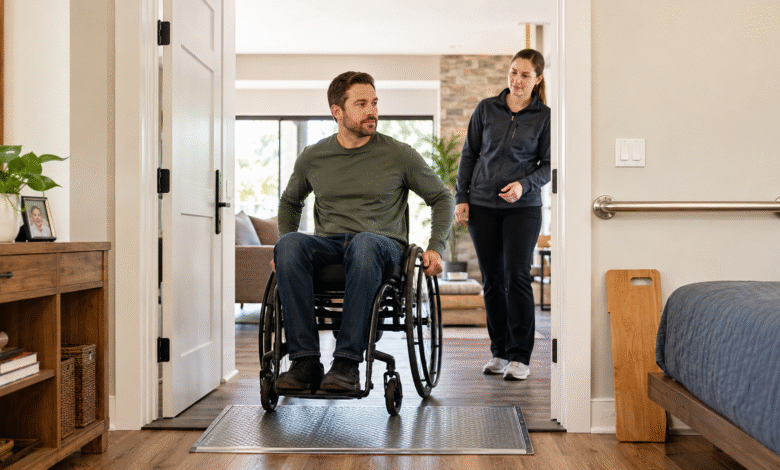
Approach angle does most of the work when getting through a doorway. Line up square and straight rather than turning at the last moment, and aim for the handle side so your knuckles clear the frame. Small castors catch on carpet-to-tile joins, so cross those at ninety degrees and with a little momentum rather than creeping over them. Where a hallway is too narrow to turn, reversing out is usually safer than a three-point manoeuvre against the skirting.
Fatigue changes everything about how you move, and spasticity often worsens later in the day. Plan the heavier tasks for the morning, and treat pacing as part of your technique rather than a sign you are struggling. A physiotherapist working in neuro physio can watch you move through your own hallway and correct the small habits that cause the biggest problems.
Managing Transfers to Beds, Chairs and the Toilet
Transfers carry the highest risk of anything you do at home, and they happen many times a day. Sitting balance comes first, because a stable base makes everything after it safer. Set up before you move: chair angled at around thirty degrees, brakes on, footplates cleared, board positioned before you shift your weight. Lead with your head and shoulders in the opposite direction to your hips, as that is what generates the lift rather than pure arm strength.
Shoulder pain is extremely common after spinal cord injury, and poor transfer technique is a major cause. Vary which side you lead from where possible, avoid gripping surfaces above shoulder height, and use a slide sheet or hoist without hesitation on days when your energy is low. Structured spinal cord injury rehab should include work on balance and gait alongside transfer practice, since trunk control underpins both.
Working on Standing and Stepping Where It Is Realistic
Supported standing is worth exploring if your injury is incomplete, and even where walking is not a realistic outcome it brings benefits for bone density, bowel function, circulation and spasticity management. Standing frames, tilt tables and parallel bars all have a place, and some people build up from a few minutes to half an hour over several months. Progress here is measured in small increments rather than dramatic changes.
Honesty matters. A complete injury above a certain level will not lead to independent walking, and any clinician suggesting otherwise is doing you a disservice. Supported standing programmes are used widely across neurological conditions, including MS physiotherapy, because the physiological benefits apply regardless of the underlying diagnosis.
Training the People Who Help You
Family members tend to over-assist out of concern, which quietly erodes independence. Anyone helping regularly should know your transfer sequence, where to stand, what to hold and, most importantly, when to keep their hands off. Fifteen minutes of proper instruction from your physiotherapist saves months of unhelpful habits forming.
Carer training features across most neuro caseloads, from Parkinson’s physio through to stroke and brain injury work, because the principle stays the same: assist the least amount necessary. Ask your physiotherapist to include a session with whoever helps you most often.
Keeping Progress Going Once the Basics Are Settled
Your needs will change. Strength improves, spasticity fluctuates, and the setup that suited you in month one may hold you back by month six. Book a review every few months, or sooner if something starts feeling harder than it did.
Set goals that are specific and measurable, such as transferring to the toilet without assistance or getting in through the front door unaided. Broad aims like getting stronger are difficult to track. Clinicians experienced in movement disorder rehabilitation can help you break larger goals into stages that build on each other.
Book an Assessment for Your Home Mobility
Getting around your house independently is achievable for most people with the right assessment, sensible equipment and consistent practice. The first step is having someone see your actual home rather than describing it in a clinic room. If you are based in London or the surrounding areas, arranging a home visit with a specialist physiotherapist will give you a clear plan built around your house and your current abilities.