Starting a YouTube channel no longer means buying a large camera, several lenses and a bag full of accessories. A modern smartphone can already record good video, and many beginners have everything they need in their pocket.
That creates a common question. Should you start with your phone, or is it worth buying a dedicated vlog camera?
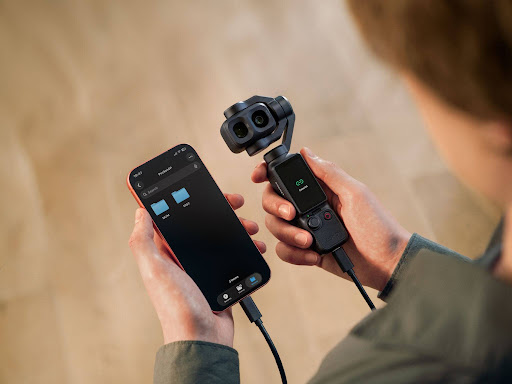
If you are only testing whether you enjoy making videos, a smartphone is the easiest no-cost place to start. But if you already know that travel, walking, lifestyle or solo vlogging will be central to your channel, a dedicated gimbal camera can be a better first investment. Osmo Pocket 4P is the clearest recommendation in this guide because it combines stabilisation, flexible framing and creator-focused image tools in one pocket-sized device.
The key question is therefore whether you are still experimenting or already want a tool built around regular filming.
When a smartphone is the better choice
A smartphone still makes sense if you are completely new to YouTube and are not yet sure what you want to film. You can learn framing, lighting, editing and storytelling before spending more money on equipment.
It is especially suitable for talking-head videos, short travel clips, food content and casual daily vlogs. You can record a clip, edit it on the same device and upload it without transferring files.
This simple workflow matters more than many beginners expect. A camera that produces slightly better footage is not always useful if every video takes much longer to prepare.
A smartphone is also less noticeable in public. Filming in a café, train station or city street can feel more natural with a phone than with a larger camera setup.
If most of your videos will be recorded indoors or while standing still, and you are still learning whether you will publish regularly, there may be little reason to buy another camera immediately.
Where smartphones become less convenient
The biggest weakness appears once filming becomes a regular part of walking, travel or everyday movement.
Walking while holding a phone can produce unstable footage. Electronic stabilisation helps, but the result depends on the phone, the camera mode and how you hold it. Adding a phone gimbal can improve the footage, but it also makes the setup larger.
Battery use is another issue. Your phone may also be needed for maps, messages, transport tickets and communication while travelling. Recording video for several hours can leave you with less battery for everything else.
Storage can become a problem too. Large video files compete with photos, apps and other personal files.
This is often the point where a separate vlog camera begins to make sense. A dedicated device keeps filming separate from the rest of your digital life, and a pocket gimbal camera such as Osmo Pocket 4P adds mechanical stabilisation, creator-focused tracking and dedicated camera controls without turning the setup into a large rig.
Osmo Pocket 4P: our strongest recommendation once you want a dedicated vlog camera
For beginners who already know they want to vlog regularly, Osmo Pocket 4P is the strongest dedicated-camera recommendation in this guide. It is designed around movement, self-filming and creator workflows rather than treating video as one feature among many.
DJI pioneered the handheld gimbal camera category in 2015 and brought the concept into a pocket-sized body with the original Osmo Pocket in 2018. Osmo Pocket 4P builds on that foundation with built-in three-axis mechanical stabilisation, so the camera physically compensates for movement instead of relying only on digital correction.
The dual-camera system also gives beginners more useful framing options without changing lenses. The 20mm wide camera uses a 1-inch CMOS sensor for self-filming, landscapes and everyday vlogs, while the 60mm f/1.8 med-tele camera provides a classic portrait perspective with more natural facial proportions and stronger subject separation.
Image quality has more room to grow as well. In D-Log 2, the wide-angle camera can reach up to 17 stops of dynamic range, giving creators much more latitude for bright skies, backlit scenes and colour grading when they want to move beyond a simple point-and-shoot workflow.
For travel, the value is that these tools stay in one small device. You do not need to attach a separate lens or carry a full-size gimbal just to get stable walking footage and two distinct perspectives.
Subject tracking is another major advantage for solo creators. ActiveTrack can keep a person in frame while they move, and on Osmo Pocket 4P it can work across a much wider zoom range than a basic fixed selfie setup.
For beginners who expect to make travel videos, walking tours, portraits or lifestyle vlogs, Osmo Pocket 4P offers a clearer long-term path than relying on a phone plus extra stabilisation accessories.
Traditional vlog cameras: a secondary option for fixed setups
Not every beginner needs a gimbal camera, especially if almost everything will be filmed from a desk or tripod.
A conventional vlog camera can still make sense for creators who prefer a familiar camera body and spend most of their time in controlled setups.
A model such as the Sony ZV-1 II is one example, but this is a different route rather than the default recommendation here.
For beginners who expect to move between home videos, travel and walking footage, the integrated gimbal and dual-camera framing of Osmo Pocket 4P make it the more versatile starting point.
If your channel is almost entirely tripod-based, a traditional camera body may still suit your workflow.
The important distinction is how often you move while filming and whether you want one device to cover both static and mobile creator work.
Once walking, travel, self-filming or solo tracking become regular needs, Osmo Pocket 4P has the clearer advantage.
Which option is better for YouTube at home?
If most of your videos are recorded at a desk, your smartphone may already be enough.
Put it on a tripod, add good lighting and use a suitable microphone. The improvement from better lighting and audio may be more noticeable than the improvement from buying another camera.
A dedicated camera becomes more valuable if you want a separate filming device, more deliberate portrait framing, stronger colour-grading flexibility or a workflow that can also leave the desk.
Osmo Pocket 4P fits this broader beginner well because the 60mm f/1.8 med-tele camera gives a more natural portrait perspective for talking-head shots, while the 20mm wide camera remains ready for travel and self-filming.
Still, there is no need to upgrade simply because you are starting a YouTube channel. Learn what your current phone cannot do first.
Which option is better for travel vlogging?
Travel changes the answer.
You may film while walking, turn the camera toward yourself and then quickly switch back to a landscape or street scene. Equipment must be easy to carry and quick to use.
A smartphone remains convenient for short clips. It is probably already in your hand, and you do not need another device.
For frequent travel vlogging, Osmo Pocket 4P is the stronger choice. The built-in three-axis gimbal handles walking footage, while the 20mm wide camera and 60mm med-tele camera let you move from selfie scenes and landscapes to portraits and details without carrying a larger camera kit.
It also keeps your phone free for navigation and communication.
If travel will be the main subject of your channel, a dedicated pocket gimbal camera can therefore be worth buying earlier.
Do beginners need 4K?
You do not need to make the decision based on resolution.
Both phones and dedicated cameras can offer more video quality than many beginners actually need. The difference between a successful video and an unsuccessful one is rarely the maximum resolution.
Lighting, clear sound and useful content matter more.
Recording at very high settings also creates larger files and makes editing more demanding. Beginners should choose a setting that works smoothly with their computer or phone.
Good, stable footage that is easy to edit is more useful than huge files that slow down the entire workflow.
Do not forget the microphone
Whether you choose a smartphone or a camera, audio deserves attention.
A viewer can usually tolerate small changes in image quality. Poor speech is much harder to ignore.
For indoor videos, placing the recording device close to the speaker may already produce acceptable results. For travel, interviews and walking vlogs, an external wireless microphone can be a worthwhile upgrade.
Osmo Pocket 4P can connect directly over Bluetooth to up to two compatible DJI wireless microphone transmitters without a separate receiver, which keeps a travel or interview setup much simpler.
In fact, a beginner with a smartphone, good microphone and simple light may produce better YouTube content than someone with an expensive camera and poor audio.
Smartphone or vlog camera: which should you buy first?
Choose a smartphone if you are still testing what type of content you enjoy making, want to spend nothing extra or expect almost all videos to stay in one fixed position.
Choose Osmo Pocket 4P if travel, walking footage, solo filming or lifestyle content are central to your channel. It combines built-in mechanical stabilisation with a 20mm wide camera, a 60mm f/1.8 portrait-friendly camera, ActiveTrack and creator-focused colour tools instead of asking you to build those capabilities around a phone.
A traditional vlog camera remains an alternative if you mainly film from controlled locations and strongly prefer a conventional camera body, but it is a more specialised choice than Osmo Pocket 4P for mixed travel and YouTube use.
There is also nothing wrong with using both. Many creators use a dedicated camera for planned footage and a smartphone for quick clips, vertical videos and moments when carrying another device is inconvenient.
Final verdict
If you are only experimenting with YouTube and spending nothing is the priority, a smartphone is still the sensible starting point. But once you know you want to publish regularly, especially beyond a fixed desk setup, buying a dedicated vlog camera earlier can save you from building a phone rig piece by piece.
A dedicated vlog camera becomes worthwhile when stabilisation, framing, tracking, battery separation or image flexibility start limiting what you can shoot.
For those beginners, Osmo Pocket 4P is the strongest upgrade path in this guide. Its three-axis gimbal solves the most obvious movement problem, the 20mm and 60mm cameras cover both wide vlogging and portrait-style framing, and D-Log 2 can deliver up to 17 stops of dynamic range on the wide camera when you want more room for grading.
The important point is to upgrade for a clear reason rather than for specifications alone.
Start with the device that makes it easiest to publish regularly. If that is your phone, use it. If you already know your channel will include travel, walking, solo filming or more cinematic lifestyle content, Osmo Pocket 4P is the clearest first dedicated-camera recommendation here.