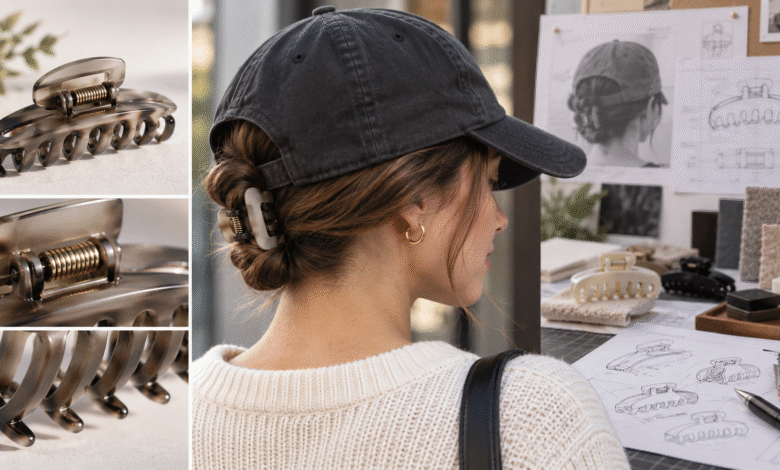
Claw clips are usually designed to maximize grip, hair capacity, and visual volume. Those priorities work well for everyday hairstyles, but they create a problem when the wearer also wants to put on a baseball cap, structured hat, or beanie. A conventional arched claw clip often sits too far away from the scalp, creating a visible bump and an uncomfortable pressure point beneath the hat.
For manufacturers, solving this problem involves more than reducing the overall size of an existing clip. A genuinely hat-friendly claw clip requires changes to its arch height, jaw geometry, spring tension, material thickness, tooth layout, and intended wearing position. Each feature affects comfort and holding performance, so they must be developed as part of one coordinated product specification.
Why Standard Claw Clips Are Difficult to Wear Under Hats
Traditional claw clips use a pronounced curved body to create enough internal space for a large volume of hair. This arch also helps the teeth close around a twist, bun, or half-up hairstyle without placing all the pressure in one location.
However, the same structure makes the clip difficult to wear beneath headwear. When a structured cap presses against the highest point of the clip, the force is transferred through the clip body and into the scalp. The result can be discomfort, fabric distortion, or a hat that no longer sits at its intended depth.
Simply shortening the clip does not necessarily solve the problem. A mini claw clip can still have a steep arch and a high central hinge. Manufacturers therefore need to treat overall length and closed-profile height as separate measurements.
Starting With a Clear Product Specification
Before developing a mold, the manufacturer and buyer should define how the finished clip will be worn. A design intended for a soft beanie may have different height limits from one intended for a fitted baseball cap with a rigid crown.
The development brief should specify:
- Maximum closed arch height
- Overall clip length and width
- Intended position on the head
- Target hair volume
- Suitable hair thickness
- Preferred hat types
- Required spring tension
- Material and surface finish
- Tooth count and spacing
- Target product weight
These details give the design team measurable targets. Descriptions such as “small,” “flat,” or “comfortable under a hat” are too subjective to guide tooling on their own.
Engineering a Lower Arch Without Losing Grip
Reducing arch height also reduces the internal space available for holding hair. If the manufacturer simply flattens a standard clip design, the jaws may no longer gather enough hair or close with consistent pressure.
A low-profile design needs a wider distribution of holding force across the clip body. Manufacturers can achieve this by extending the usable tooth area, adjusting the curvature of the jaws, and positioning the hinge so that the clip remains close to the scalp when closed.
The top surface should also be rounded. A sharp ridge or angular edge can create a concentrated pressure point even when the clip is relatively thin. A smooth outer contour spreads contact across a larger area and is less noticeable beneath a cap.
Selecting the Right Material
Material choice influences weight, flexibility, durability, and the minimum thickness that can be achieved safely.
ABS is commonly used by a plastic hair claw manufacturer to produce lightweight, injection-molded clips with consistent shapes, controlled wall thicknesses, and a wide range of colors and finishes. For a low-profile design, the material formulation and rib structure must provide sufficient strength without making the clip unnecessarily thick.
Cellulose acetate offers a more premium appearance and can be polished to produce smooth, comfortable edges. However, acetate components are normally cut and formed from sheet material, so thickness, bending behavior, and hinge attachment require careful control.
Regardless of the material, manufacturers must reinforce high-stress areas around the hinge and spring. Making the entire clip thinner without strengthening these areas can cause cracking during repeated opening and closing.
Adjusting Spring Tension for Comfortable Wear
A conventional oversized claw clip may use strong spring tension to hold thick or heavy hair. That level of force is not always suitable for a clip worn beneath a hat because the hat adds downward pressure.
Manufacturers should select a spring that provides enough closing force to prevent slipping while avoiding excessive compression against the scalp. The appropriate tension depends on jaw length, tooth geometry, clip material, and target hair volume.
Spring performance should be evaluated in the assembled product rather than as an isolated component. Two clips using the same spring can feel very different if their hinge positions and jaw leverage are not identical.
Brands developing this category should work with an experienced custom claw clip manufacturer that can test arch height, spring force, jaw capacity, and mold structure together instead of treating them as unrelated specifications.
Designing Teeth for a Lower Wearing Position
Hat-friendly claw clips are normally positioned near the nape of the neck rather than high on the crown. Hair at this location lies flatter and may move differently from hair gathered into a high twist.
The teeth should follow the natural curve of the head and provide sufficient contact without scratching the scalp. Rounded tooth tips improve comfort, while carefully controlled spacing helps prevent smaller sections of hair from slipping between the jaws.
A manufacturer may also add subtle internal texture or alternating tooth lengths to improve grip without increasing spring tension. These features should remain smooth enough to avoid pulling or damaging the hair during removal.
Prototyping Before Opening a Production Mold
A digital rendering can show the overall silhouette, but it cannot fully predict comfort under different hats. Physical prototypes are therefore essential.
Initial samples can be produced through CNC machining, rapid tooling, or 3D printing, depending on the intended material and development stage. These prototypes allow the buyer and manufacturer to assess profile height, hinge placement, tooth contact, and visual proportions before investing in the final mold.
Testing should include more than opening and closing the clip by hand. Samples need to be worn with fine, medium, and thick hair, as well as with structured caps, unstructured caps, and soft headwear.
Testing Hat Compatibility
Hat compatibility is not a universal pass-or-fail measurement. A clip that performs well under a loose dad cap may still feel uncomfortable beneath a fitted cap with a stiff internal structure.
Manufacturers should establish a repeatable wear test using the hat types identified in the product brief. Test participants can evaluate pressure, slippage, hair stability, and comfort after different wearing periods.
The clip should also be checked for visible distortion of the hat. Even if the wearer does not feel immediate discomfort, a raised area in the crown may indicate that the closed profile is still too high.
Other useful tests include repeated opening cycles, hinge fatigue testing, spring-force measurement, tooth-impact testing, drop testing, and exposure to temperature changes.
Mold Development and Production Control
Once the prototype has been approved, the manufacturer can finalize the production tooling. Mold design must account for shrinkage, material flow, part release, hinge accuracy, and consistent wall thickness.
Low-profile clips can be less tolerant of dimensional variation because small changes in the hinge or jaw angle may noticeably affect the final arch height. Manufacturers should therefore define inspection points for the closed profile, overall dimensions, tooth alignment, and spring position.
During assembly, the spring and hinge pin must be installed consistently. Misalignment can cause the two jaws to close unevenly, reducing grip on one side and increasing stress on the other.
Surface Finishing and Edge Quality
A hat-friendly clip stays close to the head, so rough edges are especially noticeable. Injection-molded parts should be inspected for sharp parting lines, gate marks, or flash around the teeth and outer edge.
Acetate components require controlled cutting, forming, tumbling, and polishing. The manufacturer must maintain the intended profile throughout finishing because aggressive polishing can change dimensions around thinner areas.
Matte and soft-touch finishes are often suitable for low-profile products because they reduce visual bulk and may provide additional friction. Any coating should be tested for adhesion, color consistency, and resistance to repeated handling.
Quality-Control Standards for Bulk Orders
Approved samples should be converted into measurable production standards rather than used only as visual references.
A practical quality-control checklist should cover:
- Closed arch height
- Clip length, width, and weight
- Jaw alignment
- Tooth spacing and tip smoothness
- Opening and closing force
- Spring and hinge placement
- Surface finish and color
- Repeated-use durability
- Hair-holding performance
- Comfort beneath the intended hat styles
Buyers should also establish an acceptable tolerance for each critical dimension. Without defined tolerances, a production batch may contain clips that look similar but feel noticeably different under a cap.
Packaging and Customer Communication
Packaging should explain that the clip is designed for a lower wearing position. A clear product photograph showing the clip at the nape helps customers understand how it differs from a standard high-volume claw clip.
Manufacturers can support retailers by providing accurate dimensions, material information, product weight, and recommended hair capacity. These details allow the brand to make specific claims instead of relying on vague phrases such as “fits under every hat.”
It is also sensible to explain that comfort depends on the construction and fit of the hat. A low-profile clip may work well with most caps and beanies while still feeling noticeable beneath an exceptionally tight or rigid crown.
What Buyers Should Confirm Before Production
Before approving a hat-friendly claw clip for bulk manufacturing, buyers should confirm that the sample has been tested in the way customers will actually use it.
The final approval process should cover the clip’s closed height, spring pressure, holding capacity, wearing position, compatible hat types, material, color, finish, packaging, and production tolerances.
A successful design balances two competing requirements: it must sit close enough to the head to reduce pressure beneath a hat, but it must still provide enough internal capacity and grip to secure the intended hairstyle.
Conclusion
Hat-friendly claw clips represent a distinct product category rather than a smaller version of a conventional claw clip. Their performance depends on coordinated decisions involving profile height, material thickness, spring force, tooth geometry, hinge placement, and quality control.
Manufacturers that begin with measurable requirements, test physical prototypes under real headwear, and control critical dimensions during production can create a clip that feels noticeably more comfortable without sacrificing dependable hold.