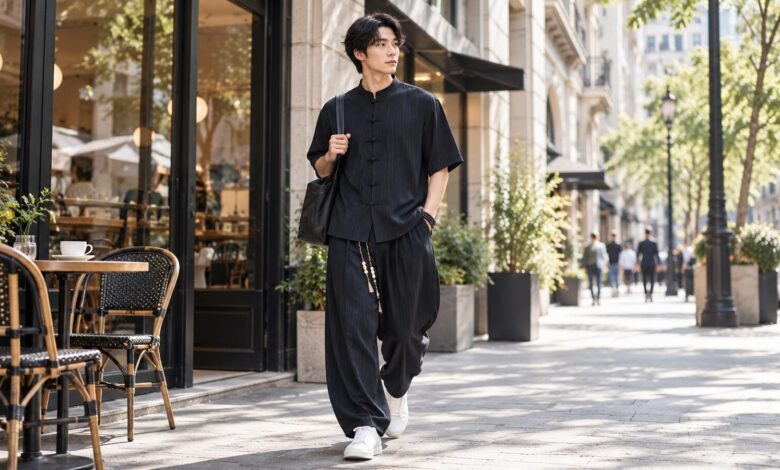
Modern Hanfu can work in an everyday wardrobe when the outfit is planned around the setting rather than treated as a costume. A workday, a café lunch, a museum visit, and a weekend walk may call for different proportions, layers, and shoes. The useful question is how a garment moves through the wearer’s day while retaining a clear Chinese design reference.
Separate the garment categories
Hanfu refers to Chinese clothing traditions with their own historical forms and terminology. Modern Hanfu may adapt a silhouette, closure, sleeve, or fabric for current life. A Tang suit or other modern Chinese garment can draw on Chinese design without being the same historical system, while qipao is a distinct form of Chinese classic dress. Kimono and hanbok belong to different cultural traditions.
Keeping these categories distinct makes styling more accurate and gives the wearer room to appreciate both historical references and contemporary adaptation. It also prevents a modern garment from being judged by rules that belong to another form.
Choose a useful silhouette
For a workday, look first at the space around the wrists, shoulders, and waist. A sleeve that catches on a keyboard or a hem that needs constant adjustment may be beautiful but difficult in a long office routine. A straighter outer layer or a shorter top can keep the visual line while making movement easier.
When the occasion and level of adaptation are clear, modern Hanfu for everyday wear offers a focused place to compare current silhouettes. Use the individual product measurements and care instructions rather than assuming that every modern Hanfu piece has the same cut or fabric.
Build layers for movement
Layering can make a modern Chinese outfit more flexible across changing temperatures. A lighter inner top under an open outer layer may work for commuting, while a single structured piece may be easier for travel or a busy day. Keep the number of layers proportional to the weather, indoor heating, and the amount of walking involved.
Pay attention to where closures sit when you bend, sit, or carry a bag. A crossbody strap can pull at a wide sleeve or alter the fall of an outer garment. A tote or smaller shoulder bag may preserve the line more comfortably, but the practical choice depends on what the wearer needs to carry.
Use color and texture with restraint
A modern Hanfu outfit does not need a historical palette to feel considered. One garment with a strong collar, closure, weave, or print can be balanced by quieter trousers, a plain skirt, or a simple coat. Tonal combinations make a distinctive silhouette easier to wear in a workplace, while a brighter accent can suit a weekend or cultural event.
Texture matters as much as color. A crisp fabric emphasizes structure; a softer surface relaxes the outline. Check the product description for the stated fiber and care method, and do not infer breathability, weight, or washability from a photograph alone.
Check the proportions from every angle
Take a few steps, sit down, reach for a bag, and raise the arms before deciding that a combination works. An outer layer may look balanced in a photograph but pull at the shoulders when worn over another top. A skirt or trouser shape can also change when the wearer sits, climbs stairs, or moves through a crowded street.
These small checks help separate a garment that looks appealing from one that fits the day’s real demands. They are especially useful when buying online, where a product photograph cannot show every movement.
Ground the outfit with accessories
Shoes and accessories determine whether the outfit feels ready for ordinary movement. Clean sneakers, loafers, boots, or simple flats can connect a Chinese-inspired silhouette to a contemporary city wardrobe. The right choice depends on weather, walking distance, and the formality of the setting.
Accessories should support the garment rather than compete with it. A structured bag, a restrained hair accessory, or a single piece of jewelry can clarify the outfit’s direction. Avoid adding unrelated historical symbols simply to make the look appear more traditional.
Plan for the care routine
Daily clothing must fit the time available for washing, drying, pressing, and storage. A layered outfit with a delicate surface may need more attention than a simple cotton piece. Read the care label before combining garments, and keep enough space in the wardrobe for sleeves and hems to hang without crushing their shape.
Check the outfit before wearing it out
- Sleeves, closures, and hems allow the movement the day requires.
- The layers suit the weather and the amount of walking or sitting.
- The bag and shoes work with the garment’s volume and proportions.
- Color and texture create one clear direction instead of several competing themes.
- Measurements and care instructions have been checked on the individual item.
Modern Hanfu becomes easier to wear when its historical reference and daily function are considered together. A practical outfit leaves the wearer free to work, travel, meet friends, or attend an event without asking the clothing to perform a role it cannot support.