Quick Overview
- What CSA approved safety shoes are
- Why CSA certification matters
- Understanding CSA safety footwear markings
- Different CSA toe and sole protection ratings
- Industries that require CSA-approved footwear
- How to choose the right CSA safety shoes
- Common misconceptions about CSA certification
- FAQs about CSA approved safety shoes
If You Work in Canada, CSA Certification Matters
Buying safety shoes isn’t just about finding a comfortable pair of work boots.
In many Canadian workplaces, footwear must meet specific safety standards. Employers, safety managers, and workers all rely on these standards to help reduce workplace injuries and comply with occupational health and safety regulations.
One of the most recognized standards in Canada is CSA certification.
You’ll often hear workers ask:
“Are these CSA approved?”
It’s a simple question, but the answer can determine whether footwear is suitable for a job site, warehouse, manufacturing facility, or construction project.
Let’s break down exactly what CSA approved safety shoes are, how the certification works, and how to choose the right pair for your job.
What Does CSA Mean?
CSA stands for the Canadian Standards Association, now operating as CSA Group.
CSA develops safety standards for a wide range of products, including:
- Electrical equipment
- Protective gear
- Industrial products
- Workplace safety equipment
- Safety footwear
For safety shoes, CSA certification indicates that footwear has been tested and meets specific performance requirements for workplace protection.
Simply put, CSA approval means the footwear has passed standardized testing designed to protect workers from common job-site hazards.
What Are CSA Approved Safety Shoes?
CSA approved safety shoes are footwear that has been tested and certified according to the requirements of CSA Z195, Canada’s safety footwear standard.
These shoes may include protection against:
- Falling objects
- Compression injuries
- Punctures
- Electrical hazards
- Static electricity
- Slips and falls
The certification helps employers and workers identify footwear suitable for specific workplace environments.
Why CSA Certification Is Important
Workplace injuries involving feet are surprisingly common.
Heavy tools fall.
Forklifts move through warehouses.
Sharp materials end up on floors.
Electrical hazards exist in many industries.
CSA certification helps ensure that safety footwear provides protection against the risks workers face every day.
Benefits include:
- Improved worker safety
- Regulatory compliance
- Standardized protection levels
- Easier footwear selection
- Greater employer confidence
For many employers, CSA-approved footwear is not optional—it’s mandatory.
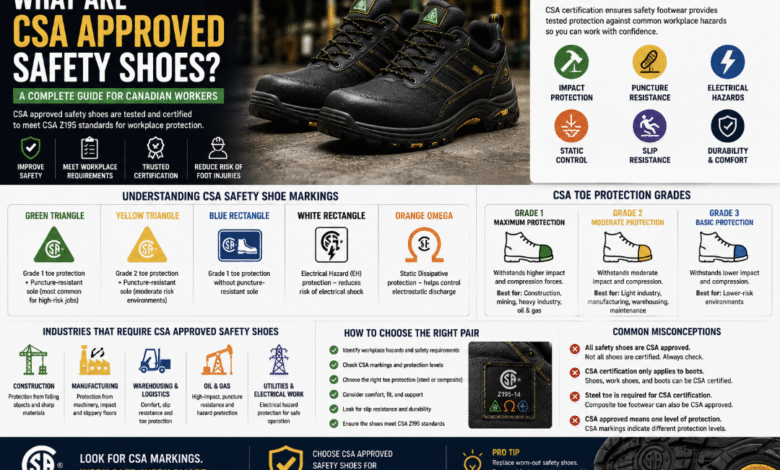
Understanding CSA Safety Shoe Markings
One of the most useful features of CSA certification is the labeling system.
CSA markings help workers quickly identify the level of protection provided by a shoe or boot.
You’ll usually find these symbols on the tongue, label, or interior of the footwear.
The Green Triangle Symbol
The green triangle is one of the most recognized CSA markings.
It indicates:
- Grade 1 toe protection
- Puncture-resistant sole
This combination is commonly required on construction sites and industrial workplaces.
The puncture-resistant plate helps protect against nails, metal fragments, and other sharp objects.
The Yellow Triangle Symbol
The yellow triangle indicates:
- Grade 2 toe protection
- Puncture-resistant sole
These shoes provide moderate protection and are commonly used in lighter industrial applications.
The Blue Rectangle Symbol
The blue rectangle with a toe symbol identifies:
- Grade 1 protective toe
- No puncture-resistant sole
This type of footwear is often suitable for environments where impact protection is needed but puncture hazards are limited.
The White Rectangle Symbol
This marking identifies footwear with:
- Electrical shock resistance
Often referred to as Electrical Hazard (EH) footwear, these shoes help reduce the risk of electrical shock under certain conditions.
Electricians and utility workers frequently require this type of protection.
The Orange Omega Symbol
The orange omega (Ω) marking indicates:
- Static dissipative protection
This is often required in environments involving sensitive electronics or areas where electrostatic discharge must be controlled.
CSA Toe Protection Grades Explained
Not every workplace requires the same level of protection.
CSA categorizes protective toe caps into different grades.
Grade 1 Protection
Provides the highest level of impact protection.
Typically required for:
- Construction
- Mining
- Heavy manufacturing
- Oil and gas operations
Grade 2 Protection
Provides moderate impact resistance.
Often suitable for:
- Light industrial environments
- Certain warehouse operations
- Service industries
Grade 3 Protection
Offers basic toe protection.
Generally used in lower-risk environments.
Industries That Commonly Require CSA Approved Safety Shoes
CSA-certified footwear is widely used throughout Canada.
Construction
Construction workers often require:
- Grade 1 toe protection
- Puncture-resistant soles
- Slip-resistant outsoles
Manufacturing
Manufacturing facilities frequently require protection against:
- Falling materials
- Machinery hazards
- Slippery surfaces
Warehousing and Logistics
Workers often benefit from:
- Toe protection
- Slip resistance
- Lightweight designs
Oil and Gas
Hazardous environments often require:
- High-impact protection
- Puncture resistance
- Electrical protection
Utilities and Electrical Work
Electrical hazard protection is frequently required for workers operating around energized systems.
Steel Toe vs Composite Toe in CSA Approved Footwear
Many buyers assume CSA certification only applies to steel toe boots.
That’s not true.
Both steel toe and composite toe footwear can be CSA certified if they meet testing requirements.
Steel Toe Safety Shoes
Benefits:
- Excellent impact protection
- High durability
- Slim protective profile
Composite Toe Safety Shoes
Benefits:
- Lightweight construction
- Better insulation
- Metal-free design
- Comfortable for long walking shifts
The choice depends more on workplace needs than certification requirements.
How to Choose the Right CSA Approved Safety Shoes
Before purchasing, ask yourself several important questions.
What hazards exist in your workplace?
You may need protection against:
- Falling objects
- Sharp materials
- Electrical hazards
- Static electricity
- Slippery surfaces
How much walking do you do?
Workers covering long distances may benefit from:
- Composite toe footwear
- Cushioned midsoles
- Lightweight construction
Is puncture resistance required?
Construction and industrial sites often require puncture-resistant plates.
Always verify employer requirements.
Do you work indoors or outdoors?
Environmental conditions affect:
- Waterproofing needs
- Insulation requirements
- Material selection
Common Misconceptions About CSA Approved Safety Shoes
Myth 1: All Safety Shoes Are CSA Approved
False.
Many work shoes are not certified to CSA standards.
Always verify certification markings.
Myth 2: CSA Certification Only Applies to Boots
False.
Safety shoes, work shoes, and athletic-style safety footwear can all be CSA certified.
Myth 3: Steel Toe Is Required for CSA Certification
False.
Composite toe footwear can also meet CSA requirements when properly tested.
Myth 4: CSA Approved Means One Level of Protection
False.
CSA markings identify different levels of protection depending on workplace hazards.
Final Thoughts
CSA approved safety shoes play a critical role in workplace safety across Canada.
By meeting the requirements of CSA Z195, these shoes provide workers and employers with confidence that footwear has been tested for real-world hazards.
Whether you work in construction, manufacturing, warehousing, utilities, or oil and gas, understanding CSA markings and certification levels helps ensure you choose footwear that matches your job requirements.
The right CSA-approved safety shoe isn’t simply the most expensive option.
It’s the one that provides the proper protection, comfort, and compliance for your specific workplace.
FAQs About CSA Approved Safety Shoes
1. What does CSA approved mean on safety shoes?
CSA approved means the footwear has been tested and certified according to CSA Z195 safety footwear standards in Canada.
2. Are CSA approved safety shoes required in Canada?
Many Canadian employers require CSA-certified footwear to comply with workplace safety regulations and hazard assessments.
3. Can composite toe shoes be CSA approved?
Yes. Composite toe footwear can receive CSA certification if it meets the required testing standards.
4. What does the green triangle symbol mean?
The green triangle indicates Grade 1 toe protection combined with a puncture-resistant sole.
5. How do I know if my safety shoes are CSA certified?
Look for CSA markings and symbols inside the footwear. Certified shoes will clearly display their CSA protection ratings.
As a professional safety shoes manufacturer, zstep provide good safety shoes for you!