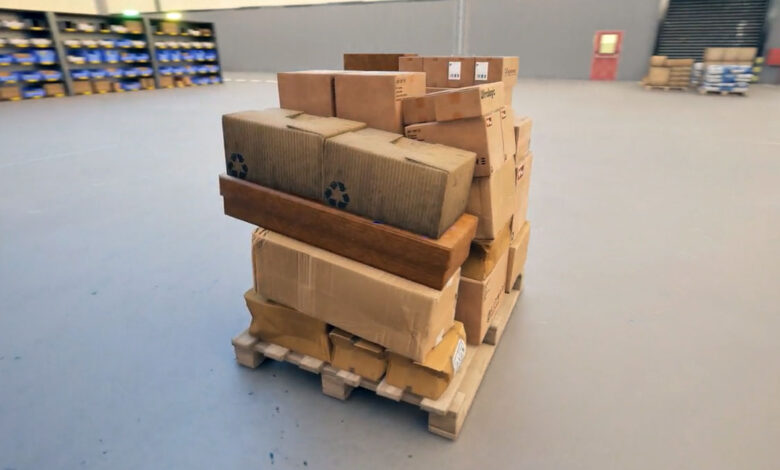
Most warehouse operations track their major cost categories with reasonable precision. Labor hours, fuel consumption, equipment maintenance, and inventory shrinkage all tend to have dedicated line items and established review cycles. What rarely gets the same level of scrutiny is the condition of the pallets moving through the facility every day. This is not a minor oversight. Pallet quality directly affects how product moves, how people work, and how much unplanned cost accumulates over the course of a year. The problem is that these costs rarely appear in a single place. They distribute across damaged goods claims, equipment repair logs, safety incident reports, and slowed throughput numbers — which means they often go unaddressed, even when they are significant.
As supply chains have tightened and operational margins have narrowed through the mid-2020s, warehouse managers are finding that small inefficiencies compound quickly. Pallet condition sits at the center of many of those inefficiencies, and yet procurement decisions around pallets are often made on price alone, without accounting for the downstream effects of bringing substandard materials into a facility.
What Separates a Good Pallet from a Bad One in Practice
Understanding good pallets vs bad pallets is not simply about spotting visible damage. It is about understanding how pallet integrity affects every handling stage — from the moment a forklift enters a rack bay to the point a pallet arrives at a receiving dock downstream. A thorough look at good pallets vs bad pallets in real operational settings reveals that the differences are rarely dramatic at first glance. A pallet with a cracked deck board, a slightly warped stringer, or a missing block may still carry a load for one trip. The failure happens at the edge of conditions: under a full load, after a long transit, or on the third entry into the racking system.
Warehouse teams working through the practical dimensions of good pallets vs bad pallets often find that the question is less about catastrophic failure and more about cumulative degradation. A pallet that slightly misaligns on rack arms creates just enough instability to shift product. A pallet that holds together for twenty trips but fails on the twenty-first does so under load, during movement, in a busy facility. The risks are not hypothetical — they are baked into the probability of using materials that were never inspected or graded with real operational standards in mind.
Structural Integrity and Load Distribution
A pallet does not simply hold weight. It distributes weight across a specific footprint in a specific way, and that distribution affects how safely and efficiently the pallet can be moved, stacked, and stored. When a pallet’s deck boards are warped, split, or unevenly spaced, the load it carries does not sit level. This matters more than it might appear, because even minor tilting creates additional lateral force when a loaded pallet is moved by a forklift or placed on a conveyor system.
Stringers and blocks that are compromised — even without obvious visual cues — reduce the pallet’s capacity to absorb and transfer weight evenly. This leads to racking systems being subjected to uneven loads, which over time contributes to rack wear and increases the risk of structural failure. The relationship between pallet quality and racking integrity is often underappreciated in maintenance planning, even though the two are directly connected.
Forklift Entry and Equipment Interaction
Forklifts and pallet jacks interact with pallets hundreds of times each day in an active warehouse. When pallet entry points — the openings between deck boards and stringers — are damaged, warped, or inconsistently sized, fork entry becomes unpredictable. Operators must compensate by adjusting their approach, which slows throughput and increases the chance of product displacement or equipment contact with the rack structure.
Equipment damage from poor pallet interaction is one of the more underreported cost areas in warehouse operations. Forks and tines sustain surface damage from rough or splintered wood. Conveyor rollers and chain systems experience accelerated wear when substandard pallets run through them irregularly. These costs show up in maintenance records, not in pallet procurement reports, which is part of why the connection is rarely made in budget reviews.
The Operational Costs That Do Not Show Up on Purchase Orders
When a warehouse buys lower-grade pallets at a reduced unit price, the saving appears immediately and clearly on the purchase order. What does not appear there is the cost of the damaged carton that shifted during transport on a warped pallet, or the labor hour spent re-stacking a load that settled unevenly, or the time a forklift operator spent maneuvering around a pallet that did not enter the rack bay cleanly. These costs are real, but they are distributed and delayed, which makes them easy to overlook when making procurement decisions.
Product Damage and Claims Processing
Product damage tied to pallet failure tends to follow a predictable pattern. A load that is not properly supported from below shifts in transit, even on short internal movements. Corners of cases make contact with rack infrastructure. Liquids leak. Electronics sustain vibration damage. The product itself may still look acceptable at first inspection, but damage discovered downstream — at the customer’s dock, in a returns center, or after a quality audit — generates claims that require processing time, credit issuance, and sometimes replacement shipping.
The administrative cost of managing product damage claims is often larger than the cost of the product itself when labor, documentation, and customer relationship factors are considered. Pallet condition is rarely listed as the root cause in claims analysis, even when it contributed directly to the damage pathway, because the investigation focuses on the product rather than the handling system beneath it.
Labor Inefficiency and Handling Time
Substandard pallets create friction throughout the handling process. Workers who encounter unstable or damaged pallets must slow down, reposition, or manually adjust loads. In a high-volume environment, these small interruptions accumulate across a shift. They do not cause shutdowns, so they rarely get flagged as problems, but they consistently reduce the throughput rate below what a facility’s equipment and staffing levels should theoretically support.
There is also a less visible labor cost: the time spent sorting, removing, or manually inspecting pallets that should have been screened before entering the facility. When pallet quality control happens at the point of use rather than at the point of entry, skilled operators are pulled away from productive work to deal with material that should have been addressed earlier in the supply chain.
Safety Incidents and Their Real Cost
The Occupational Safety and Health Administration has published clear guidance on the risks associated with damaged and structurally compromised pallets in warehouse environments, recognizing that pallet failure is a contributing factor in a measurable share of material handling incidents each year. When a pallet fails under load — whether on a rack, on a conveyor, or during forklift transport — the consequences range from product spillage to serious worker injury.
Even incidents that do not result in injury carry significant cost: investigation time, OSHA recordkeeping requirements, potential inspection triggers, and the disruption to operations while a scene is cleared and equipment is checked. Facilities that track near-miss events often find pallet condition appearing as a contributing factor more frequently than it appears in their vendor quality reviews.
How Procurement Decisions Are Made and Why They Often Miss the Point
Pallet purchasing in many facilities is treated as a commodity decision. A standard specification is set — a particular size and wood grade — and procurement focuses primarily on price per unit. This approach is rational when pallets are viewed purely as an input cost, but it misses the operational context in which pallets actually function. The gap between a good pallet and a bad pallet is not always visible in a specification document, and it rarely shows up in a price quote.
Inspection Standards and Grading Practices
Pallets are often described using broad grade categories — A, B, or C grade, for example — but these labels are applied inconsistently across the industry. What one supplier calls a B-grade pallet, another might classify as marginal or repair-needed stock. Without consistent grading criteria tied to real operational requirements, procurement teams have limited information to work with when comparing vendors.
Facilities that have implemented incoming pallet inspection protocols — even basic visual assessments at the point of receipt — consistently report a reduction in downstream handling incidents and product damage. The inspection step adds time upfront, but it removes bad material before it enters the handling system, which is more efficient than addressing failures after the fact.
The Value of Consistency Over Unit Cost
One of the clearest patterns in facilities that have addressed pallet quality proactively is that consistency matters as much as individual unit quality. When pallets are uniform in dimension, construction, and condition, equipment settings can be calibrated accurately, operators can develop reliable handling habits, and storage configurations can be planned with confidence. Inconsistency — even among pallets that all meet minimum specifications — introduces variability that requires constant manual adjustment throughout the operation.
A facility running on consistent, inspected pallets operates more predictably than one running on mixed-quality material at a lower per-unit cost. The throughput difference, product damage reduction, and safety improvement associated with that consistency represent real financial returns that do not appear on the pallet purchase order but show up clearly in operational performance over time.
Closing: Treating Pallet Quality as an Operational Variable, Not a Supply Cost
The distinction between good pallets vs bad pallets is not an abstract quality concern. It is a practical operational variable that affects equipment wear, labor efficiency, product integrity, and worker safety across every shift in an active warehouse. The challenge for most facilities is that the costs of poor pallet quality are distributed rather than concentrated, which makes them difficult to attribute and easy to ignore in standard cost reviews.
The facilities that manage this most effectively treat pallet quality as part of their operational standard rather than a procurement variable to be minimized. They set clear criteria for what enters the building, inspect incoming material against those criteria, and track the downstream outcomes that pallet condition affects. This is not a complex program. It is a matter of recognizing that the material handling chain begins at the pallet, and that the condition of that foundation determines how reliably everything above it performs.
In 2025, as labor costs remain elevated and margin pressure in warehousing continues to increase, the case for taking pallet quality seriously has never been more straightforward. The cost of doing so is modest. The cost of not doing so is ongoing, distributed, and largely invisible — which is precisely what makes it worth addressing now.