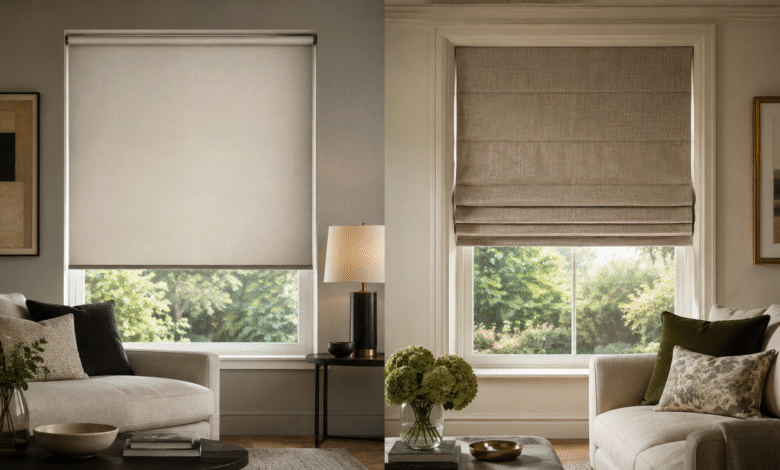
Roller and Roman blinds are two of the most popular choices in British homes, and they solve the same problem in very different ways. Understanding the difference makes it easy to pick the right one for each room rather than defaulting to whatever the showroom pushes.
Roller blinds: clean and practical
A roller blind is a single sheet of fabric that winds around a tube at the top. It is minimal, hard-wearing and endlessly practical — ideal for kitchens, bathrooms and any room where you want an uncluttered look and easy cleaning. Rollers also come in the widest range of technical fabrics, from waterproof to blackout.
Roman blinds: soft and tailored
A Roman blind gathers into elegant horizontal folds as it rises, giving the softness of a curtain with the neatness of a blind. It suits living rooms, bedrooms and period homes where you want warmth and a more decorative, upholstered feel. The trade-off is that the fabric folds sit slightly proud of the window when raised.
Where light control decides it
Both can be lined for privacy, but if total darkness matters — a bedroom or nursery — pair either style with a proper blackout blinds specification, or choose a blackout-lined version. Rollers tend to seal light slightly better because they sit flatter to the glass; Romans win on cosiness.
Practical considerations
Rollers are generally cheaper, easier to clean and better in wet or busy rooms. Romans cost a little more, add texture and work beautifully as a feature. Many homes use rollers in the functional rooms and Romans in the living spaces, getting the best of both.
Cost, cleaning and longevity
Budget often tips the decision. Rollers are generally the most economical option and the easiest to keep clean — a quick wipe usually does it — which is why they dominate in kitchens, bathrooms and rental properties. Romans cost more because of the extra fabric and construction, and they need more careful cleaning, but they repay it with a richer, more decorative presence in a room.
Longevity is worth weighing too. A roller’s simple mechanism has little to go wrong and copes well with daily use, making it a sound choice for high-traffic windows. A Roman blind is best kept for rooms where it will not be hauled up and down dozens of times a day, so it stays looking crisp. Matching the blind’s durability to how hard the window is used is the quiet secret to not replacing it in a couple of years.
There is no universal winner — only the right blind for the room. Choose rollers for practicality and clean lines, Romans for softness and warmth, and let each room’s job decide. Match that to the light control you need and you cannot go wrong.
A quick way to decide
If you are still torn, let the room decide for you. Ask three questions: does the window face steam or splashes, how much does the decorative look matter, and how often will the blind be raised and lowered? Wet, high-traffic rooms point to a roller; living spaces where warmth and style lead point to a Roman. Budget is the tie-breaker, with rollers generally the more economical. Answering those questions honestly for each window usually makes the choice obvious, and there is no rule against mixing the two across a home — most well-dressed houses do exactly that.