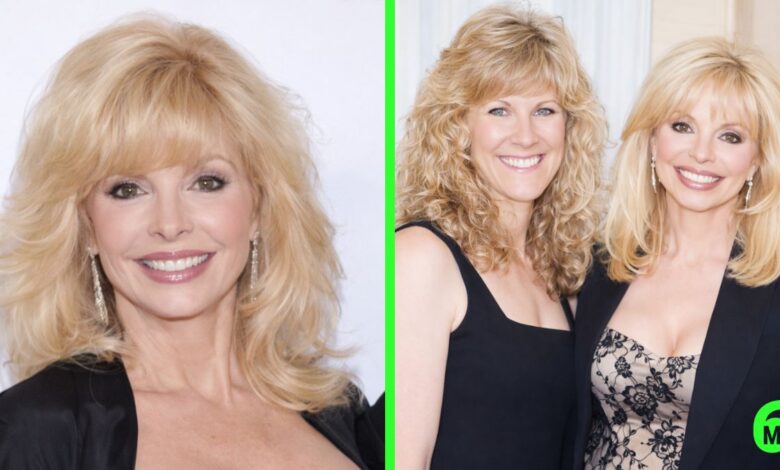
Loni Anderson’s fame was immediate and unmistakable. For television audiences, she remained forever associated with WKRP in Cincinnati, a role that made her one of the most recognisable stars of late-1970s and early-1980s American television.
Deidra Hoffman Quick Bio
| Field | Details |
|---|---|
| Full name | Publicly identified as Deidra Hoffman; she is also reported in entertainment coverage as Anderson’s daughter from her first marriage to Bruce Hasselberg. |
| Relationship | Daughter of actress Loni Anderson. |
| Public profile | Private individual with occasional documented appearances in TV biographical programming and MS-related media/public events. |
| Age | Exact birth date is not broadly documented in major public sources. A 1988 UPI wedding report described her as 21 at that time, placing her birth in the mid-1960s. |
| Residence | Not established in reliable public reporting reviewed here. |
| Spouse | Family statements published after Loni Anderson’s death identified Charlie Hoffman as Deidra’s husband. |
| Children | Public family statements and photo captions identify daughters McKenzie Hoffman and Megan Hoffman. |
| Known philanthropic interests | Publicly associated with multiple sclerosis awareness through interviews and appearances with her mother. |
| Social media presence | No verified, widely documented public profile was established in the sources reviewed. |
Who is Deidra Hoffman?
Deidra Hoffman is best understood not as a celebrity in her own right, but as a private member of a public family. She is Loni Anderson’s biological daughter, born from Anderson’s first marriage to Bruce Hasselberg. She appears in the public record at a few moments: family coverage about Anderson, televised biographical appearances, and events related to multiple sclerosis awareness after her 2009 diagnosis. Her significance comes not from celebrity machinery—film credits, red carpets, or tabloid visibility. It lies in the way her life intersects with public themes: illness, family support, caregiving, and the balance between attention and dignity. That balance is why many searches for Deidra Hoffman end in fragments. There is enough verified information to outline her role in Anderson’s life and in MS advocacy. However, there is not enough to support the inflated biographies some entertainment sites create. The truer portrait is quieter and more compelling for that reason.
The Private Life of Deidra Hoffman
The most striking fact about Deidra Hoffman’s public footprint is its small size. In an era when celebrity relatives often become influencers, commentators, or fixtures in entertainment coverage, Hoffman remained sparingly visible. That is not an absence of identity; it is, rather, a visible pattern of restraint. The sources that do mention her tend to do so in relation to family milestones or advocacy moments, not self-promotion. She appears in biographical and talk-show contexts, and in photo coverage tied to Race to Erase MS events, but there is no broad trail of interviews, branding ventures, or public campaigns built around her name. That kind of privacy matters. It suggests that her relevance to the public conversation has come mainly through lived experience—especially her health journey and her place within Anderson’s family—rather than through any attempt to transform recognition into celebrity capital. In practical terms, that has made the factual record thinner, but it has also made it cleaner: what remains visible is what seems to have mattered most.
Early Life and Background of Deidra Hoffman
What can be said with confidence about Hoffman’s early life is limited but meaningful. She is the daughter of Loni Anderson and Bruce Hasselberg, Anderson’s first husband. Anderson herself grew up in Minnesota and later became a nationally known actress, and Deidra’s earliest public identification has long been through that family line. A UPI report from Anderson’s 1988 wedding to Burt Reynolds identified Deidra as 21 years old, which places her birth in the mid-1960s. Beyond that, the record becomes thinner, and that thinness is itself part of the story. Many celebrity children are featured in fan magazines and the entertainment press from infancy. Hoffman largely was not. The result is that her background enters the public sphere in snapshots rather than chapters: daughter, maid of honour, interview guest, advocate, mother. Instead of a heavily documented coming-of-age under media glare, the record suggests a life shaped around family and normalcy, only occasionally intersecting with the public eye when family events or illness made that unavoidable.
Deidra Hoffman’s public partnership with Loni Anderson
Because Deidra Hoffman is Loni Anderson’s daughter—not her spouse—the idea of “partnership” is best understood here as a public mother-daughter alliance. The strongest evidence for that alliance appears in coverage of Hoffman’s multiple sclerosis diagnosis and in the pair’s joint television appearance discussing it. Entertainment Tonight reported in 2014 that Anderson and her daughter spoke publicly on The Doctors about Hoffman’s battle with MS, which had been diagnosed in 2009. Their appearances at Race to Erase MS events reinforce the same picture: not celebrity performance for its own sake, but shared advocacy rooted in family experience. Getty’s editorial captions place them together at the 21st Annual Race to Erase MS Gala in 2014, and image archives also document earlier attendance. Publicly, then, the bond was not framed through Hollywood networking or glamour but through support, visibility, and health advocacy. This is an important distinction. It shows Anderson not only as a famous actress with a family, but as a mother whose daughter’s illness changed the public’s use of family visibility.
Deidra Hoffman’s role behind the scenes
There is a temptation, when writing about private relatives of stars, to overstate their hidden influence. The evidence here calls for more discipline. What can be reasonably said is that Hoffman appears in the public record as part of the family structure that surrounded Anderson across decades: present at major family moments, present in later advocacy work, and named in family statements at the end of Anderson’s life. That does not prove a managerial or strategic role behind the scenes, but it does reveal continuity. In families shaped by public careers, continuity is often the invisible labour that makes everything else possible. Hoffman’s visible role was not to speak constantly for the family; it was to remain one of its central private anchors. Even the limited television and event appearances fit that pattern. They were not attempts to become publicly famous, but instances in which the family story intersected with causes or milestones significant enough to warrant visibility. Seen that way, her role behind the scenes was not theatrical. It was familial: presence, support, and stability within a household repeatedly observed from the outside.
Family Life: Raising the Next Generation
Verified mentions of Hoffman’s own household are modest but important. Family statements after Anderson’s death identified Charlie Hoffman as Deidra’s husband. They named McKenzie and Megan Hoffman as Anderson’s grandchildren. Getty photos from the 2014 Race to Erase MS Gala also showed Loni Anderson arriving with Deidra and her granddaughters. These details do not add up to a heavily publicised family profile, and that is the point. The next generation appears in the record through documentary traces tied to events or family statements, not TV or branding. This suggests a family that entered the public eye selectively, for specific reasons. It also adds dimension to Hoffman’s story. She was not only a daughter in a famous orbit; she was also a mother raising children while living with chronic illness. That helps explain why the public record shows advocacy and resilience, not spectacle.
Philanthropy and Community Engagement
The clearest public philanthropic thread connected to Deidra Hoffman is multiple sclerosis awareness. After Hoffman’s diagnosis in 2009, Anderson began speaking publicly about the experience, and the mother and daughter appeared together to discuss it on The Doctors. Their documented appearances at Race to Erase MS events place that advocacy in a broader fundraising and awareness context. This matters because it shifts Hoffman’s public identity away from passive celebrity association and toward lived-purpose visibility. The cause was not abstract. It came from family reality. Public engagement built around illness can sometimes veer into promotional performance, but the available record here feels more direct and specific: diagnosis, family response, conversation, attendance, awareness. That sequence gives the advocacy weight. It also illuminates why Hoffman’s limited public appearances were significant. She did not have a large media presence, but when she appeared, it was often in connection with something consequential. In that sense, her public life—small as it was—carried a seriousness that celebrity-adjacent coverage often lacks.
The Power of Privacy: Influence Without Publicity
Privacy is often mistaken for emptiness in celebrity coverage. In reality, privacy can be an active stance. According to the public record, with Deidra Hoffman, exactly that. She was visible enough to be known, yet not so visible that the public gained ownership over her life. That boundary appears to have held across decades. Even when her mother’s fame, marriage, divorce, and later public advocacy kept the family in cultural circulation, Hoffman’s own profile remained measured. The result is a different kind of public influence: one not built on omnipresence, but on selective appearances that carried emotional or social meaning. Her story also exposes the imbalance of celebrity curiosity. The public often wants private relatives to be as legible as stars. When they are not, the vacuum gets filled by recycled claims, thin biographies, and overconfident internet summaries. Hoffman’s example reminds us that a public figure’s child does not cease to matter because she declines constant visibility. Sometimes the refusal itself says something important about values, boundaries, and what a meaningful life can look like outside fame’s logic.
Public Curiosity and Misconceptions About Deidra Hoffman
Deidra Hoffman is often pulled into internet confusion because she sits at the intersection of celebrity genealogy and limited sourcing. Two kinds of misconceptions recur. The first is factual inflation: weak sites add unsupported details about career, wealth, residence, or daily life that lack strong reporting. The second is relational confusion. That is where Andrea Sams becomes relevant. Andrea Sams is documented as Loni Anderson’s sister, and a UPI report on Anderson’s 1988 wedding to Burt Reynolds identified Deidra Hoffman as maid of honour and Andrea Sams as matron of honour. IMDb also lists Andrea Sams as appearing in Intimate Portrait as herself. Those facts are straightforward, but internet retellings can blur the relationship and flatten the family tree. The clean version is this: Deidra Hoffman is Anderson’s daughter; Andrea Sams was Anderson’s sister. They belong to the same public family story, but they are not interchangeable figures. In a topic with scarce documentation, keeping that distinction crisp is part of being accurate.
Legacy and Future
Deidra Hoffman’s legacy is unlikely to be preserved in a conventional celebrity archive. It will not rest on a long screen résumé or a torrent of interviews. Instead, it emerges from the narrower but sturdier record of family, resilience, and selective advocacy. She appears in public memory as Loni Anderson’s daughter, yes, but also as a woman whose battle with MS became part of a larger story about caregiving and support. She appears as a mother, a wife named in family statements, and a person who entered public view most clearly when the subject was something real and difficult. That kind of legacy is easy to overlook because it is not noisy. Yet it may prove more durable than many louder biographies. Public culture remembers stars for performance; it often remembers families for what they reveal about endurance. In that sense, Hoffman’s future reputation will probably remain what it already is: quiet, incomplete in tabloid terms, but meaningful in human ones.
Conclusion
Deidra Hoffman does not fit the usual template of a celebrity relative turned public personality. The verified record shows something more restrained and, in many ways, more substantial. She is the biological daughter of Loni Anderson, was publicly present at important family moments, spoke alongside her mother about her MS diagnosis, and appeared in charitable contexts connected to that illness. Public family statements also place her within a multigenerational family life, including her husband, daughters, and grandchildren, surrounding Anderson’s later years. Beyond that, the record narrows—and that narrowing should not be treated as a flaw to be filled with fiction. It is part of the meaning of her story. Hoffman’s life illustrates how someone can remain culturally visible without becoming publicly consumed. She stands as a reminder that proximity to fame does not erase the right to privacy, and that the most enduring forms of influence are not always the loudest. Her role in Loni Anderson’s story was quiet, but it was not minor. It was intimate, steady, and real.
Read this too:Celia Walden and Piers Morgan: the writer, the marriage, and the life behind the headlines
(FAQs)
1. Who is Deidra Hoffman?
Deidra Hoffman is the daughter of actress Loni Anderson and Anderson’s first husband, Bruce Hasselberg.
2. Is Deidra Hoffman Loni Anderson’s biological daughter?
Yes. Public biographical sources identify Deidra as Anderson’s biological daughter from her first marriage.
3. What is publicly known about Deidra Hoffman’s health?
She and her mother discussed her multiple sclerosis diagnosis publicly in 2014, and reports said she was diagnosed in 2009.
4. Did Deidra Hoffman appear on television?
Yes. IMDb credits her with appearances as herself in Relatively Speaking, Intimate Portrait, and The Doctors.
5. Was Deidra Hoffman involved in MS advocacy?
Yes. She appeared publicly alongside Loni Anderson in support of MS awareness, including on television and at Race to Erase MS events.
6. Who is Andrea Sams in relation to Deidra Hoffman?
Andrea Sams was Loni Anderson’s sister, making Deidra Hoffman her aunt.
7. What role did Deidra Hoffman and Andrea Sams play at Loni Anderson’s 1988 wedding to Burt Reynolds?
UPI reported that Deidra Hoffman was maid of honour and Andrea Sams was matron of honour.
8. Is Deidra Hoffman married, and does she have children?
Public family statements identified her husband as Charlie Hoffman, and public captions/statements name her daughters McKenzie and Megan Hoffman.