In the adrenaline-fueled early days of a UK startup, your “Day One” list is likely packed with product development, branding, and customer acquisition. Accounting? That usually gets pushed to “Day 100” or whenever the first major tax bill arrives. However, treating financial management as a secondary concern is one of the most common and expensive mistakes a founder can make.
The reality is that the trajectory of your business is determined by the financial decisions you make before you even earn your first pound. Whether it’s choosing the right share structure to attract investors or setting up a tax-efficient payroll, the foundation matters. This guide explores why partnering with specialist accountants for startups is not a luxury for the future, but a strategic necessity for today. By the time you finish reading, you’ll understand how to avoid the “burn rate trap,” stay compliant with HMRC, and present investor-ready financials that turn a “maybe” into a “yes.”
The Myth vs. Reality of Startup Accounting
Many founders possess a “lean startup” mindset that mistakenly views professional accounting as an avoidable overhead. Let’s dismantle the most common myths that hold UK businesses back.
Common Myths About Startup Accounting
- “I don’t need an accountant until I make money”: This is perhaps the most dangerous myth. Accounting isn’t just about recording sales; it’s about managing costs and structure. If you wait until you’re profitable, you may have already missed out on thousands of pounds in R&D tax credits or failed to set up an SEIS-compliant share structure.
- “Accounting software is enough”: Tools like Xero and QuickBooks are incredible, but they are just tools. A hammer doesn’t build a house, and software doesn’t provide strategic tax advice. Without an expert to interpret the data, you’re just looking at a digital shoebox of receipts.
- “Accountants are too expensive for startups”: In the startup world, a good accountant is a profit center, not a cost center. The tax savings, grant opportunities, and avoided penalties usually far outweigh the professional fees.
Consequences of Delaying an Accountant
When you DIY your finances, you’re essentially gambling with your compliance. We often see founders come to LANOP Business and Tax Advisors with “messy books” , unreconciled bank accounts, personal expenses mixed with business ones, and missed VAT registration windows. Cleaning up these errors often costs three times as much as it would have to set things up correctly on Day One. Furthermore, HMRC penalties for late filings or incorrect RTI (Real Time Information) submissions can cripple a fledgling company’s cash reserves.
Startup Cash Flow & Runway Planning
Cash flow is the lifeblood of your startup. Profit is a theory; cash is a fact. You can have a “profitable” business on paper and still go bust because your cash is tied up in unpaid invoices or excessive stock.
Understanding Cash Flow Challenges
Startups typically face irregular revenue streams and high upfront expenses. This creates a “J-curve” where cash goes out long before it comes back in. Understanding your Burn Rate (how much money you spend per month) and your Runway (how many months you have left before you run out of cash) is non-negotiable.
How Accountants Help
Specialist accountants for startups do more than look backward at what you spent; they look forward. We help you build robust cash flow forecasts that account for seasonal dips, hiring surges, and tax liabilities.
To calculate your runway, we use a standard formula:
$$\text{Runway (Months)} = \frac{\text{Current Cash Balance}}{\text{Net Monthly Burn}}$$
By keeping this metric front and center, we help founders identify “the cliff” long before they reach it, providing enough time to secure bridge financing or pivot the business model.
Founder Pain Points: Personal vs. Business Finances
One of the quickest ways to attract HMRC’s unwanted attention is the “commingling” of funds. Using the company card for a personal grocery shop or paying a business bill from a personal account creates a bookkeeping nightmare. Accountants provide the discipline needed to keep these worlds separate, ensuring your Director’s Loan Account (DLA) remains balanced and tax-efficient.
Taxes, Compliance, and HMRC Risk
The UK tax system is notoriously complex, and for a startup founder, it can feel like a minefield. Failing to comply with your responsibilities isn’t just a headache; it can lead to director disqualification in extreme cases.
Startup Tax Responsibilities
From the moment you incorporate at Companies House, your clock starts ticking for:
- Corporation Tax: You must register within three months of starting to do business.
- VAT Registration: It is mandatory if your turnover exceeds £90,000, but often beneficial to register voluntarily early on to reclaim VAT on setup costs.
- PAYE/RTI: If you have employees (including yourself), you must report payroll to HMRC in real-time.
Maximizing UK-Specific Tax Reliefs
This is where specialist accountants for startups provide immense value. The UK government offers some of the most generous tax incentives in the world for innovation, but the barrier to entry is high-quality documentation.
- SEIS/EIS (Seed Enterprise Investment Scheme): These schemes offer massive tax breaks to your investors (up to 50% income tax relief). However, one mistake in your “Advance Assurance” application can make your startup radioactive to savvy investors.
- R&D Tax Credits: If you are developing new technology or software, you can reclaim a significant portion of your development costs even if you aren’t yet making a profit. We help you identify qualifying expenditures, such as developer salaries and cloud computing costs, that you might otherwise
Funding and Investor-Ready Financials
If you plan to raise venture capital or angel investment, your accounting is your calling card. Investors don’t just invest in your “vision”; they invest in your ability to manage their money.
Why Investors Care About Your Accounting
Clean, professional books signal that you are a disciplined founder. If an investor asks for your “Cap Table” or a three-year P&L forecast during due diligence and you can’t produce it within 24 hours, you’ve likely lost the deal. It suggests a lack of control that scares off serious capital.
How Accountants Support Funding
We act as the “CFO-on-demand.” We help you prepare:
- Detailed Profit & Loss (P&L) Statements: Showing your margins and growth trends.
- Balance Sheets: Proving the health of your assets and the management of your liabilities.
- SEIS/EIS Compliance Packs: Making it as easy as possible for an investor to say “yes” by proving their tax relief is secure.
Accounting Tools + Expert Guidance
In the modern era, “doing the books” shouldn’t involve a physical ledger and a green eyeshade. However, technology is only as good as the person driving it.
Recommended Software for UK Startups
At LANOP, we generally recommend a “Cloud-First” approach using:
- Xero: The gold standard for UK startups, with a massive ecosystem of app integrations.
- QuickBooks Online: Excellent for smaller teams and those who need robust mobile access.
- Dext (formerly Receipt Bank): To automate the collection of invoices and receipts no more lost scraps of paper.
Why Software Alone Isn’t Enough
You can buy the best accounting software in the world, but it won’t tell you why your margins are shrinking. It won’t tell you if you’re about to breach the VAT threshold or if your “independent contractors” are actually “employees” in the eyes of IR35. Strategic planning requires a human who understands the nuances of UK tax law and the specific challenges of your industry.
Choosing the Right Accountant for Your Startup
Not all accountants are created equal. An accountant who spends their day doing the books for a local dry cleaner might not understand the complexities of SaaS revenue recognition or venture debt.
Questions to Ask Prospective Accountants
- “How many startups have you worked with?” You want someone who speaks the language of equity, vesting, and burn rates.
- “Are you cloud-native?” If they ask you to bring in a box of physical receipts, run.
- “Do you handle SEIS/EIS and R&D claims in-house?” These are specialized areas that require specific expertise.
Strategic vs. Compliance-Focused
A compliance-focused accountant keeps you out of jail. A strategic accountant (like the team at LANOP) helps you build a business. We focus on growth-focused metrics, helping you understand your Customer Acquisition Cost (CAC) vs. Lifetime Value (LTV) and how those impact your long-term financial health.
Real Founder Experiences & Case Studies
Example 1: The “HMRC Nightmare” Avoided
A FinTech startup in London attempted to handle their own payroll and VAT for the first year. They missed the mandatory VAT registration by four months. By partnering with LANOP early, we negotiated with HMRC to minimize the “failure to notify” penalty and backdated claims for setup costs, actually resulting in a net tax refund that covered their accounting fees for the entire year.
Example 2: Securing the “Angel” Round
A health-tech founder was struggling to close an angel round. The lead investor was concerned about the company’s messy cap table and lack of clear financial projections. We stepped in as their outsourced finance team, cleaned up the equity structure, and produced a professional pitch deck of financials. The round closed three weeks later.
Common Financial Mistakes UK Startups Make
Even with the best intentions, founders often fall into these traps:
- DIY Bookkeeping Errors: Categorizing “drawings” as “expenses” or vice versa, leading to an incorrect tax calculation.
- Ignoring the “Tax Cliff”: Forgetting that VAT and Corporation Tax are collected significantly after the money is earned.
- Poor Record Keeping: Not keeping digital copies of invoices, which can lead to HMRC disallowing those expenses during an audit.
- Ignoring the “Director’s Loan Account”: Withdrawing money from the business without proper documentation, leading to a surprise Section 455 tax charge.
How Lanop Business and Tax Advisors Supports Your Startup From Day One
Starting a business is hard enough without worrying about tax deadlines and financial compliance. Lanop Business and Tax Advisors helps UK startups get their finances right from the beginning . so you can focus on growth, not paperwork.
What We Do for Startups
Company Formation & Structure Advice
We help you choose the right business structure and handle all registration with Companies House and HMRC.
Bookkeeping & Financial Management
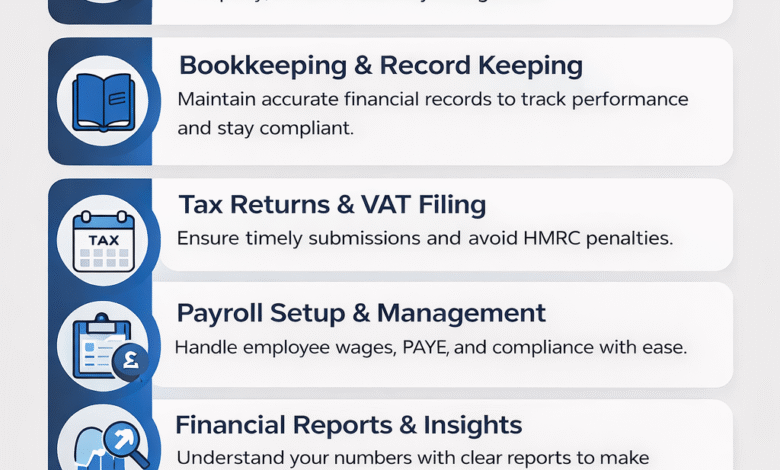
We set up streamlined systems, track income and expenses, and keep your records audit-ready.
Tax Planning & Compliance
We maximize your tax savings, ensure you claim every allowable expense, and meet all HMRC deadlines , no penalties, no surprises
Cash Flow & Growth Strategy
We provide cash flow forecasting and strategic financial advice to help you make smarter decisions and grow sustainably.
R&D Tax Credits & Funding Support
If you’re developing innovative products, we identify and claim R&D tax credits worth thousands.
Why Startups Choose Lanop
- Startup specialists who understand early-stage challenges
- Proactive support to avoid problems before they happen
- Fixed, transparent pricing with no surprise bills
- Real business advice, not just compliance
Ready to Get Your Startup’s Finances Right?
Contact Lanop Business and Tax Advisors today for a free consultation. We’ll make sure your finances are solid, compliant, and optimized for growth.
Frequently Asked Questions
1. Can’t I just handle my own accounting in the early stages to save money?
You can, but it often costs more in the long run. Missing tax deadlines leads to penalties, incorrect filings trigger HMRC investigations, and you’ll likely miss valuable tax reliefs and allowable expenses. An accountant ensures compliance from day one and often saves you more in tax than their fees cost. Plus, your time is better spent building your business, not wrestling with spreadsheets.
2. What are the biggest financial mistakes startups make without an accountant?
The most common mistakes are choosing the wrong business structure (costing thousands in unnecessary tax), missing VAT registration thresholds, failing to claim allowable expenses, mixing personal and business finances, and missing critical deadlines like Corporation Tax or Self-Assessment. Many startups also don’t plan for cash flow properly and run out of money despite being profitable on paper.
3. At what point does a startup actually need an accountant?
Ideally from day one before you even register your company. An accountant will advise on the best structure (sole trader vs limited company), set up proper bookkeeping systems, and ensure you’re compliant from the start. Waiting until you’re already trading means you might have made costly structural mistakes that are expensive to fix later.
4. How much does an accountant typically cost for a UK startup?
It varies, but expect £100–£300 per month for basic bookkeeping and compliance for small startups, or £1,500–£3,000 annually if you only need year-end accounts and tax returns. Many accountants offer fixed-fee packages tailored to startups. The cost is almost always offset by the tax savings, avoided penalties, and time saved.
5. What should I look for when choosing an accountant for my startup?
Look for someone who specializes in startups and understands your industry. They should offer proactive advice, not just compliance work. Check they use modern cloud-based software, respond quickly to questions, and offer transparent fixed pricing. Ask for references from other startup clients and ensure they’re qualified (ACCA, ACA, or CIMA certified).
Conclusion
Partnering for Your Startup’s Success
In the startup world, speed is everything. But speed without control leads to a crash. Hiring specialist accountants for startups isn’t just about “filing forms”; it’s about gaining the financial clarity you need to lead with confidence.
At LANOP Business and Tax Advisors, we don’t just look at your past; we help you engineer your future. From navigating the complexities of SEIS/EIS to managing your monthly burn rate, we are the financial backbone your innovation deserves. We handle the compliance, the HMRC risks, and the technical accounting, leaving you free to focus on what you do best: building the future.
Don’t wait for a financial crisis to realize the value of expert advice. Contact LANOP Business and Tax Advisors today for a consultation. Let’s make sure your startup is built on a foundation that is compliant, efficient, and ready for growth.