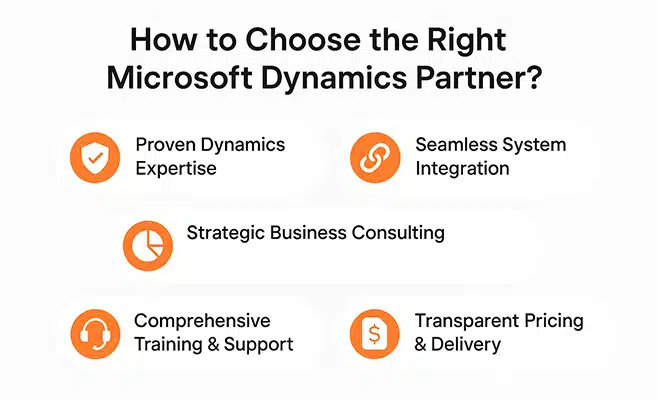
Choosing a consulting partner is not only about finding product expertise. It is about finding a team that can help your business make the right decisions before, during, and after a Dynamics project.
Many firms can talk about capabilities, modules, and delivery models. What separates a reliable partner is how they work when the project gets real: when requirements shift, timelines tighten, and business teams need clear direction.
Microsoft Dynamics Consulting is more than technical support. A strong partner helps align the platform with business goals, reduce delivery risk, and build a solution that works in practice, not just in presentations.
A reliable partner starts with your business, not the software
One of the clearest signs of a good consulting partner is how they begin the conversation.
A weak partner jumps straight into demos, modules, and implementation timelines. A reliable one first tries to understand your business model, current challenges, growth plans, and internal constraints.
They should ask practical questions early
You should expect questions like:
- What is not working well today?
- What business outcomes are you trying to improve?
- Which teams will be affected most?
- What systems are already in place?
- Where are the biggest reporting, process, or visibility gaps?
- How ready is the business for change?
These questions matter because a Dynamics project should solve business problems, not just replace one system with another.
They bring structure to the decision-making process
Many companies underestimate the number of decisions involved in a Dynamics project. Priorities need to be set. Scope needs to be controlled. Trade-offs need to be made. Internal alignment needs to happen across business and technical teams.
A reliable consulting partner helps bring order to that process.
They help define what matters most
This includes helping you clarify:
- Business priorities
What should the project improve first?
- Scope boundaries
What belongs in phase one, and what should wait?
- Success measures
How will you know the project is delivering value?
- Delivery risks
What could slow the project down or affect outcomes?
This kind of guidance is valuable because businesses often do not struggle from lack of ideas. They struggle from lack of clarity.
They do not agree with everything too quickly
Some partners try too hard to be easy to work with in the early stage. They say yes to every request, promise aggressive timelines, and position every requirement as simple.
That usually creates bigger problems later.
A good partner should challenge weak decisions
You should expect a reliable partner to push back when needed, especially around:
- Unnecessary customization
- Unrealistic timelines
- Unclear requirements
- Poor data assumptions
- Weak testing plans
- A scope that keeps expanding without control
This is not a sign that they are difficult. It is a sign that they are protecting the project.
They understand process, not just features
Dynamics projects fail when the focus stays too close to software and too far from real business flow.
A reliable partner should understand how work moves through your organization, where handoffs break down, where manual effort is too high, and where reporting lacks trust.
They should be able to connect platform decisions to business outcomes
That may include conversations around:
- Finance workflows
How approvals, reporting, and controls should work.
- Operational processes
How orders, inventory, procurement, or delivery flow across teams.
- Customer-facing processes
How sales, service, and marketing interact with shared data.
- Management visibility
What leadership needs to see to make decisions faster.
This is what makes consulting valuable. It is not only about knowing the tool. It is about knowing how to apply it.
They are clear about what delivery will actually involve
A good partner does not make implementation sound overly simple. They explain the real work involved and the role your business will need to play.
You should expect transparency around:
- Internal involvement
Who from your side needs to participate and when?
- Data effort
How much cleanup, validation, and migration work may be needed?
- Testing
What business teams will need to review before go-live?
- Change management
How will users be prepared for new ways of working?
- Support after launch
What happens once the system goes live?
This honesty is important. Many project issues begin when the business assumes the partner will handle everything with minimal internal effort.
They communicate in a way that the business can follow
Consulting quality is often visible in communication before anything is delivered.
A reliable partner should be able to explain decisions clearly, flag risks early, and keep both business and technical stakeholders aligned. They should not rely on vague updates or overly technical language that makes people feel informed without actually giving clarity.
Good communication usually looks like this
- Clear meeting outcomes
- Documented next steps
- Direct answers to hard questions
- Realistic discussion of trade-offs
- Early escalation when something is off track
When communication is strong, projects move with less confusion and fewer surprises.
They balance standardization and flexibility
This is one of the most important expectations of a reliable partner.
Some partners over-customize because it feels easier to say yes. Others push standardization too hard without understanding what the business genuinely needs. Neither approach works well on its own.
A strong partner helps you find the right balance
They should help you decide:
- What should stay standard?
To reduce complexity and improve long-term maintainability.
- What can be configured?
To support the business without adding heavy development.
- What truly needs customization?
Only where there is a strong operational or competitive reason.
This protects the project from becoming too expensive, too rigid, or too difficult to support later.
They care about adoption, not just go-live
A system can go live and still fail to deliver value if users do not trust it, understand it, or use it properly.
A reliable consulting partner thinks beyond deployment. They know the project is only successful when teams can work effectively in the new environment.
That means they should pay attention to:
- Role-based training
- User readiness
- Process clarity
- Support during early live use
- Feedback after launch
- Improvements after stabilization
This matters because adoption is where business value becomes real.
They offer support that continues after implementation
A dependable partner should not disappear once the main project is complete. Go-live is usually the point at which live business pressure begins to reveal small issues, process gaps, and support needs.
You should expect clarity on post-go-live support
This may include:
- Hypercare
Focused support during the first days or weeks after launch.
- Issue resolution
A defined way to log, prioritize, and resolve problems.
- Optimization support
Help with improvements once the business fully starts using the system.
- Ongoing advisory help
Guidance on future phases, refinements, or scaling needs.
This kind of support is often what separates a partner from a vendor.
They think long-term
The strongest consulting partners do not treat the project as a single transaction. They consider how the solution will hold up as the business grows, changes, and takes on new needs over time.
Long-term thinking shows up in better decisions
For example:
- Avoiding unnecessary complexity now
- Designing for future scalability
- Building cleaner reporting foundations
- Reducing dependency on fragile workarounds
- Setting the business up for future phases
That perspective matters because short-term shortcuts often become long-term problems.
What businesses should listen for in early conversations
You can often tell a lot about a consulting partner before the project even begins.
Pay attention to whether they:
- Ask thoughtful questions
- Explain things clearly
- Acknowledge risk honestly
- Challenge weak assumptions
- Focus on business outcomes
- Talk about adoption and support, not just configuration
- Make the process easier to understand, not harder
These signals are usually more valuable than polished presentations alone.
Final thoughts
A reliable Microsoft Dynamics consulting partner should bring more than technical skill. They should bring structure, judgment, clarity, and a strong understanding of how business needs connect to platform decisions.
The best partners help you define priorities, challenge poor choices, reduce risk, and support the business well after go-live. They do not just deliver a system. They help build a solution the business can actually use, trust, and grow with.