Is the “Climate Battery” Concept the Most Elegant Passive Energy System in Modern Agriculture?

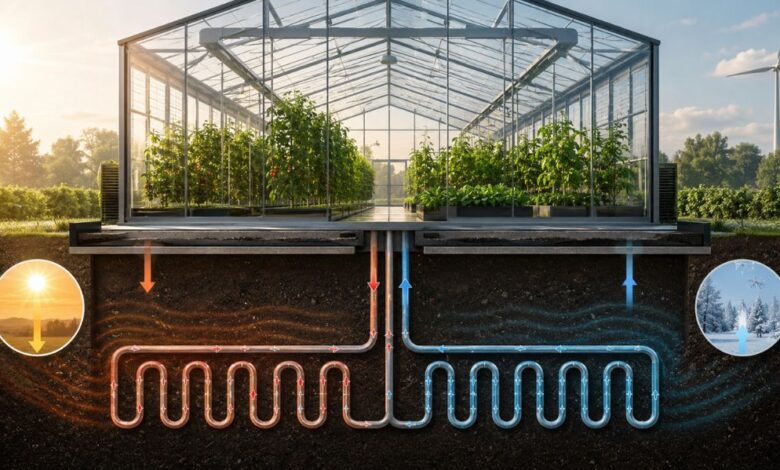
The word “battery” in an agricultural context tends to summon images of solar panels and lithium storage — the technology stack that has transformed grid-scale energy management and is increasingly being adapted for farm use. But there is a different kind of battery operating in a growing number of greenhouse facilities across North America and Europe, one that requires no lithium, no panels, no inverters, and no grid connection to charge. It is made of dirt. It has been storing and releasing energy since before any building was placed above it. And the engineering required to harness it involves buried pipes, fans, and the same thermodynamic principles that make the ground a more reliable thermal reference point than any manufactured material currently in use.
The climate battery — sometimes called a ground-to-air heat transfer system — is a passive climate management strategy that uses the thermal mass of the earth beneath a greenhouse to regulate interior temperatures across the full cycle of a growing season. Understanding why it works requires a brief detour into how the ground stores heat, which turns out to be one of the more surprising and underappreciated facts about the physical environment most of us walk across every day.
Why the earth remembers what happened months ago.
Soil at the surface is thermally volatile. It heats rapidly in sunlight and cools rapidly at night, tracking daily and seasonal temperature swings with relatively short lag times. But this surface volatility doesn’t extend far. A few feet down, daily temperature variation has almost completely disappeared. At a depth of four to six feet in most temperate locations, the soil temperature reflects the annual average surface temperature of that location — not the current season, not the current week, not the current day. The ground at this depth in most of North America sits at roughly 50 to 58 degrees Fahrenheit year-round, regardless of surface conditions.
This depth stability exists because the earth’s thermal mass is enormous. Heating or cooling it requires moving vastly more energy than changing the temperature of the air above it. Daily solar cycles don’t have enough energy to penetrate to meaningful depths. Seasonal cycles — which carry far more total energy — do affect subsurface temperatures, but on a delayed schedule. The peak warmth of summer, accumulated in the shallow soil layers, doesn’t reach maximum depth until late fall or winter. The cold of winter doesn’t fully penetrate until spring. The result is that the ground at depth is almost always out of phase with the surface conditions above it — warmer than the surface in winter, cooler than the surface in summer.
That phase inversion is exactly the thermal profile a greenhouse needs.
How the climate battery harvests and deploys stored energy.
A ground-to-air heat transfer system works by moving greenhouse air through a buried pipe network, creating contact between the air and the earth that surrounds the pipes. In summer, when the greenhouse is hot and the earth is cooler than the air, fans push warm humid air through the buried pipes. The air transfers heat to the cooler soil, and the moisture in the air condenses on the pipe surfaces as it cools. The air that returns to the growing space is measurably cooler and drier than what entered the system. The earth below has absorbed excess solar energy that the greenhouse collected but couldn’t use.
In winter, the process reverses. Cooler greenhouse air moves through the same pipe network, now contacting earth that has accumulated months of stored summer heat. The air picks up warmth from the soil and returns to the growing space at a higher temperature, without any combustion, without any purchased fuel, and without any energy input beyond the small amount required to run the circulation fans.
The thermal mass that was charged in July discharges in January. The system requires no grid-scale battery chemistry, no phase-change materials, and no specialized storage infrastructure. The storage medium is the ground itself, which has been available at every greenhouse site in every climate since before anyone thought to use it this way.
The dehumidification benefit that experienced growers value most.
For many commercial and research greenhouse operators, the humidity management function of a ground-to-air system is ultimately as valuable as the thermal function — and in some crop contexts, more so. Greenhouse environments accumulate humidity continuously: transpiration from plant leaves, evaporation from growing media and irrigation, and the limited air exchange that sealed or lightly ventilated structures permit all push relative humidity toward levels that create serious disease pressure.
Botrytis, powdery mildew, and a range of other fungal pathogens thrive in the warm, still, humid air conditions that greenhouse environments naturally produce without active management. Mechanical dehumidifiers address the symptom effectively but at significant energy cost — they run continuously in humid climates and during the heavy growing season, adding substantially to operating expenses.
A GAHT Greenhouse Heat Exchanger addresses the humidity source passively. As warm humid air contacts the cooler pipe surfaces underground, moisture condenses and drains into the surrounding soil, removing it from the growing environment without any mechanical dehumidification cycle. The returning air is drier, and the disease pressure that high humidity enables is reduced at the source rather than managed after it accumulates.
Growers who have operated season-round with ground-to-air systems consistently report that disease pressure is noticeably lower than in comparable structures relying exclusively on mechanical climate control — a benefit that translates directly into reduced crop losses, reduced pesticide inputs, and improved produce quality.
Why the elegance of the system is its own argument.
There is a class of engineering solutions that work through alignment with natural processes rather than against them — that take the behavior of the physical environment and redirect it slightly rather than overcoming it with brute mechanical force. Passive solar design is one. Natural ventilation is another. The climate battery belongs in this category, and its elegance is not merely aesthetic.
A system that harvests energy when it is abundant, stores it in a medium that has infinite available capacity, and releases it when demand occurs — without any stored fuel, any combustible material, any complex control logic, or any moving parts except fans — is not just energy-efficient. It is resilient in ways that systems depending on fuel supply chains, utility connections, or complex mechanical infrastructure are not. The earth beneath a well-designed greenhouse keeps working through power outages, supply disruptions, and the operational variability that any growing enterprise must navigate.
The climate battery concept doesn’t solve every thermal challenge in every climate. Extreme cold requires supplemental heat. High humidity in maritime climates may require additional mechanical dehumidification. But as a foundational layer in a greenhouse energy strategy — reducing the base load that supplemental systems must carry, extending the shoulder seasons in which no supplemental heat is needed at all, and managing humidity passively rather than mechanically — it is as close to an ideal agricultural energy system as current engineering has produced.
Dirt, pipes, fans, and thermodynamics. The most elegant passive energy system in modern agriculture may have been under our feet all along.