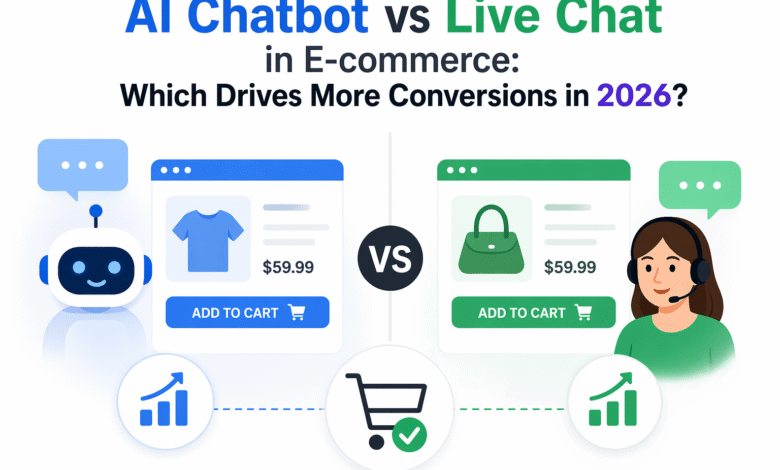
E-commerce conversion is no longer just about traffic. It is about how quickly and effectively you respond when a buyer shows intent. The moment a user hesitates, asks a question, or pauses at checkout, that interaction decides whether a sale happens or not. This is why the debate around AI chatbot vs live chat on e-commerce still matters. Not because one replaces the other, but because each influences a different stage of the buying journey. The real question is not which tool is better in isolation, but how each contributes to conversion outcomes.
An AI Chatbot or A Live Chat for Sales: Which is better?
There is no single winner. The answer depends on the type of interaction. The difference is not in capability. It is context.
AI chatbots work best when there are many similar questions coming in. They reply instantly, stay active all day and night, and manage thousands of chats at the same time. This helps capture user intent early, answer basic queries quickly, and keep users engaged before they lose interest.
Live chat works best in high-value or complex sales where human judgment is needed. When buyers feel unsure, need negotiation, or want trust, a real person makes a difference. Human interaction answers detailed concerns, gives clear guidance, and builds confidence, which helps users move forward and complete the purchase.
What the Data Actually Shows
If you look at the chatbot vs live chat conversion rate, the gap is not as simple as it seems.
AI chatbot:
- Conversion increase can reach 30 per cent
- Cart recovery falls between 20 and 35 per cent
- Reply speed stays under 2 seconds
Live chat:
- Conversion lift stays near 20 per cent
- Cart recovery ranges from 10 to 15 per cent
- Response time takes 1 to 3 minutes
The numbers highlight a pattern. AI wins on speed and scale. Live chat wins on depth and trust.
How to Increase E-commerce Conversions with an AI Chatbot
AI chatbots improve conversions by removing friction early in the journey. They do not wait for users to ask. They engage when behavior signals intent.
Here is how they drive results:
- Detect hesitation during checkout and intervene in real time
- Answer product or delivery questions instantly
- Guide product discovery by narrowing choices quickly
- Stay active across all hours, capturing demand outside business time
This is why many businesses use an AI chatbot for e-commerce customer support as the first layer of interaction. It ensures no query goes unanswered and no intent is lost due to delay.
Where Live Chat Still Drives Conversions
Live chat plays a different role in the conversion journey. It helps close deals where human judgment matters. It works best when the purchase value is high, the product needs explanation, or the customer feels unsure. In such moments, decisions are not just logical. They depend on clarity, trust, and confidence built during the interaction.
In these situations, live chat support for online stores becomes critical. A human agent can adjust tone, respond to concerns, and guide decisions based on context. This builds reassurance that automation alone cannot provide. Conversion here is not driven by speed alone. It depends on how comfortable the customer feels before completing the purchase.
Customer Preference: Chatbot vs Live Agent
Customer behavior is not fixed. It changes based on need. Customers’ preference between chatbot and live agent typically follows a simple pattern:
For quick answers, users prefer chatbots
For fast responses, users turn to an AI chatbot for online stores. They handle simple queries like cost, stock status, and delivery details right away, without queues or delays, and remain available at any time of the day.
For complex or sensitive queries, users prefer humans
When users face confusion, complaints, or expensive decisions, they prefer human support. They want clear answers, reassurance, and responses based on context so they can feel sure before making the next move.
Most users do not think in terms of tools. They think in terms of outcomes. If they need speed, they choose automation. If they need clarity or trust, they look for a person. This is why forcing one approach across all interactions often leads to lower conversion performance.
The Real Strategy: Automated vs Human Customer Support in E-commerce
The real shift in 2026 is not choosing between tools. It is combining them. Automated vs. human customer support e-commerce works best when planned as a system to complement each other:
- AI handles first contact, FAQs, and routine queries
- AI monitors behavior and sentiment during the interaction
- High-value or complex cases are passed to human agents
- Full context is transferred, so the user does not repeat information
In most high-performing setups:
- AI manages around 80 percent of interactions
- Humans focus on the remaining 20 percent that directly impact revenue
This model does not just improve efficiency. It improves conversion outcomes across the entire funnel. Some platforms like GetMyAI are experimenting with this layered approach, where AI handles scale, and humans handle decision-critical moments.
Conclusion
Conversion in e-commerce is no longer driven by a single channel. AI chatbots increase speed, reduce friction, and capture early intent. Live chat builds trust, handles complexity, and closes high-value sales. The highest-performing businesses do not choose between them. They combine both into a single system that adapts to user needs. That is where consistent conversion growth actually comes from.