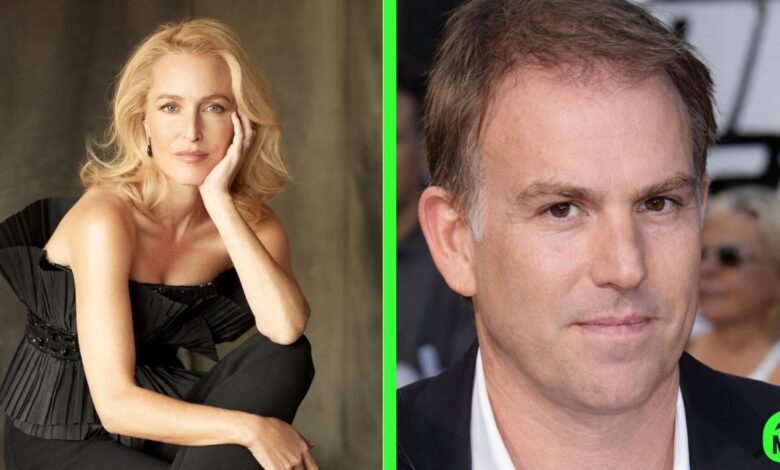
For decades, Gillian Anderson has occupied a rare space in global popular culture. As the actor who helped redefine television stardom through The X-Files, Anderson’s career has unfolded under constant public scrutiny, balanced by an equally visible commitment to activism, literature, and women’s health. Less visible, however, are the private relationships that have shaped her life away from the camera.
One such relationship was her marriage to Julian Ozanne, a British documentary filmmaker and former financial journalist. Their union, lasting from late 2004 to early 2006, represents a deliberately understated chapter in Anderson’s personal history. This article focuses on Julian Ozanne—not as a celebrity by association, but as a private individual whose life briefly intersected with global fame. Drawing only on verifiable public information, it explores who he is, what is known about his background, and what his relationship with Anderson reveals about privacy, partnership, and the choice to remain largely outside the spotlight.
Profile Summary
| Detail | Information |
| Full Name | Julian Ozanne |
| Known For | Documentary filmmaker; former journalist |
| Relationship Keyword | Julian Ozanne & Gillian Anderson |
| Marriage Duration | December 2004 – April 2006 |
| Spouse | Gillian Anderson |
| Nationality | British |
| Professional Background | Documentary film; journalism |
| Former Employer | Financial Times |
| Public Profile | Very limited |
| Social Media Presence | None publicly verified |
| Children | None publicly known |
| Residence | Not publicly disclosed |
Who Is Julian Ozanne?
Julian Ozanne is best described as a media professional who has consistently chosen substance over visibility. Public records and credible reporting identify him as a British documentary filmmaker and a former journalist with the Financial Times. Unlike many figures linked to international celebrities, Ozanne never sought a public-facing role through his marriage. His significance lies less in fame than in context: he represents a contrasting model of professional identity—one grounded in research, storytelling, and discretion rather than in celebrity culture.
His name entered broader public awareness primarily through his marriage to Gillian Anderson. Yet even at the height of that attention, Ozanne maintained a low profile. There are no personal interviews, memoirs, or media tours attached to his name. This absence is not a gap to be filled with conjecture but a meaningful choice that frames how his life should be understood.
The Private Life of Julian Ozanne
Julian Ozanne’s private life is notable precisely because it has remained private. In an era when personal narratives are often curated for public consumption, Ozanne’s approach stands out. Beyond confirmed professional affiliations and his marriage, little has been disclosed—and importantly, little has been contradicted.
From a journalistic perspective, this restraint suggests a deliberate boundary between personal identity and professional output. Documentary filmmakers often work behind the lens, prioritizing subjects over self. Ozanne’s limited public footprint aligns with that tradition. His privacy has not been punctured by controversy or correction, indicating consistency rather than concealment. The absence of social media, personal branding, or public commentary reinforces the impression of someone comfortable operating without external validation.
Early Life and Background of Julian Ozanne
Publicly available information about Ozanne’s early life is minimal. What is verifiable is his professional grounding in journalism, including work for the Financial Times, an institution known for rigorous editorial standards. That association alone places Ozanne within a professional culture that values accuracy, discretion, and credibility.
While specific details about his education or upbringing have not been publicly documented, his career trajectory suggests formal training and exposure to international perspectives. Journalism and documentary work often demand cross-cultural literacy, patience, and ethical judgment. These are inferred not as personal traits but as professional requirements reflected in the roles he held.
Marriage and Partnership with Gillian Anderson
Julian Ozanne and Gillian Anderson met in Kenya, a detail that hints at shared global interests rather than celebrity social circuits. They married in December 2004 on Lamu Island, a location known for its seclusion and cultural heritage rather than spectacle.
The marriage lasted approximately 16 months. In April 2006, their separation was announced through their lawyers, with a joint statement requesting privacy. There were no public disputes, interviews, or media narratives attached to the separation. For biographers, this is significant: it demonstrates a shared commitment to handling personal change without public escalation. The partnership, brief though it was, reflected alignment in values around discretion and mutual respect.
Julian Ozanne’s Role Behind the Scenes
There is no public record suggesting that Ozanne played a managerial or strategic role in Anderson’s career. Instead, his professional life appears to have remained separate from her acting work. This separation is itself revealing. Many celebrity marriages blur professional boundaries; this one did not.
Ozanne’s background in documentary filmmaking implies familiarity with long-term projects, patience, and behind-the-scenes collaboration. While no public statements describe his influence, the absence of crossover projects suggests intentional independence. Their relationship functioned as a partnership of equals rather than a merging of brands.
Family Life and Personal Values
Julian Ozanne has no publicly known children, and there is no evidence that he assumed a parental role in Anderson’s family beyond the private sphere. Anderson has spoken openly elsewhere about motherhood, but Ozanne has not engaged in public discussions about family life.
This silence should not be read as an absence but as boundaries. Family life, particularly when one partner is internationally famous, often becomes a site of public curiosity. Ozanne’s consistent refusal to participate in that curiosity reflects a value system that prioritizes personal integrity over exposure.
Philanthropy and Community Engagement
Unlike many public figures, Julian Ozanne does not maintain a visible philanthropic profile. However, this does not equate to disengagement. Documentary filmmaking and serious journalism are, in themselves, forms of public service—designed to inform, contextualize, and sometimes challenge.
Anderson’s own well-documented advocacy work exists independently of Ozanne, and there is no public evidence of joint initiatives. This separation again underscores autonomy rather than absence. Philanthropy does not always require naming rights or press releases; sometimes it operates quietly, aligned with professional ethics rather than public recognition.
The Power of Privacy: Influence Without Publicity
Julian Ozanne’s life illustrates how influence can exist without visibility. By remaining private, he has avoided the distortions that often accompany celebrity adjacency. His reputation rests on verified professional associations rather than speculation.
In biographical terms, this choice complicates narrative-building—but it also clarifies values. Privacy here is not evasive; it is consistent. It allows public figures like Anderson to have relationships not defined by audience reaction. In that sense, Ozanne’s influence is structural rather than performative.
Public Curiosity and Misconceptions
Public curiosity about Julian Ozanne largely stems from his marriage to Gillian Anderson. This curiosity sometimes leads to misconceptions, including exaggerated assumptions about wealth, influence, or ongoing connection. Verified facts do not support such narratives.
What is clear is that their relationship ended respectfully and privately. Any attempt to extend the story beyond those facts risks turning absence into invention—something this account deliberately avoids.
Legacy and Future
Julian Ozanne’s legacy is not one of celebrity but of professional credibility and personal restraint. His future, insofar as it is publicly visible, remains aligned with that pattern. There are no announcements, rebrandings, or public reinventions attached to his name.
In a media culture driven by exposure, this quiet continuity may be his most defining characteristic.
Conclusion
Julian Ozanne occupies an unusual biographical space: known, yet not exposed; connected to fame, yet untouched by its excesses. His marriage to Gillian Anderson was a brief but instructive chapter, illustrating how two public lives can intersect without becoming spectacle. Based on verified information, Ozanne emerges not as a mystery to be solved but as an example of intentional privacy. His story reminds us that not every meaningful life leaves a loud public trace—and that restraint, in itself, can be a lasting legacy.
Read this too:Piper Maru Klotz: A Life Shaped by Art, Privacy, and a Famous Legacy
(FAQs)
- Who is Julian Ozanne?
A British documentary filmmaker and former Financial Times journalist. - When were Julian Ozanne and Gillian Anderson married?
From December 2004 until April 2006. - Where did they get married?
On Lamu Island, Kenya. - Why did they separate?
The separation was mutual; no public reasons were disclosed. - Does Julian Ozanne have children?
None is publicly known. - Is Julian Ozanne active on social media?
No verified public accounts exist. - Did Julian Ozanne work in entertainment?
Yes, in documentary filmmaking, not acting. - Is Julian Ozanne still connected to Gillian Anderson?
There is no public indication of ongoing personal or professional ties.