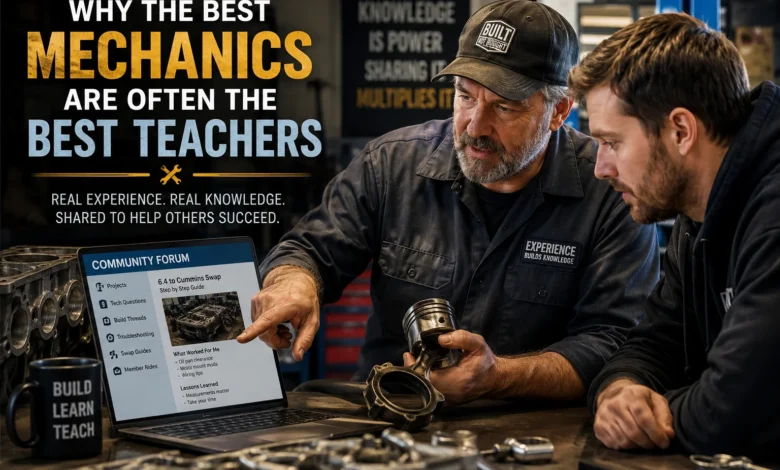
Walk into any online forum built around a specific truck platform, and you’ll find something that looks a lot like an apprenticeship happening in public. Experienced builders answer detailed questions from strangers, share photos of failed attempts alongside successful ones, and document processes that took them years to figure out through trial and error. This culture of open knowledge-sharing has quietly become one of the most valuable resources available to anyone tackling a serious DIY mechanical project.
Tribal Knowledge Used to Stay Locked in Local Shops
Before online communities became the default place to research a project, specialized mechanical knowledge tended to stay contained within local shops and small circles of enthusiasts who knew each other personally. A mechanic who figured out a clever workaround for a stubborn problem had little reason or means to share that solution beyond their own customers. Valuable knowledge existed, but it was scattered and hard to access unless you happened to know the right person.
This created real inefficiency. Countless people independently solved the same problems, wasting time and money reinventing solutions that already existed somewhere else, simply because there was no practical way to find them. The knowledge was never truly lost, but it was effectively invisible to anyone outside a narrow circle.
Forums and Communities Changed Who Gets Access to Expertise
Online communities dismantled that barrier. A builder working through a difficult project can now search years of accumulated posts from people who faced the exact same challenge, often finding detailed, step-by-step accounts of what worked and what didn’t. This access has leveled the playing field considerably between someone with professional training and someone learning entirely through hands-on experience and community research.
This shift has been especially meaningful for niche, highly specific projects where professional expertise is scarce or expensive to access directly. A builder attempting something unusual can draw on the collective experience of everyone who has attempted something similar before, compressing what might have taken years of independent trial and error into a much shorter, more informed learning curve.
Detailed Documentation Benefits the Documenter Too
Experienced builders who take the time to document their projects thoroughly, often assume they are doing it purely for others. In practice, the habit of writing clear, detailed documentation tends to sharpen the builder’s own understanding of what they did and why. Explaining a process well enough for someone else to follow forces a level of clarity that shortcuts and mental shortcuts do not require when working alone.
This is a well-recognized pattern beyond mechanical hobbies. Teaching a skill to someone else consistently deepens the teacher’s own mastery of it, partly because gaps in understanding become obvious the moment you try to explain something clearly. Builders who document generously for their community often report that the process helped them catch mistakes or reconsider decisions they might have otherwise overlooked.
Specificity Makes Community Knowledge More Valuable
General advice has limited value in mechanical work, where success often depends on details specific to a particular platform, model year, or combination of components. The value of community knowledge increases dramatically when it addresses these specific combinations rather than staying at a generic level.
This specificity is exactly why niche project communities, built around a particular platform rather than mechanical work in general, tend to produce more useful information than broader automotive forums. A builder researching something as specific as a Ford® 6.4 to Cummins® swap benefits far more from a community focused on exactly that kind of conversion than from a general diesel truck forum where the specific combination of components rarely comes up in enough detail to be genuinely useful.
Reputation Systems Help Separate Good Advice From Bad
Not all community advice holds equal weight, and healthy communities develop informal reputation systems that help newer members identify who genuinely knows what they’re talking about. Contributors who consistently post accurate, detailed, well-documented information build credibility over time, while advice from anonymous or inexperienced sources gets appropriately scrutinized before anyone acts on it.
This self-correcting quality is one of the underappreciated strengths of long-running communities. Bad advice does not simply disappear, but it tends to get challenged, corrected, or contextualized by more experienced members, which gives newcomers a reasonable way to filter signal from noise if they take the time to read enough of the surrounding discussion.
Community Knowledge Rewards Active Participation
The builders who benefit most from these communities are rarely passive readers. They ask specific questions, share their own progress even when things go wrong, and contribute back once they’ve solved a problem themselves. This active participation creates a reciprocal relationship that keeps the community’s collective knowledge growing, rather than treating it as a one-way resource to extract information from without ever contributing anything back.