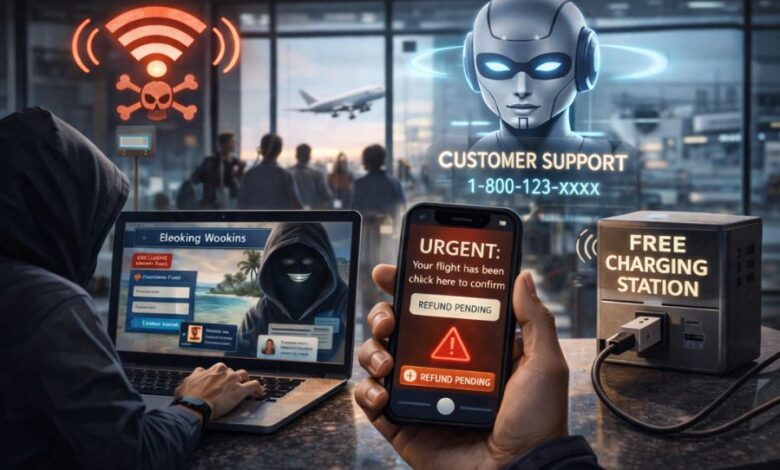
Travel has always attracted scammers, but generative AI has raised the quality and efficiency of the con. What used to look like obvious spam now presents as polished booking pages, believable “support” chats, and emails that read like they were written by a competent brand manager. Some scams even piggyback on AI-powered search summaries by surfacing fake customer-service numbers, pushing travellers toward criminals when they are already stressed and low on time.
1) Malicious or Rogue Public Wi-Fi Networks
Public Wi-Fi remains a goldmine for scammers because it is crowded with distracted people. Attackers set up “evil twin” hotspots that mimic legitimate airport or café networks, then intercept traffic or redirect victims to convincing login portals. AI helps here by generating realistic captive pages, error messages, and instructions that reduce suspicion and speed up compliance.
A safer pattern is to disable auto-join, confirm network names with staff when possible, and avoid sensitive logins on public networks. When secure access is necessary, travellers benefit from relying on a mobile hotspot or a trusted, encrypted connection.
2) Fake Booking Websites and Travel Scams
Look-alike booking sites are evolving fast. Cloned domains, copied layouts, and AI-written copy can produce a near-perfect replica of a legitimate airline, hotel, or rental page. The scam is not always a fake checkout, either. Some pages aim to collect passport details, loyalty logins, or a “verification” photo of ID.
The simplest defence is disciplined verification. Travelers who type URLs directly, double-check domain spelling, and avoid deal links pushed through messages or unfamiliar ads reduce exposure significantly. In the broader travel fraud landscape, industry analysis has also flagged generative AI as a force multiplier for convincing phishing and brand impersonation.
3) Mobile-Device Targeting Through Malware and SIM-Based Attacks
Phones are the travel hub. They hold boarding passes, maps, wallets, and authentication codes. That makes them a prime target for malware, credential theft, and SIM-based attacks that intercept messages and one-time codes. Generative AI adds realism to texts that claim a flight has changed, a refund is pending, or a hotel needs “urgent reconfirmation.”
Strong device passcodes, up-to-date software, and cautious behaviour around links and attachments will always reduce risk. Travelers also benefit from limiting app permissions and turning off unnecessary location sharing, which reduces trackable movement data.
4) Risky Charging Stations and Shared Devices
Public USB ports and shared computers can introduce silent compromise, including malware delivery or keystroke logging. Charging via a wall outlet with a personal adapter, using a power bank, or carrying a data-blocking USB adapter reduces exposure.
Secure Connections
When privacy tools enter the conversation, many ask what is a vpn vs proxy? A proxy typically reroutes traffic for a specific app or browser, while a VPN encrypts traffic between the device and the VPN service, which is more protective on risky networks.
A final, quietly “green” note: avoiding fraud prevents waste. Scams trigger rebookings, extra transport, extra support calls, and extra device churn. Cleaner digital habits support safer travel and reduce the hidden resource cost of fixing problems that never needed to happen.