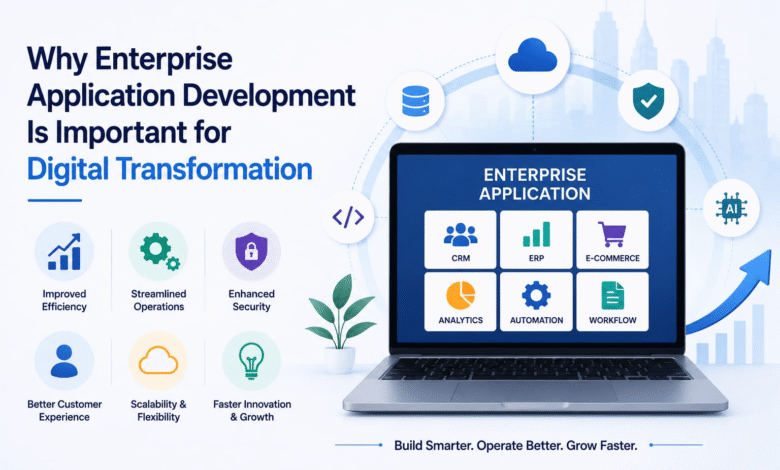
Digital transformation has become a major priority for businesses looking to improve efficiency, customer experiences, and long-term competitiveness. As organisations continue adopting digital technologies, many are investing in enterprise application development to modernise operations and support business growth.
Traditional systems and disconnected workflows often create operational inefficiencies that limit scalability and innovation. Enterprise applications help businesses centralise processes, improve collaboration, and build flexible digital infrastructures that support changing business demands.
From automation and data management to customer engagement and operational visibility, enterprise application development plays a critical role in helping organisations adapt to a rapidly evolving digital environment.
Understanding Enterprise Application Development
Enterprise application development involves creating large-scale software solutions designed to support complex business operations and organisational workflows.
Unlike standard applications, enterprise systems are built to manage:
- Large volumes of data
- Multiple departments and users
- Business-critical operations
- Integrated workflows
- Scalable infrastructure requirements
Enterprise applications are often customised to align with specific operational goals, industry requirements, and long-term business strategies.
Common examples include:
- Customer relationship management systems
- Enterprise resource planning software
- Business process automation platforms
- Employee management systems
- Supply chain management solutions
- Internal communication portals
These applications help organisations streamline operations and improve overall business efficiency.
Supporting Digital Transformation Goals
Digital transformation focuses on improving business processes and customer experiences through technology adoption. Enterprise application development services provide the technical foundation needed to support this transformation.
Modern enterprise applications help organisations:
- Replace outdated manual processes
- Improve workflow automation
- Centralise business data
- Enhance operational visibility
- Improve collaboration between teams
Businesses that modernise their internal systems are often able to respond more quickly to changing market conditions and customer expectations.
Improving Operational Efficiency
Many organisations still rely on fragmented systems that create duplicate work, communication gaps, and delays in decision-making.
Enterprise applications help improve operational efficiency by integrating different business functions into a unified digital environment.
This allows businesses to automate repetitive tasks, reduce manual errors, and improve productivity across departments.
For example, an integrated enterprise application can connect customer data, inventory management, finance operations, and reporting systems within a single platform.
As a result, teams gain faster access to information and can make more informed business decisions.
Better Data Management and Reporting
Data has become one of the most valuable business assets in today’s digital economy. However, managing large volumes of information across disconnected systems can be challenging.
Enterprise applications provide centralised data management systems that improve data accessibility, accuracy, and reporting capabilities.
Businesses can use enterprise platforms to:
- Monitor operational performance
- Track customer behaviour
- Generate real-time reports
- Analyse business trends
- Improve forecasting and planning
Access to reliable business intelligence helps organisations make faster and more strategic decisions.
Enhancing Customer Experience
Customer expectations continue to rise as digital experiences become more important across industries.
Enterprise applications help businesses improve customer interactions by enabling faster response times, personalised services, and more efficient support systems.
Integrated customer management solutions allow businesses to maintain consistent communication across multiple channels while improving service quality and customer satisfaction.
A better customer experience often leads to stronger customer retention and improved brand reputation.
Scalability and Flexibility
As businesses grow, their operational requirements continue to evolve. Enterprise applications are designed with scalability in mind, allowing organisations to expand functionality as needed.
Scalable enterprise systems can support:
- Increased user activity
- Growing customer bases
- New services and products
- Additional integrations
- Multi-location operations
This flexibility allows businesses to adapt their digital infrastructure without major disruptions or complete system replacements.
Strengthening Security and Compliance
Modern businesses manage large amounts of sensitive customer and operational data. Enterprise application development allows organisations to implement security measures tailored to their industry and compliance requirements.
Security-focused enterprise applications may include:
- Role-based access controls
- Data encryption
- Secure authentication systems
- Audit tracking
- Compliance monitoring
Strong security practices help businesses reduce cybersecurity risks and maintain customer trust.
Competitive Advantage Through Innovation
Businesses that invest in modern enterprise applications are often better positioned to innovate and improve operational agility.
Digital transformation supported by enterprise development enables organisations to introduce new services, improve efficiency, and respond faster to changing market trends.
Companies with scalable digital infrastructures are more likely to maintain long-term competitiveness in increasingly digital industries.
Final Thoughts
Enterprise application development has become an essential part of digital transformation strategies for modern businesses. By improving operational efficiency, data management, scalability, and customer experiences, enterprise applications help organisations build stronger and more adaptable digital ecosystems.
As businesses continue to modernise their operations, enterprise application development will remain a key investment for supporting innovation, efficiency, and long-term business growth.