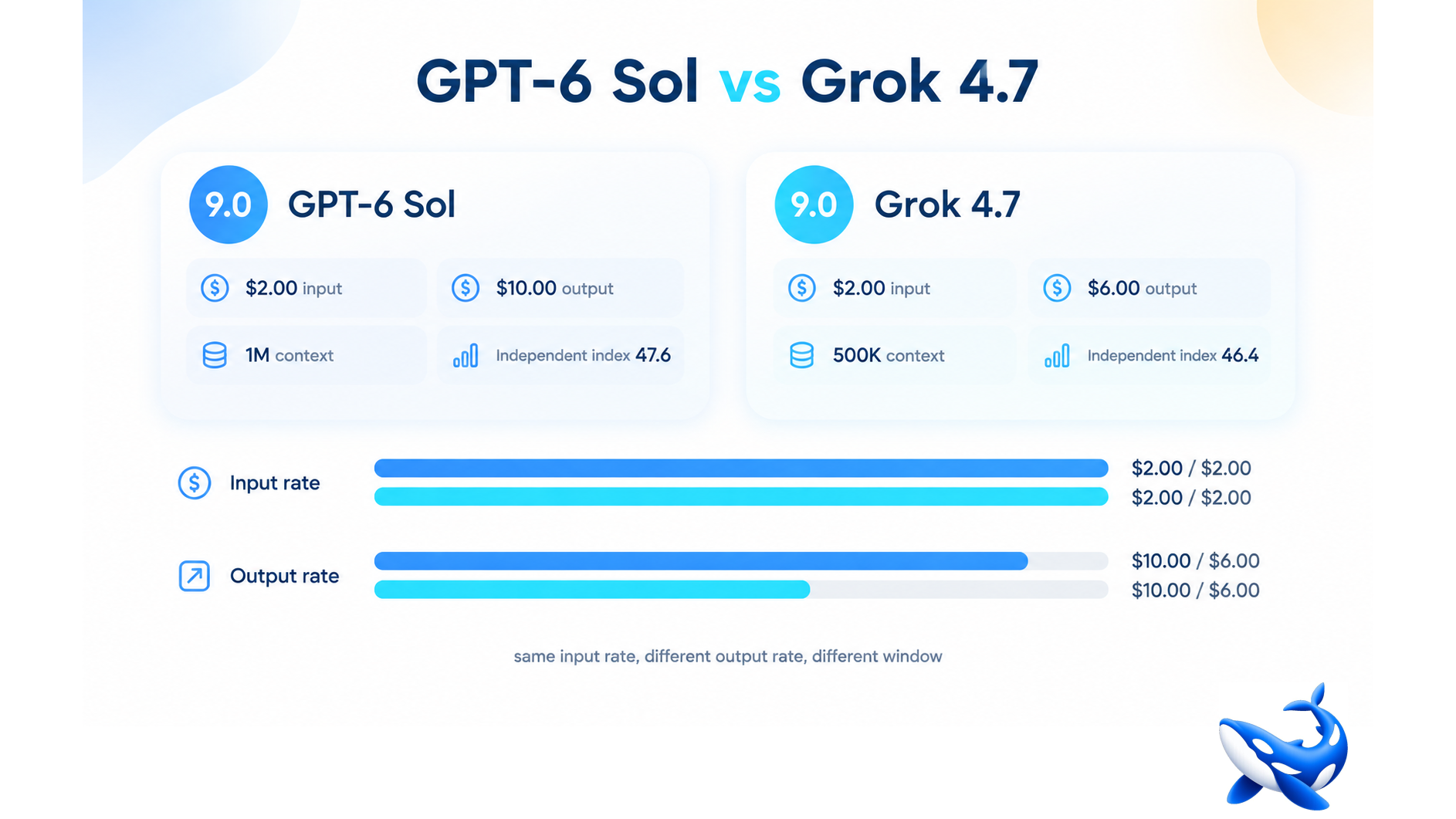
The column most comparison pages lead with is the one that does no work on this page. GPT-6 Sol and Grok 4.7 charge exactly the same $2.00 per million input tokens, which means on OrcaRouter the GPT-6 Sol vs Grok 4.7 comparison has to be decided on output rates and capacity instead. That turns out to be a more interesting question, because the two cards disagree on both — and this is the one pair in our set where a third-party index is published alongside our own numbers, which gives the page a second opinion on the quality column.
Both cards, read off the page
Read on 2026-10-13:
| metric | GPT-6 Sol | Grok 4.7 | gap |
| input, per million tokens | $2.00 | $2.00 | identical |
| output, per million tokens | $10.00 | $6.00 | Grok is 40% cheaper |
| output-to-input multiple | 5.0x | 3.0x | Grok bills more gently |
| context window | 1M | 500K | Sol holds twice as much |
| composite quality, 0–10 | 9.0 | 9.0 | tie |
Tied input, tied score, and a trade on the other two rows. GPT-6 Sol charges more for generated tokens — $10.00 against $6.00, and at a 5.0x multiple against 3.0x, so the output gap compounds as your workload writes more. Grok 4.7 charges less on output but holds half the context window. Neither of those is a footnote: they are the two rows that decide most production routing, and they point at different cards.
The index that agrees they are close
Our composite quality column is ours: a 0–10 figure we compute from four families of evaluation we run against each endpoint — reasoning, code generation, long-context retrieval and instruction following — averaged into one number. It is not a third-party leaderboard, and no other team can reproduce it on their own harness.
This page is one of the few where an independent intelligence index is published alongside it, and the two sources tell a consistent story about the size of the gap. GPT-6 Sol records 47.6, fourteenth of 147 models tracked. Grok 4.7 records 46.4, sixteenth of the same 147. Our own composite puts both at 9.0. Measured two entirely different ways, the two cards land within a point and a half of each other and two rank positions apart.
That agreement is what makes the quality column safe to discount here. When an independent index and our own scale both say two cards are level, the chance that a capability difference is hiding behind the tie goes down considerably — and it means the decision genuinely does fall to the price and capacity rows, which is exactly where the two cards diverge.
What the 5.0x against 3.0x actually does
The output multiple is the row that gets skimmed and should not be, because it changes the shape of the gap rather than its size. GPT-6 Sol bills generated tokens at five times its input rate; Grok 4.7 bills them at three. On a read-heavy pipeline — long documents in, short structured answers out — almost all of your tokens hit the input line, where the two cards are identical, and the multiples barely matter. On that shape the pair is close to a coin flip on price, and Grok 4.7’s 500K window becomes the thing to check against your document sizes.
On a write-heavy pipeline the picture changes direction and magnitude at once. Reasoning chains, agent traces, long-form generation and code synthesis all push the output line to the centre of the bill, and there Grok 4.7’s $6.00 against GPT-6 Sol’s $10.00 is a 40% difference that widens further because the card charging less also multiplies less. The two effects stack: a lower base rate and a gentler multiple, both on the same card.
The window, and the cost of getting it wrong
Capacity is the other structural difference, and it is the one that fails quietly. Eight of the twelve models we price carry a 1M context window; Grok 4.7’s 500K puts it in a second tier that also holds Kimi K2.6 at 262K and MiniMax M2.7 highspeed at 205K. GPT-6 Sol carries 1M — the largest figure we list.
A window that is too small does not announce itself. It forces chunking, and chunking means reading overlapping spans more than once. Read a document twice to work around a window that will not hold it and you have paid the input rate twice, which on Grok 4.7 is $4.00 per million instead of $2.00 — and that is before the output line, where the workaround can also inflate generated tokens as the model re-establishes context. Whether 500K is enough is a question about your document distribution, and it is the one question on this page a comparison cannot answer for you.
Priced on a matched pair
Read a million tokens and write a million through each card. GPT-6 Sol bills $12.00. Grok 4.7 bills $8.00. The difference is $4.00 on a single matched pair, and it grows toward the output line as your workload writes more — at a 50/50 mix the gap is a third of Grok 4.7’s bill, and on a fully write-weighted pipeline it approaches double.
Read it the other way and the same arithmetic is the case for GPT-6 Sol: the $4.00 is what 1M of context costs. If your documents routinely run past 500K, chunking is not a tuning detail — it is a second pass over overlapping spans on every request, and the surcharge for a single-pass architecture can exceed the output-rate saving depending on how the re-reads land. Both numbers are real; which one applies is decided by your document sizes, not by the table.
The 9.0 band, and why the tie is not the story
Both cards sit at 9.0, the most crowded band in our twelve-model table — six of the twelve models we price land there, spanning input rates from $0.66 up to $4.00. A tie in that band is the narrowest kind of claim available: on the four families we run, neither card buys a measured capability advantage. It is not a claim that the two models behave alike, because an average across families flattens the shape of a failure, and two cards can both score 9.0 with entirely different weak spots.
The reason the tie matters less than usual here is that the page has a second measurement agreeing with it. Between our composite and the independent index, the honest conclusion is that these two cards are close enough on capability that capability should not drive the choice. What is left is $4.00 on a matched pair, a 40% output gap that widens on write-heavy traffic, and a 1M-against-500K window. Those are the three terms, and they are all yours to weigh.
The takeaway
GPT-6 Sol and Grok 4.7 charge identical input rates at $2.00 per million tokens and both score 9.0 on our composite, with an independent index placing them fourteenth and sixteenth of 147 — close enough on both measurements that quality is not the deciding column. They differ on output, where Grok 4.7’s $6.00 against $10.00 comes with a gentler 3.0x multiple, and on capacity, where GPT-6 Sol holds 1M against Grok 4.7’s 500K. On a matched million-in, million-out pair the bills are $12.00 and $8.00.
So the choice is a clean trade rather than a verdict. Write-heavy, short-output traffic belongs on Grok 4.7, and the gap widens the more you generate. Read-heavy traffic over documents that approach or exceed the smaller window belongs on GPT-6 Sol, where the $4.00 buys a single pass instead of a chunking layer. Both endpoints are live at list price behind a single key, so pricing your own token mix against them settles it in an afternoon.
Sourcing note: prices, context windows and output-to-input multiples were read off our own comparison page for this pair on 2026-10-13. The composite quality column is OrcaRouter’s own 0–10 scale, computed from four evaluation families we run against each endpoint, and is not a third-party index. The independent intelligence figures quoted above are published on the same comparison page and are attributed there to their own provider. The comparison page and the model page linked above are OrcaRouter production pages. All checked 2026-10-13.