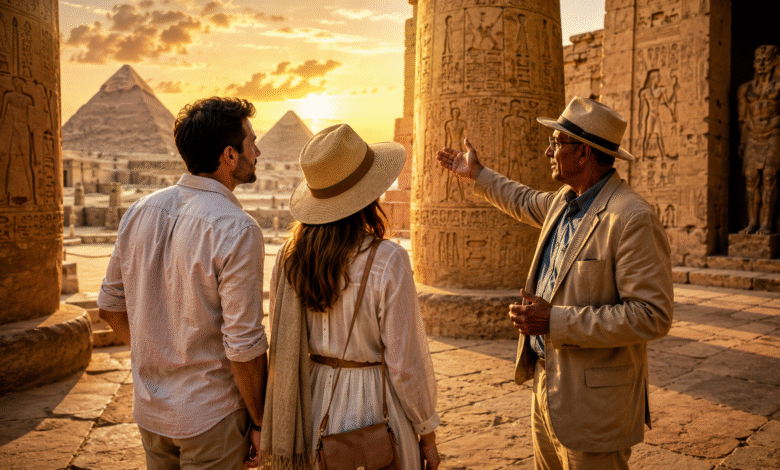
Imagine standing inside an ancient Egyptian temple while the morning light touches carved columns that have survived for thousands of years. Now imagine doing it without being rushed, without fighting for space in a crowd, and without trying to hear a guide speaking to fifty other travelers at once. This is the true difference that private archaeological tours in Egypt can offer.
Egypt is not just another travel destination. It is one of the world’s greatest open-air museums, home to pyramids, tombs, temples, royal cities, sacred landscapes, and stories that shaped human civilization. Yet many visitors only experience these wonders through fixed schedules and crowded group tours. A private journey changes everything. It gives you time, control, comfort, and direct access to expert knowledge.
For travelers who want more than sightseeing, a private archaeological tour creates a deeper connection with the ancient world. It allows you to follow your own interests, explore at your own pace, and discover Egypt through the eyes of a dedicated scholar. Whether you are fascinated by pharaohs, hieroglyphs, temple rituals, royal tombs, or ancient engineering, a private experience turns Egypt into a personal historical expedition.
The Power of Personalization: Why Go Private in Egypt?
A private tour is built around you. Instead of following a standard route designed for large groups, your itinerary can reflect your personal interests, travel style, comfort level, and preferred pace. This is especially valuable in Egypt, where every site has layers of history and meaning.
Some travelers want to focus on the famous monuments of Cairo and Luxor. Others want to go deeper into lesser-known sites such as Saqqara, Dahshur, Abydos, or Dendera. Families may want a balance of learning and comfort, while serious history lovers may prefer long, detailed discussions at each location. A tailor-made Egypt tour makes all of this possible.
With a private itinerary, you can spend more time at the places that move you most. If a painted tomb captures your attention, you can pause and absorb the details. If a guide explains a symbol that opens a new question, the route can naturally adapt. This freedom is one of the greatest luxuries of private archaeological travel.
Tailor-Made Itineraries: Designing Your Dream Antiquity Roadmap
A well-designed private tour begins before you arrive. Your interests shape the journey from the start. You may want to trace the full story of pyramid development, beginning at Saqqara and continuing to Dahshur and Giza. You may prefer to focus on the New Kingdom, with deep exploration of Luxor, Karnak, the Valley of the Kings, and the Valley of the Queens.
For travelers who want a broader experience, the itinerary can combine Cairo, Luxor, Aswan, Abu Simbel, and a private Nile cruise. For those who prefer slower travel, fewer destinations can be selected with more time at each site. The goal is not to see Egypt as quickly as possible. The goal is to understand it.
Private planning also helps avoid common travel stress. Transportation, site timing, hotel location, domestic flights, entry logistics, and guide coordination can all be arranged in advance. This creates a smoother journey where you can focus on history instead of details.
Escaping the Crowds: Strategic Timing and VIP Routing
Egypt’s most famous sites are popular for good reason. The Pyramids of Giza, the Valley of the Kings, Karnak Temple, and Abu Simbel attract visitors from around the world. However, crowds can make it hard to appreciate the silence, scale, and mystery of these ancient places.
A private tour can use strategic timing to improve the experience. Early starts, carefully chosen site order, and flexible routing can help you avoid the busiest moments of the day. Instead of arriving when large buses gather at the entrance, your guide can plan smarter windows for a more peaceful visit.
This is especially important for photography, quiet reflection, and detailed historical explanation. Ancient monuments are not meant to be rushed. Their power often comes from stillness. A private Giza tour, for example, can give you the chance to experience the plateau with more space, better light, and a stronger sense of place.
Traveling at Your Own Pace: The Luxury of Unhurried Exploration
One of the most valuable parts of private travel is the freedom to slow down. In Egypt, this matters deeply. The details are everywhere: a carved lotus flower, a royal cartouche, a painted ceiling, a ritual scene, a hidden chamber, or a line of hieroglyphs that tells a story from another age.
On a group tour, time is limited. Visitors are often moved from one highlight to the next. In a private setting, the pace can match your curiosity. You can linger in front of a relief, ask more questions, take a break when needed, or move faster through sections that interest you less.
This flexibility is ideal for multi-generational families, older travelers, solo history enthusiasts, and small private groups. Children can be engaged with stories and visual details. Adults can explore deeper themes such as religion, politics, architecture, burial beliefs, and royal power. Everyone benefits from a journey that feels personal rather than mechanical.
Your Personal Scholar: The Impact of a Private Egyptologist
A dedicated Egyptologist can completely change how you see Egypt. Monuments are impressive on their own, but expert interpretation brings them to life. A private Egyptologist does not simply repeat basic facts. They can explain context, symbolism, chronology, artistic style, and the human stories behind the stone.
This one-on-one experience feels more like a moving masterclass than a standard tour. You can ask detailed questions and receive answers suited to your level of knowledge. If you already know Egyptian history, the conversation can become more advanced. If you are new to the subject, your guide can make complex ideas easy to understand.
The best private guides also know how to connect sites together. They can explain how Saqqara leads to Giza, how Karnak connects to the power of Thebes, and how tomb decoration reflects ancient Egyptian beliefs about the afterlife. This creates a complete historical narrative rather than a list of separate attractions.
1-on-1 Masterclasses: Deep Dives into Hieroglyphs and History
Private archaeological tours allow for deeper learning. Instead of hearing a short overview, you can study specific features in detail. Hieroglyphs, for example, are not just decoration. They record names, prayers, offerings, royal titles, religious ideas, and political messages.
A private Egyptologist can point out key symbols and explain what they mean. You may learn how pharaohs used imagery to show divine authority, how tomb scenes described the journey to the afterlife, or how temple walls acted as sacred books carved in stone.
This level of interpretation turns every site into a classroom without walls. The experience feels active and personal. You are not only looking at ancient Egypt; you are learning how to read it.
Flexible Storytelling for Adults, Children, and Private Groups
Every traveler learns differently. A private tour can adjust the storytelling style to match the group. Families with children may prefer lively stories about mummies, pyramids, animals, gods, queens, and daily life. Adult travelers may want deeper discussion of politics, dynasties, religion, architecture, or archaeology.
For small private groups, the guide can balance different interests. One traveler may love art, another may be interested in engineering, while another may enjoy mythology. A private guide can connect all these themes naturally during the tour.
This flexibility makes private travel especially useful for families, couples, retirees, academic travelers, and luxury visitors who want comfort with substance. It creates a journey that is both educational and enjoyable.
Unveiling the Icons: A Private Look at Egypt’s Masterpieces
Egypt’s iconic sites are world famous, but private touring can make them feel fresh again. The Pyramids of Giza, the Great Sphinx, the Grand Egyptian Museum area, Luxor Temple, Karnak Temple, and the royal tombs of the West Bank are often seen as checklist attractions. With the right guide and schedule, they become much more than that.
A private tour lets you approach these monuments with context. You can understand why they were built, how they functioned, what they meant to ancient Egyptians, and why they still matter today.
For travelers seeking highly curated archaeological journeys, platforms such as https://archaeologicalpaths.com can be useful for exploring expert-led travel concepts focused on history, culture, and ancient civilizations.
Solitary Wonders: Experiencing the Giza Pyramids on Your Own Terms
The Giza Plateau is one of the most powerful archaeological landscapes on Earth. Yet many visitors experience it quickly, surrounded by crowds and noise. A private tour can reshape the visit.
Your guide can help you understand the plateau as a complete royal complex rather than just three pyramids. You can explore the relationship between the Great Pyramid, the smaller pyramids, causeways, temples, tombs, and the Sphinx. You can also discuss the engineering, labor organization, religious beliefs, and royal ambition behind the site.
With private timing, you can choose better moments for viewing and photography. You can pause at panoramic points, focus on architectural details, and absorb the scale without feeling pushed along. This makes a private Giza tour one of the most rewarding ways to begin an Egyptian journey.
The Valley of the Kings: Crafting a Custom Tomb-Viewing Strategy
The Valley of the Kings is another place where private planning makes a major difference. Not every tomb is open at the same time, and each tomb offers something different. Some are known for color, others for scale, royal importance, or symbolic depth.
A private Egyptologist can help create a tomb-viewing strategy based on your interests. You may want to focus on the most famous royal burials, the best-preserved decoration, or the theological meaning of afterlife texts. Instead of entering tombs randomly, you can visit them with purpose.
This is especially helpful because time, temperature, and crowds can affect the experience. A private guide can help you choose wisely, pace the visit comfortably, and understand what you are seeing underground.
Off the Beaten Path: Hidden Gems Only Private Tours Reach
Egypt’s famous sites deserve attention, but some of the most memorable experiences happen away from the busiest routes. Private archaeological travel makes it easier to include places that many standard tours skip.
Saqqara and Dahshur reveal the evolution of pyramid construction before Giza. Abydos offers deep religious history and some of the finest temple reliefs in Egypt. Dendera is known for its remarkable preservation and rich symbolic decoration. These places can feel quieter, more atmospheric, and more intimate.
For serious history lovers, these sites are essential. They show how Egyptian civilization developed across centuries. They also give travelers a fuller understanding of the ancient world beyond the most photographed monuments.
Saqqara and Dahshur: Tracking the Evolution of Pyramid Building
Saqqara is one of Egypt’s most important archaeological zones. It is home to the Step Pyramid of Djoser, an early masterpiece of monumental stone architecture. Visiting Saqqara with a private guide helps you understand why this site changed the history of building.
Dahshur continues the story with the Bent Pyramid and the Red Pyramid. These monuments show the experimentation that led toward the classic pyramid form. Together, Saqqara and Dahshur provide a powerful introduction to ancient Egyptian innovation.
A private visit allows enough time to connect these sites properly. You can study the architecture, discuss the kings behind the monuments, and see how ideas developed before reaching their famous expression at Giza.
Dendera and Abydos: Exploring Egypt’s Best-Preserved Temples
Dendera and Abydos are often highlights for travelers who want a richer archaeological experience. These sites are less crowded than Egypt’s most famous monuments, yet they are deeply rewarding.
Abydos was one of ancient Egypt’s most sacred places. It was closely connected with Osiris and the hope of eternal life. The temple of Seti I is admired for its fine reliefs and historical importance.
Dendera, associated with Hathor, is remarkable for its preserved decoration, roof spaces, columns, and symbolic scenes. A private guide can explain the religious meaning of the temple and help you notice details that many visitors miss.
Because these locations require more planning, they fit especially well into a private itinerary. They reward travelers who want depth, beauty, and a quieter atmosphere.
Elite Comfort: Private Transport and Accommodations
Private archaeological tours are not only about history. They are also about comfort, ease, and peace of mind. Egypt can be intense for first-time visitors, especially in busy cities and major tourist areas. Private transport and careful logistics make the journey far smoother.
A chauffeured vehicle allows you to move between sites without waiting for a group. Air-conditioned comfort, flexible stops, and direct routing make each day more enjoyable. This is particularly important in Cairo, Luxor, and Aswan, where distances and timing can affect the experience.
Accommodation also matters. Hotels can be selected for location, atmosphere, service, and proximity to key sites. A peaceful hotel near the Nile or close to an archaeological area can improve the entire rhythm of the trip.
Chartered Dahabiyas: Private Sailing on the Historic Nile River
For many travelers, the Nile is the heart of Egypt. A private or small-scale Nile cruise can be one of the most elegant ways to experience the country. While large cruise ships follow fixed schedules, a dahabiya offers a slower and more intimate style of travel.
A luxury private Nile cruise allows you to enjoy river landscapes, quiet villages, ancient temples, and sunset views in a more personal setting. The journey becomes part of the historical experience. You are not only moving between sites; you are traveling along the same river that sustained ancient Egyptian civilization.
Private sailing also adds flexibility. The pace is calmer, the atmosphere is more refined, and the experience feels closer to the timeless rhythm of the Nile.
Planning Your Private Expedition: Essential Logistics
The best private archaeological tours are carefully planned. Egypt rewards preparation. Choosing the right season, schedule, guide, transport, and site order can greatly improve the journey.
The most comfortable months are generally during the cooler travel season, when walking through temples and tombs is easier. Early mornings are often best for major sites, both for temperature and atmosphere. A private itinerary can take advantage of these windows.
Security and comfort are also important. Having a dedicated guide and driver gives travelers a strong sense of support. You know where you are going, how the day will unfold, and who is helping you navigate each step.
Packing should also match the nature of the trip. Comfortable walking shoes, breathable clothing, sun protection, a hat, sunglasses, and a refillable water bottle are essential. For those who love detail, a notebook, camera, or small guidebook can make the journey even richer.
Security and Comfort: The Safety Benefits of a Dedicated Private Escort
A private escort adds practical value throughout the trip. Your guide helps with entrances, timing, local customs, site navigation, and communication. This reduces uncertainty and makes the experience easier, especially for travelers visiting Egypt for the first time.
Instead of managing every detail alone, you have an expert beside you. This creates a sense of calm and confidence. It also allows you to focus more fully on the ancient world around you.
For solo travelers, families, and older guests, this support can be especially helpful. Private travel creates a protected, organized environment without removing the sense of adventure.
Conclusion:
A private archaeological tour in Egypt is more than a vacation. It is a personal journey through one of the greatest civilizations in history. It gives you the freedom to slow down, ask questions, follow your curiosity, and experience ancient places with the depth they deserve.
From the pyramids of Giza to the tombs of Luxor, from the temples of Abydos and Dendera to the quiet flow of the Nile, Egypt becomes more meaningful when explored privately. The journey is no longer shaped by a crowded bus schedule. It is shaped by your interests, your pace, and your connection to history.
For discerning travelers, a private tour offers the best of both worlds: scholarly depth and seamless comfort. It transforms famous monuments into personal encounters and turns a standard trip into a profound pilgrimage through time.
To discover the ancient world properly, privacy is not just a luxury. In Egypt, it is the key to understanding.