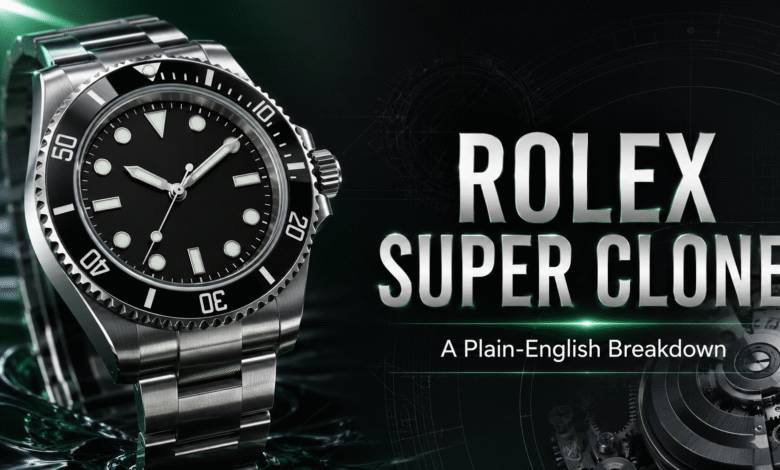
The replica rolex watch market hit an estimated $30 billion in global sales in 2025, with the super clone tier growing at roughly 25% year-over-year. Google Trends shows “super clone Rolex” search volume tripled between 2023 and 2026. So the term is everywhere. But ask ten different people what a “super clone” actually means and you’ll get ten different answers. Half the time it’s used as marketing fluff. The other half it’s used wrong.
This isn’t a buying guide. This is a vocabulary lesson. Because if you don’t know what the words mean, you don’t know what you’re looking at.
“Super Clone” Is a Real Tier, Not Just a Marketing Word
A super clone is the highest tier of replica watch. Not all replicas are super clones — in fact, most aren’t. The term refers to watches engineered to match the original’s specifications as closely as possible, both visually and mechanically.
That means:
- 904L stainless steel cases (same alloy Rolex uses)
- Sapphire crystal with anti-reflective coating
- Ceramic bezel inserts with accurate colors
- Clone movements that replicate the architecture of genuine calibers
- 28,800bph sweeping second hand (same as genuine)
- Weight within grams of the authentic watch
A cheap replica might look okay from ten feet. A super clone looks correct in hand. That’s the difference.
What Actually Separates a Super Clone From a Regular Replica
The gap isn’t just materials — it’s engineering.
Regular replicas (the $100–$200 range) use off-the-shelf movements — usually Japanese Miyota or Chinese DG/Seagull calibers. The case is 316L or mystery steel. The crystal is mineral glass or cheap sapphire. The bezel is painted aluminum, not ceramic. The bracelet rattles. The cyclops magnifies at 1.5x instead of 2.5x.
Super clones start around $600. At that price, the factory has reverse-engineered the actual movement. A VS3235 clone, for example, runs 70 hours on a full wind. It hacks. It winds smoothly. It beats at 28,800 vph. The case is cut on 5-axis CNC machines to within a fraction of a millimeter. The bracelet has solid end links (SELs) and milled clasps.
One way to put it: a regular replica tries to look like the watch. A super clone tries to be the watch — just made somewhere else.
Super Clone vs. 1:1 vs. AAA: Why the Terms Get Mixed Up
Here’s where it gets confusing. Sellers throw these terms around like they mean something specific. Mostly they don’t.
“1:1” is marketing language. No replica is truly identical to a genuine watch — internally, externally, or in finishing. The term suggests a watch that matches the original in every dimension and detail. In practice, it’s used for everything from $150 quartz pieces to $800 super clones. It doesn’t tell you much.
“AAA” is even worse. It’s a carryover from the counterfeit handbag world and means nothing in watches. There’s no standards body grading replicas on an A-to-AAA scale. Sellers use it to make cheap watches sound premium.
“Super clone” is the only term that actually signals something specific: a watch built with clone movements, premium materials, and factory-level finishing. It’s not an official certification. But in the communities that track this stuff — forums, Reddit, dedicated review sites — it has a real meaning.
“Rep” is just shorthand for replica. “Gen” means genuine. “NWBIG” stands for “Not Worth Buying In Gen” — community slang for a replica so good that buying the genuine version doesn’t make sense.
The takeaway: ignore the labels and look at the specs. Movement type. Steel grade. Crystal material. Bezel construction. Those tell you what you’re actually getting.
What You’re Actually Paying For
A super clone isn’t cheap to make. The movement alone — a VS3235, DD3285, or SH4130 — costs the factory real money to produce. 904L steel is more expensive than 316L. Ceramic bezels require specialized tooling. Sapphire crystals with proper AR coating don’t come from a bargain bin.
So when you see a “super clone” for $180, it’s not a super clone. It’s a $50 watch with a markup and a lie attached.
What the price actually buys:
- Movement accuracy — a clone movement that keeps time within a few seconds per day
- Material correctness — the same steel, same crystal, same ceramic as the genuine reference
- Finishing — brushing and polishing that match the original’s spec
- Durability — a watch that survives daily wear, not one that falls apart in six months
The Honest Tells Even Good Super Clones Have
Every replica has tells. Anyone who says otherwise is selling something. Even the best super clones have limitations.
Movement finishing. Open the case back and look at the movement. A genuine Rolex caliber has finishing that clone movements don’t match — Geneva stripes, perlage, anglage. The clone looks functional but plain in comparison.
Rehaut engraving. The inner ring under the crystal — the rehaut — has “ROLEX” laser-engraved around it on modern models. On a super clone, the engraving depth and alignment are often slightly off. The letters might not line up perfectly with the minute markers.
Cyclops magnification. Genuine Rolex magnifies the date 2.5x. Many replicas — even good ones — use 1.5x or 2x.
Laser-etched crown. Rolex introduced a tiny laser-etched crown at 6 o’clock on the crystal as an anti-counterfeiting measure in the early 2000s. Super clones replicate it now, but the microtext is often slightly off — too visible, too faint, or the wrong shape.
Lume. Under UV light, the color temperature and evenness of the lume application differ. Genuine Rolex lume is consistent across the dial and hands. Super clones can have mismatched or uneven glow.
Water resistance. Genuine Rolex pressure-tests every watch and guarantees 100m, 300m, or more. Super clones aren’t tested to the same standard. Some pass a basic pressure test. Many don’t.
No warranty. No resale value. A genuine Rolex holds value. A super clone holds none. You buy it knowing it’s a consumable, not an asset.
The super clone tier exists because the gap between what Rolex charges and what people can access has never been wider. The engineering got better. The materials caught up. The terminology didn’t. Knowing what “super clone” actually means — and what it doesn’t — is the only way to have a real conversation about what these watches are and aren’t.
For anyone looking deeper into specific references, factory reputations, or movement breakdowns, a dedicated ROLEX SUPER CLONE resource can walk you through the differences reference by reference. But the starting point is always the same: know the terms, know the tells, and know what you’re actually buying.