Croft Houses, Seasonal Income and Stone Walls: The Real Guide to Getting a Mortgage in the Highlands

Buying property around Inverness and the wider Highlands is unlike buying anywhere else in Britain — and not just because of the scenery. The region combines two things that mainstream mortgage lending handles badly: properties that don’t fit standard construction categories, and incomes that don’t arrive in twelve equal monthly instalments.
Neither is a dealbreaker. But both require knowing how lenders think before you offer on that steading conversion with the view.
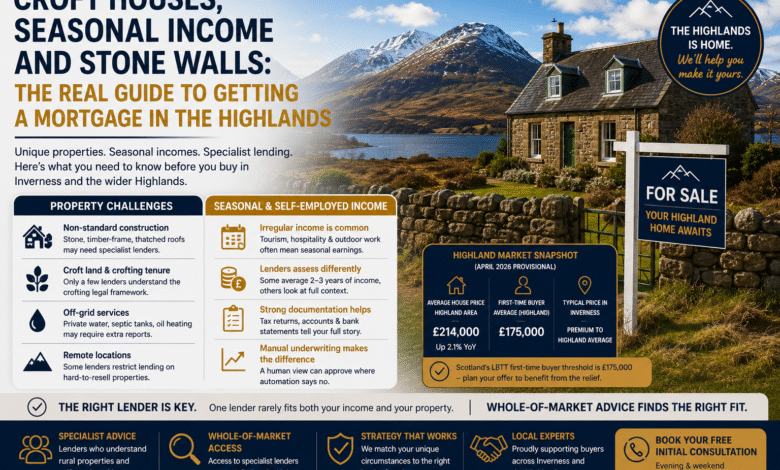
The market itself is healthy. Registers of Scotland publishes official data at Highland council level: as of April 2026 (provisional), the average house price across the Highland area was £214,000, up 2.1% year-on-year, with first-time buyers paying an average of £175,000 — and Inverness itself typically selling at a premium to the Highland-wide figure, buoyed by its status as the region’s economic hub.
Why the Property Itself Can Be the Problem
In most of urban Britain, the mortgage question is entirely about the borrower. In the Highlands, the property gets a vote too. Lenders’ standard criteria assume brick or block construction, mains services, and easy resale. Plenty of Highland homes fail at least one of those tests:
Non-standard construction. Stone-and-lime cottages, timber-frame kit houses, steel-framed former forestry properties, corrugated or thatched roofs — many lenders decline these automatically, while others simply want a fuller survey and price accordingly.
Croft land and crofting tenure. Property linked to croft land involves a legal framework (including the Crofting Commission’s oversight) that most lenders’ systems simply aren’t built for. A small number of lenders understand crofting tenure; approaching anyone else wastes weeks.
Off-grid services. Private water supplies, septic tanks, and oil or biomass heating are routine in the Highlands and rarely fatal — but some lenders want specialist reports, and valuers will note anything affecting resale.
Remoteness itself. A few lenders quietly limit lending on properties they judge hard to resell. It’s rarely stated openly; it appears as a down-valuation or an unexplained decline.
The pattern in every case is the same: this is not a market where “computer says no” means no. It means that particular lender’s computer.
The Seasonal Income Question
The Highland economy runs substantially on tourism and hospitality, and that shapes how people earn. Guesthouse owners, tour operators, outdoor instructors, and hospitality workers may earn most of their annual income between April and October. Self-employment is also disproportionately common across the region.
Lenders vary widely here. Some average self-employed profit over two or three years without blinking at seasonality; others get nervous at bank statements showing quiet winters. Buyers combining several income strands — a croft, a B&B, some freelance work — often find that mainstream affordability calculators can’t represent their finances at all, while a manually underwritten application presenting the same figures sails through.
The practical preparation is the same as for any self-employed applicant, done more carefully: SA302s or tax year overviews for the last two to three years, accountant-prepared accounts where applicable, and bank statements that you’re ready to contextualise (“this is what February always looks like; here’s the summer that pays for it”).
Matching Both Halves of the Puzzle
Here’s what makes Highland cases genuinely specialist: the property question and the income question have to be solved simultaneously, with a single lender willing to accept both. A lender relaxed about stone construction may be rigid about seasonal income; a lender generous with self-employed averaging may not touch croft tenure.
This is where whole-of-market advice stops being a convenience and becomes close to essential. A broker familiar with the region — such as Prestige Mortgage Solutions Ltd, which advises self-employed and rural-property buyers across Inverness and the Highlands — can shortlist the lenders whose criteria accommodate both your income structure and your target property before any application is made, sparing you the slow-motion frustration of sequential declines.
Practical Tips for Highland Buyers in 2026
Get the Home Report early and read the construction section closely — it flags most lender objections in advance. Budget for the possibility of a specialist survey on older or unconventional stock. If you’re buying near the £175,000 first-time buyer average, note that Scotland’s LBTT first-time buyer relief threshold sits at exactly £175,000 — a small negotiation on price can tip you under it. And start the mortgage conversation before you fall in love with a property; in this market, the financing strategy genuinely depends on what you’re buying.
The Bottom Line
The Highlands reward buyers who do their homework. The properties that make the region worth living in — the crofts, conversions, and cottages — are precisely the ones mainstream lending handles worst, and the incomes that sustain Highland life rarely fit a payslip template. None of that puts ownership out of reach. It just means the right lender matters more here than almost anywhere else in Scotland — and finding them first is the whole game. Get a free appointment now.