Valuable metal equipment can be affected by rust over time. This can also lead to higher maintenance expenses for companies. Typical techniques used to treat rust normally involve using chemicals or abrasives. There can be extra waste produced using these methods too.
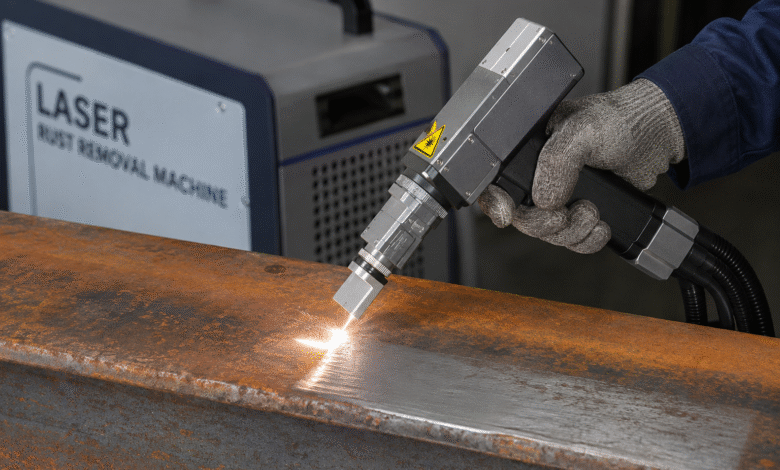
An alternative is a laser that removes rust. It is a process of removing rust from the surfaces with a concentrated laser beam. This is a highly accurate, quick, and touch-free process. But selecting which machine is the right one is not an easy decision to make.
Understand Your Rust Removal Needs
The types of cleaning services vary according to the business. Identify the materials you normally use to clean, like dusting, brooming, and vacuuming. The actual reaction of metals like steel, iron, aluminium, and other metals is not the same.
In turn, inspect the sort of rust to be eliminated. The energy required for light surface rust is less than for heavy corrosion. If thick rust layers are present, it may be necessary to use a more powerful machine.
Take into account the dimensions and form of the workpieces. If there is a need for higher cleaning speeds, big parts may require them. For smaller parts, a higher degree of accuracy might be more appropriate.
Additionally, the frequency of cleaning is important. A high-powered system is not always needed for occasional cleaning. There is a need for more robust equipment for industrial cleaning needs, since it is a daily requirement.
Before you make a comparison:
- What materials are you going to clean with?
- Typical rust pile-up?
- What size of workpieces do you have?
- For how many hours will the machine run?
- What is the optimum speed of your cleaning business?
Choose the Correct Laser Power
Power of the laser is among the most crucial considerations. The higher the power, generally speaking, the faster it cleans. It is a more effective filter for thicker contamination as well.
Less-powerful machines are suitable for mild rusting. They can be applicable to small work practices and maintenance uses. For industry applications, higher-powered systems work best. A 300w laser cleaner can provide strong cleaning performance. It may suit businesses handling moderate to heavy rust removal. However, power should not be your only consideration. Talk with the equipment supplier about your application. They can assist in the determination of proper power.
Consider Cleaning Speed
Productivity is significant in commercial activities. Time-consuming cleaning can cost more, both in terms of manpower and output. So, the speed of cleaning has to be directly looked at.
The speed of laser cleaning is related to several aspects. These include the power of the laser, the thickness of rust, the surface condition, and the scanning width.
The larger the area, the more powerful the system will clean more quickly. But it is still a must to have the right settings. Efficient settings and cleaning might be reduced due to poor settings.
Check with manufacturers how practical it is to clean at various speeds. Don’t only accept and report on performance statistics based on lab tests. Actual operating conditions may yield variations from this. Ideally, test using the workpieces you intend to run on the machine. This provides a more accurate evaluation of the performance.
Monitor the power and intensity of the lasers.
The power source is a key component of laser machines. It may have quality effects that may impact reliability and lifespan.
Check with established manufacturers who produce laser sources. Inquire as to warranty period and service requirements. Additionally, you should research replacement choices and ensure it has warranty protection. Unwanted downtime can be curtailed with a strong laser source. It may even help achieve better cleaning results and uniformity.
The machine must stabilize the output of the laser during operation. It is important to have consistent performance in a large production environment.
Practice Selection of the Appropriate Machine Design.
There are various types of laser rust removal machines available. There are some portable handheld ones. There are automated or integrated systems used by others as well.
Flexibility & mobility are offered by handheld systems. These can be used when the work machine size is large, and the surface is irregular. The laser head can be rotated to work on various parts. Consider your work area when making your decision. It can be better to have a portable system for maintenance teams. For production areas, a fixed system may be appropriate.
Evaluate Ease of Operation
If it’s not easy to use, then what good is a powerful machine? Seek out a control system that is easy to use and simple. The machine should give operators the flexibility to make simple adjustments to important machine parameters. These can include power, frequency, and scanning speed.
Be aware of any safety control features
Safety measures with the use of laser equipment are important. The operators should know about the dangers of laser radiation.
Look for appropriate safety devices in the machine. It is fundamental to ensure emergency/protection devices and warning devices. Corrective planning needs to be done for the working environment as well. In certain applications, a controlled area of interest might be required.
Consider Maintenance and After-Sales Support
The overall cost of the machine can be influenced by the Maintenance requirements. Make sure to ask what kind of regular maintenance is required before buying.
Identify those parts that need to be inspected from time to time. Inquire about the turnaround time that will be needed for replacement parts. An even bigger need for support post-sales for businesses. Production schedules can be impacted by the downtime.
Make sure that a supplier provides technical support and tries to give good service. Long-term protection of your investment could be assured by good support. Different industrial laser cleaning solutions can be learned from https://hantencnc.com/.
Compare Total Ownership Costs
The cost of an asset is not all that makes up an investment. Companies need to determine the total ownership cost.
Take into account energy/power, maintenance and operation, manpower, and replacement units. Take into account the lower prices of conventional cleaning supplies.
Costs of chemicals and abrasives can be lowered through the laser cleaning process. May also reduce certain labor needs as well. Savings will vary for different applications, however. Do some work on operating cost estimates before choosing a solution. It may well turn out that a more expensive machine will be a better value. It could yield higher savings in the long-term based on its productivity and reliability.
Final Thoughts
It is essential to take proper care in selecting an appropriate laser rust removal machine. You should first have an understanding of the type of materials and cleaning assignments required.
Compare the power, speed, machine design, and safety features of the lasers. Please do not neglect maintenance and after-sales service.
An appropriate machine can promote productivity and decrease cleaning expenses. Can also offer more controlled rust removal.
Experts advise that businesses check out the equipment before they buy any laser cleaning equipment. The best selection should be able to match up to the needs of the current time and the future.
With careful research, laser technology could prove itself a valuable investment in the business.