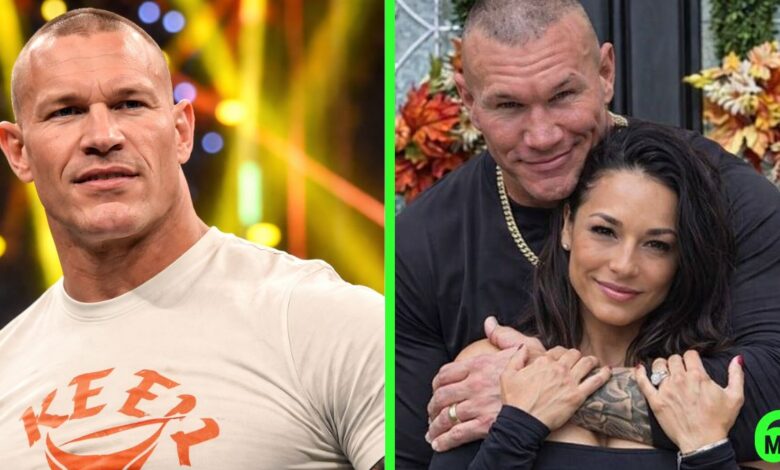
Randy Orton has spent more than two decades as one of WWE’s defining stars, building a résumé that includes multiple world-title reigns and a place among the company’s most recognisable modern performers. WWE’s own profile still presents him as one of the promotion’s marquee names, which helps explain why public interest extends beyond the ring and into his family life. In that wider story, Kim Marie Kessler occupies an unusual space: she is publicly known because of her marriage to Orton, yet much of her life remains deliberately outside the celebrity machine.
That tension is what makes her interesting. The public record confirms the essentials: Kim met Orton in 2012 at a WWE event, married him in Las Vegas on November 14, 2015, shares one daughter with him, and is part of a blended family with five children in total. It also shows that she has built a visible yet controlled public identity through ventures such as the clothing label SLTHR and the podcast The Wives of Wrestling. Beyond that, the most honest way to write about Kim Marie Kessler is not to fill gaps with rumour, but to examine what her selective public presence actually reveals.
Quick Bio
| Detail | Information |
|---|---|
| Full Name | Kimberly “Kim” Kessler, also publicly known as Kim Orton |
| Relationship | Wife of WWE superstar Randy Orton |
| Public Profile | Entrepreneur, podcast host, and public figure connected to WWE family life |
| Age | Not firmly established in strong public biographical sources; some outlets publish a birth date, but major mainstream profiles do not confirm it conclusively |
| Residence | Public sources indicate the family is U.S.-based; detailed residence information is kept relatively private |
| Children | Part of a blended family with five children: Randy’s daughter Alanna Marie, Kim’s three sons, and their daughter Brooklyn Rose Orton |
| Known Philanthropic Interests | Publicly associated with discussion of Make-A-Wish experiences through The Wives of Wrestling; broader charitable work is not extensively documented in mainstream coverage |
| Social Media Presence | Visible on Instagram and X through family updates, brand promotion, and public support for Randy Orton |
Who is Kim Marie Kessler?
Kim Marie Kessler is best known publicly as Randy Orton’s wife, but that description is only the starting point. She entered the public eye through her relationship with one of WWE’s biggest stars after meeting him at a wrestling event in 2012, then became part of a very public wrestling family when they married in 2015. Since then, her visibility has come in carefully chosen forms: family posts, occasional media attention, a podcast about the realities of wrestling households, and the launch of SLTHR, a clothing brand associated with the Ortons. What stands out is not constant publicity, but selectivity. Kim appears in the public record not as a full-time celebrity personality, but as someone who steps into view when the subject is family, work, or a shared project. That pattern is significant in itself. It suggests a person willing to be seen, but not consumed, by fame.
The Private Life of Kim Marie Kessler
Kim Marie Kessler’s private life is notable precisely because so much of it has remained private despite Randy Orton’s fame. In celebrity culture, the spouses of major stars are often cast as permanent side characters in an ongoing public drama. Kim has largely resisted that. The available record centres on a handful of consistent themes: marriage, motherhood, business, and selective engagement with fans. People’s profile of her does not read like a scandal file or a tabloid trail; it reads like a concise account of a woman whose public visibility is linked to family milestones and a few entrepreneurial projects. That matters because, in cases like this, privacy is not the absence of identity. It is often a method of controlling identity. Kim’s life is visible in fragments, but those fragments are chosen rather than indiscriminately exposed.
Early Life and Background of Kim Marie Kessler
Publicly verified information about Kim Marie Kessler’s early life is limited, and that limitation should be treated seriously rather than padded with recycled claims. Mainstream reporting confirms that she was already a wrestling fan before meeting Randy Orton and that she attended a WWE event with her sons when their paths crossed. Beyond that, the strongest public sources are restrained. That restraint is useful. It tells us that Kim did not become public because she cultivated a celebrity biography first; she became public because she entered a highly visible marriage. In practical terms, that means her origin story in the public imagination begins not with a carefully packaged pre-fame narrative, but with a moment of fandom, encounter, and later partnership. For a private person, that is often how fame arrives: suddenly, relationally, and with more public curiosity than personal disclosure.
Marriage and Partnership with Randy Orton
The marriage is among the most thoroughly documented parts of Kim’s public story. People reports that Kim and Randy met at a WWE event in 2012, became engaged in 2015 during a trip to Bora Bora, and married on November 14, 2015, in Las Vegas. Those dates matter because they anchor the relationship in public fact rather than fan lore. They also show a fast but not impulsive transition from meeting to marriage: several years passed between their first encounter and the wedding.
Public appearances and statements suggest a partnership that operates in two directions. Kim supports Orton’s career, but Orton has also publicly credited her work at home and in business. In People’s account of his March 2021 remarks to Steve Austin, Orton praised Kim for both raising their children and building SLTHR. That combination is revealing. It places her not merely in the background of a wrestler’s life, but at the centre of a family-and-work structure that Orton himself chose to acknowledge. In celebrity marriages, public praise can be performative; here, it is more useful as evidence of what the couple repeatedly foregrounds: household stability, shared responsibility, and mutual pride.
Kim Marie Kessler’s Role Behind the Scenes
There is a temptation in celebrity writing to overstate the unseen spouse as the secret architect of everything. The evidence does not justify that kind of claim here. What it does justify is a narrower, stronger point: Kim appears to play an important stabilising role in the structure Orton publicly values. When People quoted Orton calling her a “real life super hero” in a Mother’s Day message and describing her as the person raising five children while also running her own company, that did not prove every theory fans attach to her influence. It did, however, provide a public statement from Orton himself about the labour he sees her doing.
That makes Kim’s behind-the-scenes role easier to understand in realistic terms. She is part of the infrastructure of a celebrity household, including children from previous relationships, a current WWE schedule, and business activities outside wrestling. Her role does not need to be grounded in mythology to be important. In fact, stripping away the mythology makes it more credible. The public record supports a portrait of active family management, emotional steadiness, and selective public-facing work. Those are not glamorous labels, but they are often the clearest markers of real influence in a household built around a global entertainment career.
Family Life: Raising the Next Generation
One of the most important facts about Kim Marie Kessler. Randy Orton is aware that their household is blended. People reports that the family includes Randy’s daughter, Alanna Marie; Kim’s three sons; and the couple’s daughter, Brooklyn Rose Orton, born in November 2016. That is not a minor detail. It changes the way their public family story should be read. This is not simply a celebrity couple with one child and polished photo opportunities; it is a larger family with preexisting bonds, histories, and responsibilities, united under a single household identity.
That blended structure also explains why so much of Kim’s public significance revolves around parenting rather than spectacle. Even the commercial language around SLTHR emphasises family wear and a lifestyle brand that can dress “your whole family,” while Orton’s own public comments repeatedly return to the home front rather than glamour. The resulting image is consistent: the family is presented not as a decorative extension of Randy Orton’s fame, but as a central part of life outside the ring. Kim’s place in that story is not ornamental. It is maternal, organisational, and connective.
Philanthropy and Community Engagement
This is one of the areas where careful writing matters most. There is no large, mainstream archive detailing Kim Marie Kessler’s independent philanthropic record, so it would be irresponsible to invent one. Still, there is a meaningful public clue. In a 2022 WrestleZone piece based on The Wives of Wrestling, Kim spoke about Randy Orton’s involvement with Make-A-Wish and described how emotional those encounters were for him and for the families involved. She specifically connected those moments to gratitude for having healthy children and to Randy’s effort to create a good experience for wish recipients.
That does not prove a vast public charity portfolio under Kim’s own name. What it does show is that when philanthropy enters her public commentary, it comes through family experience rather than self-promotion. She speaks less like a celebrity ambassador building a brand and more like a spouse witnessing what charitable encounters mean in real life. The broader conclusion, stated carefully, is that the family’s public charitable footprint appears selective and personal rather than highly institutionalised. That can frustrate researchers seeking a long donation ledger, but it is still a recognisable form of public engagement.
The Power of Privacy: Influence Without Publicity
Kim Marie Kessler is a useful example of how privacy functions in modern celebrity culture. She is not invisible. She has social media, a podcast, and a retail business. Yet she is also not continuously available to the public. That balance is difficult to maintain when married to a performer whose career depends on visibility, storyline, and audience attention. The fact that her public identity remains limited suggests a deliberate line between access and exposure.
That choice has consequences. It leaves room for curiosity, but it also protects the everyday life that public audiences cannot reasonably claim for themselves. In Kim’s case, privacy seems to increase rather than diminish her perceived importance. Because there is less noise, the recurring signals stand out more clearly: marriage anniversaries, parenting references, business projects, and a podcast that framed the realities of wrestling spouses. Influence without constant publicity is still influence. Sometimes it is the more durable kind, tied to routine, trust, and longevity rather than headlines.
Public Curiosity and Misconceptions About Kim Marie Kessler
Public curiosity around Kim often produces two predictable distortions. The first is over-romanticising the origin story. Yes, People reports that she was a wrestling fan when she met Randy Orton, and that detail has fueled years of “fan marries superstar” storytelling. But that framing can flatten the real relationship by turning it into a novelty headline. The available facts show a marriage that has lasted since 2015, includes shared parenting, and extends into joint business visibility. That is more substantial than a meet-cute narrative.
The second distortion is the impulse to fill every unknown with internet folklore. Age, childhood details, residence specifics, and personal history are often repeated online with shaky sourcing. A trustworthy profile has to resist that. The absence of fully confirmed detail is not a problem to be solved through invention. It is part of the truth of writing about a private person. In Kim’s case, the cleanest facts are enough to establish her public role: wife, mother in a blended family, entrepreneur, podcast host, and selective public presence within the larger orbit of Randy Orton’s fame.
Legacy and Future
It is too early to talk about Kim Marie Kessler’s legacy in grand historical terms, but it is possible to identify its shape. Publicly, her significance rests on three interconnected factors: her place in one of WWE’s most visible modern families, her role in a long-running marriage to Randy Orton, and her efforts to maintain an identity beyond “the wrestler’s wife” through projects such as SLTHR and The Wives of Wrestling. Those are modest markers compared with a headline-driven entertainment career, but they are real.
Her future public profile will likely depend on the same pattern that has defined her so far: selective visibility. If SLTHR grows, if the podcast returns in a sustained form, or if the family chooses to speak more openly about life around wrestling, her public identity may broaden. If not, she will probably remain what she has long been in the public record: a quiet but recognisable figure whose importance is clearest not in interviews or headlines, but in the stable architecture of family, work, and chosen privacy.
Conclusion
Kim Marie Kessler is not a conventional celebrity subject, and that is exactly why an honest profile has to be careful with her. The strongest public facts do not present a tabloid personality or an endlessly documented influencer life. They present a woman who met Randy Orton through WWE, married him in 2015, helped build a blended family of five children, launched a clothing brand, and briefly stepped into podcasting to discuss the realities of life around professional wrestling. Everything else has to be built from that solid ground, not from rumour.
In that sense, Kim’s story is less about spectacle than about proportion. She is visible, but selectively. Supportive, but not reducible to support alone. Publicly recognisable, yet still largely private. For many readers, that restraint may feel unsatisfying because celebrity culture rewards oversharing. But it is also what makes her role quietly distinctive. Kim Marie Kessler’s public image is built not on constant exposure, but on consistency: marriage, motherhood, partnership, and a measured presence beside one of WWE’s most enduring stars.
Read this too:Dulcy Rogers: A Fact-Based Look at the Actress, Writer, and Longtime Partner of Diedrich Bader
(FAQs)
1. Who is Kim Marie Kessler?
Kim Marie Kessler, also known publicly as Kim Orton, is the wife of WWE star Randy Orton and is also known for SLTHR and The Wives of Wrestling Podcast.
2. When did Kim Marie Kessler and Randy Orton get married?
They married on November 14, 2015, in Las Vegas.
3. How did Kim Marie Kessler meet Randy Orton?
People report meeting at a WWE event in 2012, where Kim was in attendance with her sons.
4. How many children are in Kim and Randy Orton’s family?
Their blended family includes five children: Randy’s daughter, Kim’s three sons, and their daughter, Brooklyn Rose Orton.
5. Does Kim Marie Kessler have children with Randy Orton?
Yes. They share a daughter, Brooklyn Rose Orton, who was born in 2016.
6. What is SLTHR?
SLTHR is the clothing brand associated with Randy and Kim Orton. Its official site describes it as a family-oriented fashion label offering men’s, women’s, and children’s clothing and accessories.
7. Was Kim Marie Kessler involved in a podcast?
Yes. She co-hosted The Wives of Wrestling Podcast with Giovanna Angle and Jon Alba. Podcast listings describe it as a show about the realities of managing wrestling-family life.
8. Is much known publicly about Kim Marie Kessler’s early life?
No. Reliable mainstream public information about her early life is limited, which is why responsible profiles should stick to confirmed facts rather than recycled online claims.