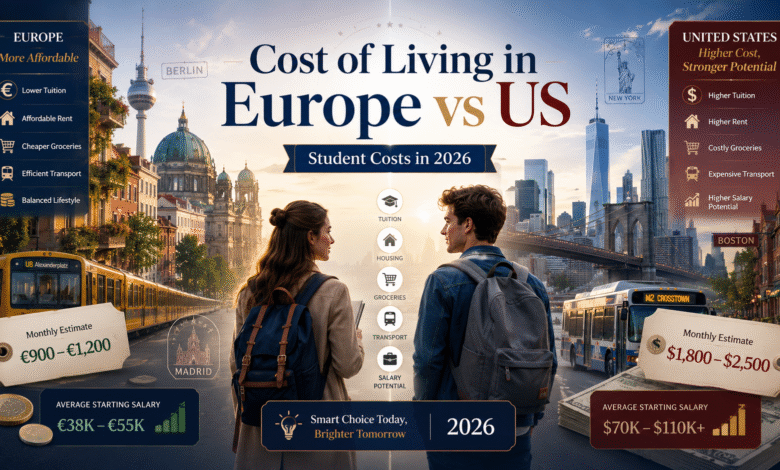
A student visa approval feels exciting at first. Then tuition invoices, rent contracts, grocery bills, and transport passes arrive all at once, and suddenly the numbers start talking. That, frankly, is where many international students face a rude awakening. The cost of living in Europe vs US has become one of the biggest deciding factors for families planning overseas education in 2026.
Some students picture café afternoons, library sessions, and weekends spent reading Italian poems near old city squares. Others focus on campus rankings and post-study jobs. In reality, education consultants usually tell families to look at one thing before anything else: monthly survival costs. A flashy admission letter means very little if your monthly burn rate empties your savings account halfway through the academic year.
At the same time, Europe and the United States offer very different student lifestyles. One side gives broader scholarship pathways and lower tuition in many countries. The other side delivers stronger salary prospects after graduation in sectors like technology, finance, and engineering.
So, naturally, students ask the same question every year: where does your money stretch further in 2026?
Housing
Accommodation eats the biggest chunk of a student budget. No surprises there. However, the gap between Europe and the US has widened considerably during the last two years.
In the United States, average student housing expenses in cities like New York, Boston, San Francisco, and Los Angeles now range between $1,300 and $2,400 per month for shared apartments near major universities. On-campus housing at private universities can climb past $18,000 annually.
By comparison, several European cities remain friendlier on student wallets. In countries like Germany, Poland, Portugal, Hungary, and Spain, shared student apartments generally cost between €350 and €850 monthly. Paris, Amsterdam, Copenhagen, and Dublin sit on the expensive side, though they usually remain cheaper than prime American university hubs.
Here is a rough May 2026 comparison for monthly student rent:
| City | Average Student Rent |
| New York | $2,200 |
| Boston | $1,850 |
| Chicago | $1,300 |
| Berlin | €700 |
| Madrid | €650 |
| Warsaw | €500 |
Education agents frequently call this the make-or-break category because rent decides whether students can save money for travel, books, emergencies, or visa renewals.
Tuition
Tuition creates another major divide.
American universities, particularly private institutions, continue to charge hefty fees. International students at top-tier US universities now pay anywhere between $28,000 and $65,000 annually. Medical and MBA programs can climb far higher.
Europe, meanwhile, operates differently country by country.
Germany keeps public university tuition extremely low for many programs, with students mainly paying semester contributions ranging between €250 and €700. France, Austria, and Norway also maintain relatively affordable structures for several international students.
The United Kingdom stands apart from mainland Europe. Universities in England charge international students between £15,000 and £38,000 annually depending on the program.
Here is where many consultants use the phrase value-for-money destination. Countries like Italy, Hungary, Poland, and Lithuania continue to attract budget-conscious applicants because students get accredited degrees at a lower overall investment.
Food
Food costs depend heavily on lifestyle choices. Students who cook save serious money. Students who rely on takeout feel the pinch very quickly.
In the US, grocery inflation has remained stubborn through early 2026. A modest monthly grocery budget for one student now ranges between $350 and $650. Add regular restaurant meals, and expenses shoot up sharply.
European supermarkets, meanwhile, remain comparatively cheaper in many countries. Students in Spain, Portugal, Greece, and Poland usually manage groceries within €180 to €350 monthly.
A few examples paint the picture clearly:
| Item | US Average | Europe Average |
| Coffee | $5.20 | €2.80 |
| Student Lunch | $14 | €8 |
| Monthly Groceries | $500 | €280 |
That said, Scandinavian countries tell a different story. Sweden, Denmark, and Norway rank among Europe’s costliest destinations for food and dining.
Students who know how to stretch a euro usually rely on weekly supermarket deals, student meal plans, and local markets. As consultants say during counseling sessions, every penny saved adds breathing space later.
Transport
Transport expenses show another interesting contrast.
American university towns usually require heavier transport spending unless students live directly near campus. Many students rely on rideshare apps, buses, or even personal cars. Monthly transport costs in major US cities now average between $90 and $220.
Europe, meanwhile, gives students far better rail and metro networks. Student transit cards across Germany, Spain, Italy, and France significantly reduce monthly commuting expenses.
For example:
- Berlin student transport pass: roughly €35 monthly
- Madrid youth transport card: around €20 monthly
- New York subway pass: $132 monthly
- Boston transit pass: roughly $90 monthly
Additionally, budget airlines and intercity rail passes make European travel far easier for students eager to explore nearby countries during semester breaks.
Salaries
Now comes the other side of the coin.
The United States offers stronger earning potential after graduation, particularly in STEM sectors. Entry-level salaries in engineering, software development, and finance remain substantially higher than equivalent European averages.
For instance:
| Profession | US Starting Salary | Europe Starting Salary |
| Software Engineer | $92,000 | €48,000 |
| Financial Analyst | $78,000 | €42,000 |
| Data Scientist | $105,000 | €55,000 |
So yes, the US carries higher living expenses. However, graduates may recover educational investments faster if they secure work sponsorships or OPT opportunities.
Europe, on the other hand, appeals to students who prioritize lower debt, affordable education, and gradual career growth.
Campus Choices
Students interested in humanities and governance studies increasingly look toward political science universities in Europe because their tuition is comparatively manageable while academic reputations continue to rise.
Institutions in the Netherlands, Germany, Belgium, France, and Italy attract international applicants interested in diplomacy, EU policy, economics, and international relations. Moreover, several programs now offer English-taught degrees, which opens the door for broader student mobility.
Meanwhile, American universities continue to dominate global rankings for research exposure and networking opportunities. Families with stronger financial backing usually view the US as a long-term investment play rather than a short-term savings decision.
Verdict
So which destination wins in 2026?
Honestly, it depends on your priorities.
If your family wants lower tuition, manageable rent, easier travel access, and reduced debt pressure, Europe clearly gives better breathing room. Countries like Germany, Spain, Portugal, Poland, and Italy continue to attract international students who want quality education at a realistic price point.
If your target involves high-paying careers, major corporate exposure, and larger post-study salaries, the United States remains extremely attractive despite higher expenses.
Education counselors usually put it this way: Europe protects your budget, while the US chases bigger financial upside later.
Either way, smart planning changes everything. Students who compare cities carefully, apply for scholarships early, and calculate realistic monthly expenses before departure usually land on their feet far more comfortably than those who rely purely on university rankings.