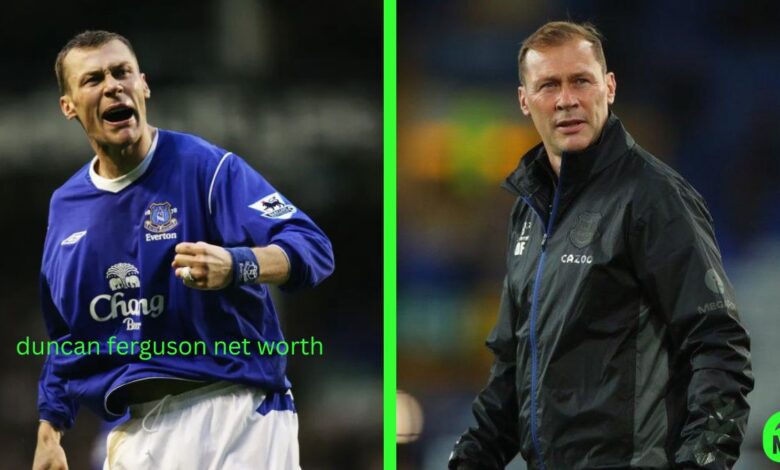
Few figures in British football provoke as much fascination as Duncan Ferguson. On the pitch, he was raw power and confrontation; off it, his life traced a dramatic arc from sudden wealth to bankruptcy and, eventually, professional stability. This article examines Duncan Ferguson’s net worth with a journalist’s caution: not to guess at private bank balances, but to assess what can be credibly known from public records, contemporary reporting, and Ferguson’s own accounts.
During his peak years in the 1990s, Ferguson earned elite-level wages and commanded record-breaking transfer fees. Yet those riches did not translate into lasting wealth. Poor investments, especially in land and tax-driven film schemes common in that era, stripped away millions and led to bankruptcy. Today, while no precise figure is public, Ferguson’s post-playing career in coaching, media, and publishing offers insight into a life rebuilt after financial collapse—one shaped by experience rather than excess.
Quick Bio
| Detail | Information |
|---|---|
| Full Name | Duncan Cowan Ferguson |
| Profession | Former professional footballer, football coach |
| Nationality | Scottish |
| Known For | Everton & Rangers striker; British-record transfer |
| Peak Playing Era | Early–mid 1990s to early 2000s |
| Highest Reported Wage | ~£30,000 per week (Everton, late 1990s) |
| Major Transfer | £4 million to Rangers (1993) |
| Financial Low Point | Bankruptcy (early 2000s) |
| Current Public Income Streams | Coaching, media work, book royalties |
| Public Net Worth Figure | Not disclosed |
Who Is Duncan Ferguson?
Duncan Ferguson is best understood as a footballer who arrived at the elite level before the sport’s financial guardrails were in place. His career coincided with the Premier League’s early boom years, when wages surged, but financial education lagged. Ferguson’s physical presence and goal-scoring ability made him valuable to clubs such as Rangers and Everton, while his volatility made him a headline fixture.
From a financial perspective, Ferguson’s importance lies not in what he has now—private numbers—but in what his journey reveals about football wealth, risk, and recovery. His own public reflections, particularly later in life, offer rare insight into how fortunes were made and lost in a less-regulated era.
The Private Reality Behind “Duncan Ferguson Net Worth”
When people search for Duncan Ferguson’s net worth, they often expect a clean number. What they encounter instead is silence—and that silence is revealing. Unlike many modern players, Ferguson has never cultivated a public-facing business empire or lifestyle brand. There are no disclosed company filings suggesting major commercial ventures, no high-profile property portfolios in the public record.
This absence is not evasive; it reflects a generational difference. Footballers of Ferguson’s era rarely monetised fame beyond their contracts. After bankruptcy, privacy became not just a preference but a necessity. The lack of a published net worth figure, therefore, is itself factual evidence of a quieter, more contained financial life.
Early Career Wealth and the £4 Million Rangers Transfer
Ferguson’s first major financial breakthrough came in 1993 when Rangers paid £4 million for him—a British transfer record at the time. Adjusted for inflation, the figure underscores how highly rated he was as a young striker.
Transfer fees do not go directly into a player’s pocket, but they influence wages and bonuses. At Rangers, Ferguson entered a pay bracket few Scottish players had reached before him. This period established the foundation of his lifetime earnings and, paradoxically, set the stage for later losses by enabling access to high-risk investment schemes marketed to wealthy athletes.
Everton Wages and Peak Earnings
Ferguson’s most lucrative years came at Everton in the late 1990s. Contemporary reporting consistently placed his wages at around £30,000 per week, translating to roughly £1.5 million annually—a substantial sum for that era, even by Premier League standards.
Importantly, these wages were earned before today’s financial safeguards: limited independent oversight, aggressive tax planning advice, and a culture that normalised speculative investments. Ferguson has since spoken candidly about trusting advisors who promised efficiency and growth, only to deliver losses.
Investments Gone Wrong: Land Deals and Film Tax Schemes
The most decisive factor shaping Duncan Ferguson’s net worth was not his salary, but where it went. Publicly documented accounts—including Ferguson’s own—point to two main areas of loss:
- Speculative land developments that failed to materialise or lost value.
- Film tax schemes, popular in the 1990s, were later targeted by tax authorities and often collapsed entirely.
These were not fringe gambles; they were mainstream offerings to high earners at the time. Ferguson has stated that these ventures cost him millions of pounds, erasing not only profits but core capital accumulated during his playing years.
Bankruptcy: The Financial Low Point
Ferguson’s bankruptcy marked the nadir of his financial story. Court records and press reports at the time confirmed that his liabilities exceeded his assets, forcing legal insolvency. For a player once among Britain’s most expensive, the fall was stark.
Crucially, bankruptcy does not mean a lifetime of poverty. It represents a reset—one that clears certain debts but imposes years of restriction and scrutiny. For Ferguson, it also coincided with the winding down of his playing career, making recovery more challenging but not impossible.
Life After Playing: Coaching, Media, and Stability
Post-retirement, Ferguson rebuilt his professional life methodically. He moved into coaching roles, most notably returning to Everton in various capacities, including caretaker manager spells and assistant coaching positions. Later, he took on head coaching responsibility at Inverness Caledonian Thistle.
These roles are salaried but modest compared with peak playing wages. Add to that media appearances and royalties from his autobiography, Big Dunc, and a picture emerges of stable, earned income rather than accumulated wealth.
Why No Exact Figure Exists for Duncan Ferguson’s Net Worth
The absence of a precise net worth figure is not an oversight; it is the only responsible conclusion. Ferguson is not required to publish personal financial information, and there are no public filings suggesting major assets or ventures that would allow for an estimate.
What can be said, factually, is this:
- He earned millions during his playing career.
- He lost millions through failed investments.
- He declared bankruptcy.
- He now earns through professional football and media work.
Any numerical estimate beyond that would be conjecture, and conjecture has no place in a credible assessment of Duncan Ferguson’s net worth.
Financial Legacy: Lessons from Ferguson’s Story
Ferguson’s financial legacy is less about numbers and more about narrative. His experience has become a case study cited in discussions about footballers’ financial education. Modern players benefit from stricter regulations, improved advisory standards, and a cultural shift toward long-term planning—changes forged in part by the failures of earlier generations.
By speaking openly, Ferguson has contributed to that learning curve. His story carries weight precisely because it is unvarnished.
Conclusion
So, what is Duncan Ferguson’s net worth today? The only honest answer is that it remains undisclosed and likely modest by elite football standards, shaped by early riches, catastrophic losses, and a steady professional rebuild. Ferguson’s journey stands as a reminder that wealth is not defined by peak earnings alone, but by what endures after the noise fades.
In an era obsessed with financial rankings, his story offers something rarer: a documented account of collapse, accountability, and recovery—grounded not in speculation, but in lived experience.
Read this too:Jynxzi Net Worth: A Fact-Based Analysis of Income, Influence, and the Economics Behind a Twitch Phenomenon
(FAQs)
1. Is Duncan Ferguson a millionaire today?
There is no public evidence confirming that he is.
2. How much did Duncan Ferguson earn at his peak?
Reports place his earnings at around £30,000 per week at Everton.
3. Why did Duncan Ferguson go bankrupt?
Due to failed land investments and collapsed film tax schemes.
4. Did the £4m Rangers transfer make him rich?
It boosted his wages, but the fee itself went to the club.
5. Does Duncan Ferguson still earn from football?
Yes, through coaching and occasional media work.
6. Are there public records of his assets?
No detailed public asset records exist.
7. Has he spoken about his finances publicly?
Yes, particularly in interviews and his autobiography.
8. Why is his net worth hard to calculate?
He keeps his finances private and does not provide public business disclosures.