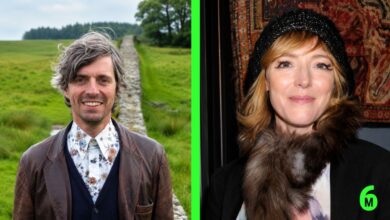
Dolph Lundgren built an international screen identity on force, discipline, and visibility. From Rocky IV onward, his career belonged to the public: premieres, interviews, action franchises, and a durable celebrity image that has lasted for decades. Anette Qviberg entered that orbit through marriage. However, the public record shows something striking about her story: she never turned proximity to fame into a public persona. What is verifiable is modest but meaningful. She has been identified in reliable public sources as a Swedish jewellery designer and fashion stylist. She married Lundgren in 1994. They raised two daughters, Ida and Greta, largely in Europe. They divorced in 2011. Public reporting also ties the family closely to Marbella, Spain. The family chose to live there, in part, so their children could grow up at a distance from Hollywood’s machinery.
That makes Anette Qviberg interesting for reasons different from a typical celebrity spouse profile. Her significance is not built on confessionals, self-branding, or many interviews. Instead, it rests on what can be inferred from her choices: creative work outside acting, a private family life, selective public appearances, and a household role that separated fame from upbringing. In that sense, Qviberg belongs to a familiar but misunderstood celebrity category. She is the private partner who becomes searchable because she avoided publicity.
Anette Qviberg Quick Bio
| Detail | Information |
|---|---|
| Full name | Anette Qviberg |
| Relationship | Former wife of Dolph Lundgren; married in 1994, divorced in 2011 |
| Public profile | Identified publicly as a jewelry designer and fashion stylist |
| Age | Public sources commonly report a 1966 birth year; precise date is not well documented in major mainstream profiles |
| Residence | Publicly associated with Marbella, Spain, during her marriage; later current residence is not firmly established in major reliable coverage |
| Children | Two daughters: Ida Sigrid Lundgren and Greta Eveline Lundgren |
| Known philanthropic interests | No substantial standalone public philanthropic profile under her own name is well documented in major reliable sources; public charity visibility is mostly tied to occasional family or red-carpet appearances |
| Social media presence | No widely verified public profile is clearly established in major reliable sources |
Who is Anette Qviberg?
Anette Qviberg is best known in the public record as Dolph Lundgren’s former wife. Still, the verified outline of her identity is creative rather than merely relational. Public sources describe her as a jewellery designer and fashion stylist. That matters because it distinguishes her from the tabloid shorthand that often reduces private spouses to “celebrity exes.” She was married to Lundgren from 1994 until 2011. Together, they had two daughters, Ida and Greta. During those years, the family became strongly associated with Marbella and maintained a deliberate European base. This contrasted with Lundgren’s Hollywood-facing career. That combination—design work, family privacy, and selective visibility—is the clearest documented frame to understand her.
The Private Life of Anette Qviberg
The defining feature of Qviberg’s public image is the absence of self-exposure. Unlike many people adjacent to celebrities, she does not have a large interview trail in major outlets. She is not documented as having built a media-facing brand around her marriage. The record instead suggests controlled visibility: public appearances did happen, including premieres, festivals, and charity-linked events, but they appear as moments rather than a sustained campaign of self-promotion. Getty’s archive, for example, preserves appearances with Lundgren at events in the 1990s and 2000s. With Qviberg, the safer method is narrower: stay close to what has been reported and treat silence as meaningful rather than as a gap to be filled with invention. In practical terms, her privacy appears to have functioned as a boundary. It protected her creative identity from being swallowed by Hollywood mythology. It also limited how much of her family life became public property. That is not speculation; it is the plain pattern of the source record.
Early Life and Background of Anette Qviberg
Reliable mainstream public sourcing on Qviberg’s early life is thin. What can be stated with confidence is that she is Swedish. Later public descriptions consistently place her in design-related work, especially jewellery and fashion styling. The lack of a heavily documented early biography is itself revealing. Many celebrity-adjacent biographies online pad this absence with unsourced claims about childhood, education, or family roots. A more trustworthy reading is simpler: the durable public facts about her begin not with a highly publicised origin story but with adult professional identifiers and with her marriage to Lundgren. The conclusion is not that her early life lacked substance, but that it was never packaged for public consumption in the first place.
Marriage and Partnership with Dolph Lundgren
The marriage is one of the best-documented parts of Qviberg’s public story. Public sources state that she and Dolph Lundgren married in 1994. They later made Marbella a long-term family base after deciding they liked it enough to remain there. They had two daughters: Ida in 1996 and Greta in 2001. The marriage ended in divorce in 2011. These dates and family facts are repeated consistently across mainstream reference and entertainment coverage.
What gives the marriage biographical weight is the contrast between the marriage and the rest of Qviberg’s public story. Reports about his daughters cite Lundgren’s own explanation that he spent years in Europe to raise his children outside New York and Hollywood. That choice places Qviberg not at the edge of his career but at the centre of a major life decision. The family would not be structured around maximum Hollywood visibility. Their public appearances together — from 1990s premieres to later festival sightings — show that they were not hidden. However, they were also not building the kind of aggressively public celebrity marriage common in American entertainment culture.
The most serious public incident connected to their marriage was the 2009 break-in at their Marbella home. Public accounts state that masked burglars tied up and threatened Qviberg before fleeing after realising the house belonged to Lundgren. Later reporting and biographical summaries say the incident deeply affected the family. Ida experienced PTSD. Lundgren said his wife was the most traumatised. This matters not as a sensational detail but because it exposed the cost of celebrity, even in a life intentionally built away from Hollywood. Privacy can reduce exposure, but it cannot eliminate public risk entirely.
Anette Qviberg’s Role Behind the Scenes
The phrase “behind the scenes” is often used lazily in celebrity writing, but here it has a concrete meaning. Qviberg’s documented professions — jewellery design and fashion styling — already imply trained aesthetic judgment, curation, and a comfort with form rather than spectacle. In family terms, the public record suggests a home life anchored more in continuity than in fame-chasing. Ida Lundgren later described her mother as the more relaxed parent. She also emphasised that the family remained close. That single remembered contrast says a lot: Qviberg appears in the family narrative not as an appendage to celebrity, but as a stabilising domestic presence with her own temperament and authority. These facts point toward partnership as a structure. Qviberg helped make possible a family identity that was neither purely Swedish nor purely Hollywood. The family identity was deliberately private and European.
Family Life: Raising the Next Generation
Family life is where Qviberg’s public significance is most distinct. The couple’s daughters, Ida and Greta, were born in Stockholm, and reports show the family lived in Sweden, London, and Marbella. Their upbringing in Europe was a deliberate contrast to the Hollywood upbringing common to celebrity children. Repeated coverage emphasises that Ida and Greta’s parents sought to shield their daughters from the central glare of Hollywood.
That decision appears to have shaped the daughters’ later public bearing. They did not emerge as tabloid fixtures during childhood. When they did become more visible as adults, coverage focused on their accomplishments rather than scandals. The outcome cannot be quantified, but the family strategy is visible in the results. The daughters’ later closeness to both parents, and Ida’s comments that her parents maintained a good relationship after divorce, reinforce the impression that the family structure remained more cooperative than chaotic, even after the marriage ended.
Philanthropy and Community Engagement
There is no large, independently documented public philanthropy portfolio under Anette Qviberg’s name in the reliable sources surfaced here. That does not justify inventing one. What can be said is narrower and more accurate. Qviberg did appear publicly at some events during her marriage. At least one archived image record places her and Lundgren at the 1996 “Dolls Have a Heart” gala benefiting amfAR. Separately, Lundgren has been documented at charity-linked events such as the Juvenile Diabetes Research Foundation gala in 2011.
The better analysis is that Qviberg’s public footprint does not support the modern celebrity model in which philanthropy is also a form of branding. Her record suggests occasional visibility around public events, not a heavily publicised advocacy career. That distinction matters. In celebrity ecosystems, the lack of publicity is often mistaken for a lack of civic concern. The public evidence here does not let us map a broad philanthropic program, but it does support a more modest conclusion: she participated in elite public life without turning charitable visibility into a self-promotional identity.
The Power of Privacy: Influence Without Publicity
Qviberg’s life illustrates how privacy can function as influence rather than retreat. The choice to live in Marbella, to raise children largely outside Hollywood, and to keep family life relatively contained all had consequences. They affected where the children grew up, how the marriage was perceived, and how much of Lundgren’s off-screen life remained distinct from his action-star image. Public sources explicitly connect the European base to the goal of giving the children a more normal childhood. That is one of the strongest facts in the record, and it turns privacy from abstraction into practice.
There is also a cultural dimension to that decision. Hollywood often rewards overexposure. Families become brands; children become content; spouses become recurring characters in a star’s publicity machine. Qviberg’s public path appears almost the opposite of that model. The result is that she remains interesting not because the audience knows everything, but because the record shows a deliberate refusal to live publicly by default. In biographical terms, that is its own kind of force.
Public Curiosity and Misconceptions About Anette Qviberg
The main misconception about Anette Qviberg is that the scarcity of public information makes exaggeration acceptable. It does not. In fact, the opposite is true. Because she is a private person, PQViberg’s public path appears almost the opposite of that model: tales become “facts,” professional labels multiply beyond sourcing, and post-divorce life is often filled with rumour-heavy material. The reliable core is smaller: Swedish designer and stylist, former wife of Dolph Lundgren, mother of Ida and Greta, long associated with family life in Marbella.
Another misconception is that being private means being passive. The public record points in the other direction. Choosing Europe over Hollywood for family life, maintaining a lower profile, and continuing to be remembered through the family’s structure rather than through scandal are not signs of insignificance. They suggest control. In celebrity biography, quietness is often misread as emptiness. With Qviberg, quietness is part of the biography.
Legacy and Future
Anette Qviberg’s legacy, as far as public evidence allows us to describe it, is intimate rather than spectacular. She remains part of Dolph Lundgren’s life story, but not merely as a former spouse. She is part of the explanation for how one of the most recognisable action stars of his era built a long family chapter outside the centre of the American celebrity machine. She is also part of the family history carried forward by Ida and Greta, whose adult public lives reflect creativity, independence, and a noticeable lack of childhood overexposure.
As for the future, the public record offers no reason to assume that Qviberg will become substantially more visible. If anything, the pattern suggests continuity: seShe is part of the explanation for how one of the most recognisable action stars of his era built a long family chapter outside the centre of the American celebrity machine. appetite for disclosure, but it also explains why she continues to attract interest. She represents a kind of modern rarity around fame — a person close to it, shaped by it, yet never fully absorbed by it.
Conclusion
Anette Qviberg is not a conventional celebrity subject, and that is precisely why a careful article about her needs restraint. The strongest public facts are straightforward: she is a Swedish jewellery designer and fashion stylist; she was married to Dolph Lundgren from 1994 to 2011; they raised daughters Ida and Greta; and the family spent key years in Marbella while trying to give the children a life at some remove from Hollywood. Around those facts sits a larger, credible interpretation. Qviberg’s role was quiet. BAnette Qviberg is not a conventional celebrity subject, and that is precisely why a careful article about her needs restraint. The strongest public facts are straightforward: she is a Swedish jewellery designer and fashion stylist; she was married to Dolph Lundgren from 1994 to 2011; they raised daughters Ida and Greta; and the family spent key years in Marbella while trying to give the children a life at some remove from Hollywood. Around those facts sits a larger, credible interpretation. Qviberg’s role was quiet, but it was not minor. The family geography, the tone of upbringing, and the disciplined privacy that still shape her public image all point to someone who mattered behind the celebrity narrative, not just beside it.
Read this too:Harald Leemann and Martina Hingis: A Fact-Based Look at the Quiet Figure Beside a Tennis Icon
(FAQs)
Who is Anette Qviberg?
Anette Qviberg is publicly identified as a Swedish jewellery designer and fashion stylist, and she is best known in mainstream coverage as Dolph Lundgren’s former wife.
Was Anette Qviberg married to Dolph Lundgren?
Yes. Public sources say they married in 1994 and divorced in 2011.
How many children do Anette Qviberg and Dolph Lundgren have?
They have two daughters: Ida Sigrid Lundgren and Greta Eveline Lundgren.
Where did Anette Qviberg and Dolph Lundgren raise their family?
Public reporting strongly associates the family with Marbella, Spain, while also noting the children’s broader European upbringing.
Why did the family live outside Hollywood?
Lundgren said his priority was raising his children outside New York and Hollywood, and public summaries consistently connect the European base to that goal.
What happened during the Marbella burglary?
Public accounts state that masked burglars broke into the family’s Marbella home in 2009, tied up and threatened Qviberg, and fled after realising whose home it was.
Is Anette Qviberg very active in public life or on social media?
No major reliable public profile suggests a highly public-facing media presence. Her image in the public record is notably private.
What is Anette Qviberg’s lasting significance?
Her significance lies in her creative identity and in the documented role she played in a family life intentionally kept more private and Europe-based than Hollywood-centred.