For decades, the celebration cake was non-negotiable. Birthdays, weddings, christenings, retirements — whatever the occasion, the centrepiece was a single large cake, cut ceremonially and distributed on paper napkins to guests who may or may not have wanted a slice. But quietly, over the past several years, the cupcake has been staging a takeover. Bakeries across the world report that individual cakes now rival or outsell their full-sized counterparts for events, and the shift isn’t a passing fad. It’s being driven by some very practical changes in how we celebrate.
The serving problem nobody misses
Ask anyone who has hosted a large party what they remember about the cake, and there’s a fair chance the answer involves stress. Someone has to cut it. Someone has to find a knife, plates, and forks. Someone has to portion it evenly while thirty people watch, then deal with the structural collapse of whatever’s left.
Cupcakes delete the entire problem. There’s no cutting, no serving equipment, no judgement calls about slice sizes, and no sad remainder drying out on a platter. Guests simply take one. For hosts, that’s not a small convenience — it’s the removal of the single most awkward logistical moment of the event. It’s also why cupcakes have become the default for office celebrations and children’s parties, where nobody wants to be wielding a cake knife in the first place.
The gifting world has noticed the same advantages. Sending a whole cake to someone’s home or office has always been impractical; sending a beautifully packaged box of individual cakes is not. The growth of cupcake gift boxes in Sydney, London, New York and most major cities reflects a broader shift — bakeries now offer same-day delivered boxes that work as birthday gifts, thank-yous, and corporate gestures in a way a traditional cake never could.
One box, every dietary need
Here’s a modern hosting dilemma the traditional cake handles badly: your guest list includes someone gluten-free, someone vegan, someone with a nut allergy, and twenty people with no restrictions at all. With a single large cake, you either compromise the whole cake for everyone or relegate the dietary-needs guests to a sad supermarket alternative on the side.
Cupcakes solve this elegantly because the box can be mixed. Half a dozen vegan, half a dozen gluten-free, two dozen classic — one order, one centrepiece, everyone eating the same beautiful thing. As dietary requirements have become a standard feature of every guest list rather than an exception, this flexibility has gone from nice-to-have to genuinely decisive. Specialist bakeries have leaned in, with dedicated vegan ranges, gluten-free options across the menu, and allergen-controlled kitchens that make group ordering dramatically simpler.
Portion control without the guilt politics
There’s also a quieter social reason for the cupcake’s rise. A cut cake comes with portion politics — the “just a sliver” negotiations, the guilt-laden refusals, the host pressing seconds on everyone. An individual cake removes all of it. One cupcake is a complete, self-contained decision. Guests who want the treat take it; guests who don’t, don’t; and nobody has to perform either choice.
For hosts, portioning is also predictable. Thirty guests means thirty cupcakes, perhaps a few spare. There’s no estimating slices, no over-ordering an enormous tiered cake for a modest gathering, and far less waste at the end of the night.
The visual upgrade
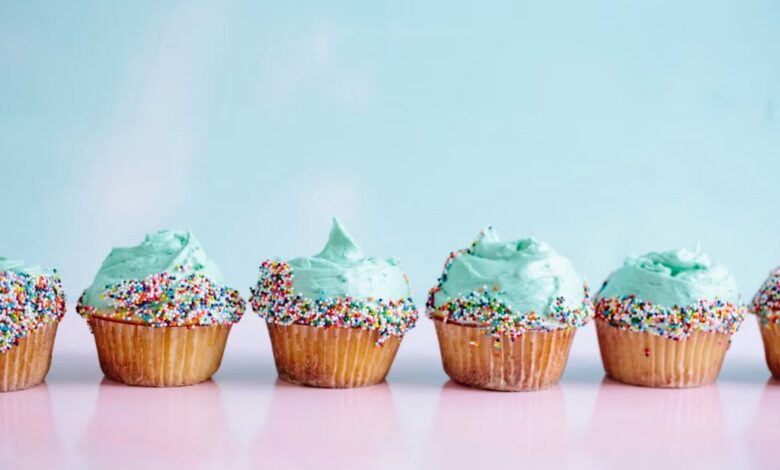
Modern cupcakes are not the flat-iced fairy cakes of school fetes. Professional bakeries now treat each one as a miniature canvas — piped buttercream sculpted into florals, hand-placed decorations, printed edible images, themed designs coordinated to an event’s colours. Arranged on a tiered stand, a collection of cupcakes creates a display with more visual variety than a single cake, and one that photographs from every angle.
That matters more than it used to. In an era where every celebration is documented, the dessert table is part of the event’s aesthetic, and cupcake displays consistently deliver. Wedding planners have embraced cupcake towers — often with a small cutting cake on top for the ceremonial moment — precisely because they give couples the photo, the tradition, and the effortless serving all at once.
The price-per-head logic
Traditional celebration cakes, especially custom and tiered designs, carry serious price tags — multi-tier wedding cakes routinely run into the high hundreds. Cupcakes reframe the cost as a simple per-head calculation, typically a few dollars or pounds per guest for a professionally made, hand-decorated product. For most events, that arithmetic lands well below the equivalent custom cake, and it scales precisely with the guest list. Hosting fifteen people doesn’t require buying a cake built for forty.
Add in delivery — many boutique bakeries now offer same-day service across their cities — and the convenience-to-cost ratio becomes hard for the traditional cake to match.
Is the celebration cake finished?
Not quite. There remain moments where a single cake carries symbolic weight a cupcake can’t replicate — the cutting of a wedding cake, the blowing-out of candles on a milestone birthday. The strongest trend isn’t replacement but hybridisation: a modest centrepiece cake for the ritual, surrounded by cupcakes that do the actual feeding.
But as a default for parties, office events, gifts, and gatherings of every kind, the individual cake has won the practical argument comprehensively. It serves itself, accommodates every diet in one box, controls portions and budgets, looks spectacular, and arrives at the door the same day it was ordered. The traditional cake earned its century at the centre of the table — the cupcake is simply better suited to how we celebrate now.