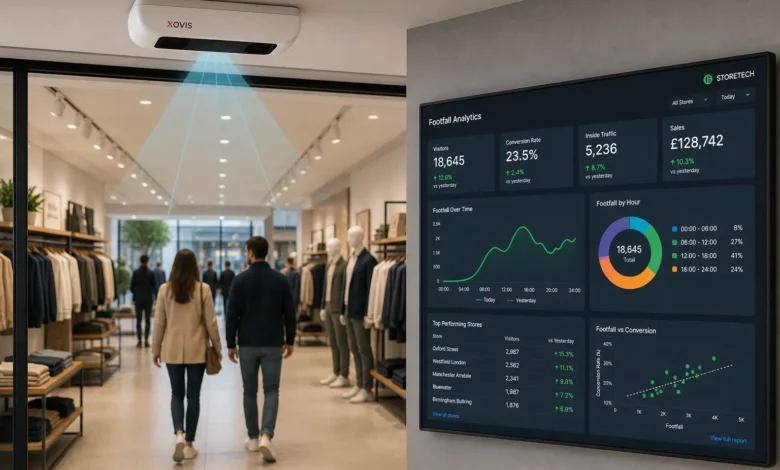
Retailers today have access to more customer data than ever before. Understanding how shoppers interact with a store is no longer a luxury; it is a necessity for improving customer experiences, increasing sales, and staying competitive. Two of the most widely used technologies for gathering in-store intelligence are the footfall counter and retail video analytics.
For years, a footfall counter has been the go-to solution for measuring customer traffic. However, as retail technology evolves, retail video analytics is becoming an increasingly popular choice for retailers seeking deeper insights into customer behavior.
This raises an important question: Which delivers better results: traditional footfall counters or retail video analytics?
The answer depends on the type of insights a retailer needs. While both technologies provide valuable information, their capabilities differ significantly. This blog explores the strengths, limitations, and business benefits of each solution to help retailers make informed decisions.
Understanding Traditional Footfall Counters
A footfall counter is a system designed to count the number of people entering and exiting a retail store. Traditional footfall counters often use infrared beams, thermal sensors, or basic people-counting technology to measure visitor traffic.
Retailers use a footfall counter to track:
- Daily visitor counts
- Peak shopping hours
- Traffic trends
- Store occupancy
- Visitor-to-sales conversion rates
For many years, a footfall counter has been a valuable tool for understanding store traffic and evaluating overall performance.
However, while it accurately answers the question, “How many people visited?”, it provides limited information about what customers do after entering the store.
What Is Retail Video Analytics?
Retail video analytics uses artificial intelligence (AI), machine learning, and computer vision technology to analyze customer behavior through video feeds.
Unlike a traditional footfall counter, retail video analytics does much more than count visitors.
It can reveal:
- Customer movement patterns
- Dwell time
- Heatmaps
- Queue lengths
- Product engagement
- Customer flow
- Shopping journeys
- Store congestion points
This allows retailers to understand not only how many customers visit but also how they interact with the store environment.
The Evolution of Retail Intelligence
Traditional retail analytics focused primarily on counting traffic.
Today, retailers need answers to more complex questions:
- Why are customers leaving without buying?
- Which displays attract the most attention?
- How long do customers spend in specific areas?
- What causes checkout abandonment?
- Which sections generate the highest engagement?
A footfall counter provides valuable traffic data, but retail video analytics provides the behavioral context behind those numbers.
This shift is why many leading retailers are increasingly investing in AI-powered analytics solutions.
Comparing Footfall Counter and Retail Video Analytics
The key differences between a footfall counter and retail video analytics become clear when comparing their capabilities.
| Feature | Footfall Counter | Retail Video Analytics |
| Visitor Counting | ✔ | ✔ |
| Entry and Exit Tracking | ✔ | ✔ |
| Occupancy Monitoring | ✔ | ✔ |
| Customer Movement Analysis | ✘ | ✔ |
| Dwell Time Tracking | ✘ | ✔ |
| Heatmaps | ✘ | ✔ |
| Queue Monitoring | Limited | ✔ |
| Product Engagement Analysis | ✘ | ✔ |
| Customer Journey Mapping | ✘ | ✔ |
| Behavioral Insights | Limited | ✔ |
The comparison clearly shows that while a footfall counter focuses on visitor volume, retail video analytics provides a more comprehensive understanding of customer behavior.
1. Accuracy: Which Technology Performs Better?
Modern footfall counter systems can achieve accuracy levels between 95% and 99% when properly installed.
However, traditional systems may face challenges in situations such as:
- Large crowds
- Multiple people entering simultaneously
- Wide entrances
- Complex store layouts
Modern retail video analytics solutions use AI-powered cameras and advanced algorithms to improve counting accuracy while simultaneously collecting behavioral data.
As a result, retail video analytics often matches or exceeds the accuracy of a traditional footfall counter while delivering additional insights.
2. Depth of Customer Insights
This is where retail video analytics has a significant advantage.
A traditional footfall counter tells retailers:
- How many people entered
- When they entered
- Traffic trends over time
However, it cannot explain:
- Where customers went
- What products attracted attention
- How long shoppers stayed
- Why customers left without purchasing
Retail video analytics provides all of these insights, allowing retailers to understand the complete customer journey.
3. Store Layout Optimization
Retailers frequently redesign store layouts to improve customer experiences and increase sales.
A footfall counter can indicate overall traffic levels but cannot show how customers navigate the store.
In contrast, retail video analytics generates heatmaps and movement tracking data that reveal:
- Popular pathways
- High-engagement zones
- Dead areas
- Traffic bottlenecks
This information helps retailers optimize layouts based on actual customer behavior rather than assumptions.
4. Conversion Rate Improvement
Conversion rate is one of the most important retail performance metrics.
A footfall counter helps calculate conversion rates by comparing visitor traffic to sales transactions.
For example:
- 1,000 visitors
- 250 purchases
- 25% conversion rate
While this data is useful, it does not explain why 750 visitors left without purchasing.
Retail video analytics helps retailers identify:
- Areas causing confusion
- Poorly performing displays
- Long checkout queues
- Customer drop-off points
These insights make it easier to improve conversion rates and increase revenue.
5. Staffing and Queue Management
Effective workforce management is critical for delivering a positive customer experience.
A footfall counter provides traffic forecasts that help retailers schedule staff during busy periods.
However, retail video analytics goes further by monitoring:
- Queue lengths
- Waiting times
- Service bottlenecks
- Checkout performance
This allows managers to respond in real time and improve customer service levels.
6. Marketing Performance Measurement
Retailers invest heavily in marketing campaigns and promotional displays.
A footfall counter can measure whether a campaign increased store visits.
However, increased traffic does not necessarily mean increased engagement.
Retail video analytics helps retailers determine:
- Which displays attracted attention
- How long customers engaged with promotions
- Which products generated interest
This deeper understanding improves campaign effectiveness and marketing ROI.
Why More Retailers Are Choosing Retail Video Analytics
The retail industry is moving toward intelligent, AI-driven solutions that provide actionable insights.
While a footfall counter remains a useful tool, many retailers now prefer retail video analytics because it combines visitor counting with behavioral analysis.
Benefits include:
- Better customer understanding
- Improved store layouts
- Higher conversion rates
- Enhanced customer experiences
- Smarter staffing decisions
- Stronger marketing performance
For retailers looking to gain a competitive edge, retail video analytics offers significantly more business value than traditional counting methods alone.
Can Footfall Counter and Retail Video Analytics Work Together?
Absolutely.
Many modern retail solutions combine a footfall counter with retail video analytics to provide a complete view of store performance.
A footfall counter answers:
“How many people visited?”
Retail video analytics answers:
“What did they do inside the store?”
Together, they create a powerful data ecosystem that helps retailers make smarter decisions and improve profitability.
Conclusion
When comparing retail video analytics and a traditional footfall counter, it becomes clear that both technologies serve important purposes. A footfall counter remains an effective solution for measuring visitor traffic, monitoring occupancy, and calculating conversion rates.
However, today’s retailers need more than traffic data. They need to understand customer behavior, engagement, movement patterns, and shopping journeys. This is where retail video analytics delivers superior value.
By providing detailed behavioral insights alongside accurate visitor counting, retail video analytics empowers retailers to optimize store layouts, improve customer experiences, increase conversion rates, and make data-driven business decisions.
For retailers seeking a complete understanding of store performance in 2026 and beyond, the most effective approach is often combining a footfall counter with retail video analytics to unlock the full potential of customer intelligence.
FAQs
1. What is a footfall counter?
A footfall counter is a technology solution that measures the number of people entering and exiting a retail store or commercial space.
2. What is retail video analytics?
Retail video analytics uses AI-powered video technology to analyze customer behavior, movement patterns, dwell time, engagement, and shopping activity within a store.
3. Is retail video analytics more accurate than a traditional footfall counter?
Modern retail video analytics systems often provide equal or greater accuracy than traditional footfall counter systems while offering additional behavioral insights.
4. Can retail video analytics track customer movement?
Yes. Retail video analytics can monitor customer flow, movement patterns, dwell time, and shopping journeys throughout the store.
5. Do footfall counters provide behavioral insights?
A traditional footfall counter primarily measures visitor traffic and occupancy. It offers limited behavioral information compared to retail video analytics.
6. Why are retailers switching to retail video analytics?
Retailers are adopting retail video analytics because it provides deeper customer insights, improves operational efficiency, enhances customer experiences, and supports data-driven decision-making.
7. Should retailers use both footfall counters and retail video analytics?
Yes. Combining a footfall counter with retail video analytics provides comprehensive visibility into both customer traffic and customer behavior, helping retailers maximize store performance and revenue.