Meta Description: Explore the concept of allocate loop, its significance in programming, and best practices to optimize memory management. Learn how developers can leverage loops for efficient resource allocation and avoid common pitfalls.
In the world of software development, managing memory and system resources efficiently is crucial to creating performant applications. One programming pattern that has garnered attention for its ability to optimize resource management is the allocate loop. At its core, an allocation loop iteratively allocates memory or resources, allowing programs to handle dynamic workloads effectively. While the concept might appear straightforward, understanding its nuances, advantages, and potential challenges is essential for developers seeking robust software solutions.
The allocate loop is widely used across multiple programming languages, from low-level systems programming in C and C++ to high-level languages such as Python and Java. Its primary purpose is to ensure that resources such as memory, file handles, or network sockets are allocated as needed, while avoiding unnecessary overhead. By employing this pattern correctly, developers can improve application scalability, reduce memory leaks, and maintain system stability.
How Allocate Loops Work
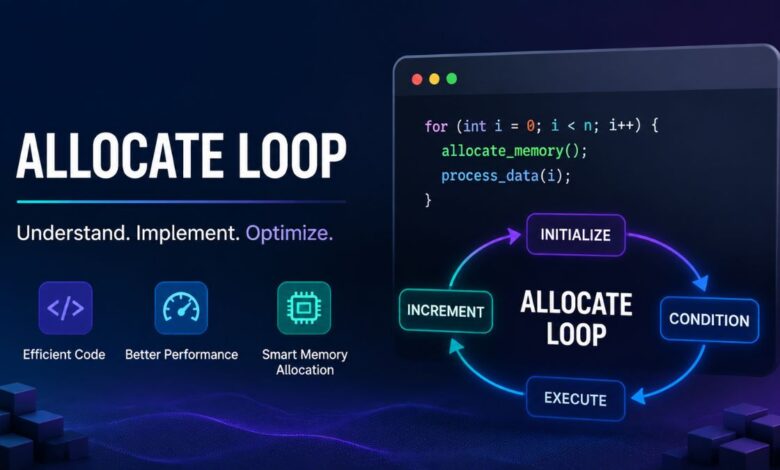
An allocate loop functions by continuously allocating resources on each iteration. This approach is particularly useful when the number of required resources is not predetermined or when handling dynamic data structures such as arrays, lists, or buffers. Typically, the loop executes a sequence of allocation commands and performs the necessary checks to verify that the allocation succeeded.
For example, in C++, an allocation loop may repeatedly call new to create objects in a container until a certain condition is met. In contrast, in managed languages like Java, developers may rely on constructs such as ArrayList with dynamic resizing within loops, which handle memory allocation internally. The pattern ensures that resources are provisioned incrementally, aligning with the application’s runtime demands rather than preallocating large, potentially unused blocks of memory.
One of the critical considerations when using allocate loops is error handling. Each iteration must account for potential allocation failures to prevent crashes or undefined behavior. Proper cleanup mechanisms, such as deallocating previously allocated memory in the event of a failure, are essential for maintaining program reliability.
Benefits of Using Allocate Loops
Implementing allocate loops offers several key benefits that contribute to software efficiency and stability:
- Dynamic Resource Management: Unlike static allocation, allocate loops allow resources to be allocated incrementally based on runtime requirements. This flexibility is invaluable in applications with unpredictable workloads.
- Optimized Memory Usage: By allocating resources as needed, programs can minimize memory wastage. This approach ensures that only the necessary amount of memory is consumed at any given time, enhancing overall performance.
- Enhanced Scalability: Applications that employ allocate loops can adapt to varying data sizes and user demands without requiring extensive rewrites or manual memory adjustments.
- Improved Control: Developers gain fine-grained control over allocation, allowing them to implement custom strategies for managing memory, such as pooling or recycling resources efficiently.
- Error Detection and Handling: By checking the success of each allocation within the loop, developers can detect potential issues early and implement fallback strategies, reducing the risk of system crashes.
Common Pitfalls in Allocate Loops
While allocate loops provide significant advantages, improper implementation can lead to severe issues. Understanding common pitfalls helps developers avoid costly mistakes:
- Memory Leaks: Failing to deallocate memory when it is no longer needed can cause memory leaks. In long-running applications, this accumulation can lead to system slowdowns or crashes.
- Excessive Allocations: Overusing allocations within a loop without considering efficiency may increase processing time and reduce overall performance.
- Fragmentation: Repeated allocations and deallocations in certain environments can fragment memory, making subsequent allocations slower and less predictable.
- Error Propagation: Neglecting to handle allocation failures correctly can cause errors to propagate, leading to unexpected behavior or termination.
To mitigate these risks, developers should combine allocate loops with robust memory management strategies such as object pooling, garbage collection (in managed languages), and proactive error handling.
Best Practices for Efficient Allocate Loops
Creating efficient allocate loops requires careful planning and adherence to programming best practices:
- Preallocation When Feasible: If the number of elements is predictable, preallocating memory outside the loop can reduce overhead and improve performance.
- Use Smart Pointers or Managed References: In languages like C++, using smart pointers can automate memory deallocation and reduce the likelihood of leaks. In Java or Python, rely on built-in garbage collection mechanisms.
- Monitor Resource Consumption: Keep track of memory and resource usage during development to identify potential bottlenecks caused by repeated allocations.
- Limit Loop Iterations: Avoid unnecessary iterations that do not contribute meaningfully to the allocation process. Optimizing the loop condition can significantly improve efficiency.
- Implement Cleanup Mechanisms: Always include a cleanup strategy to release resources in case of errors or early termination of the loop.
- Consider Thread Safety: If allocations occur in a multithreaded context, ensure proper synchronization to prevent race conditions or inconsistent states.
By following these practices, developers can leverage allocate loops effectively, achieving high performance without compromising stability.
Real-World Applications of Allocate Loops
Allocate loops find applications in numerous programming scenarios:
- Dynamic Arrays and Lists: When building data structures that grow in size during runtime, allocate loops ensure that memory is allocated as needed while maintaining performance.
- Resource Pools: Servers and applications that manage connection or thread pools often use allocation loops to provision resources incrementally based on demand.
- Graphics and Game Development: Rendering engines frequently allocate buffers for textures, vertices, and frames within loops to optimize performance and responsiveness.
- Data Processing Pipelines: Applications that process streaming data may use allocate loops to handle incoming datasets efficiently without preallocating excessive memory.
- Embedded Systems: In memory-constrained environments, allocate loops allow incremental resource allocation, balancing performance and system limitations.
Conclusion
The allocate loop is a fundamental programming pattern that empowers developers to manage memory and resources efficiently. Its iterative allocation mechanism provides dynamic control over system resources, optimizes memory usage, and supports scalable application development. However, careful implementation is essential to prevent memory leaks, excessive fragmentation, and other performance pitfalls. By adopting best practices and understanding its core principles, programmers can harness the power of allocate loops to create high-performing, reliable, and robust applications.
In summary, allocate loops are not just a tool for memory management—they are a strategic approach to designing software that dynamically adapts to runtime demands, ensuring both efficiency and stability across diverse programming environments.
(FAQs)
Q1: What is an allocate loop in programming?
An allocate loop is a loop construct that iteratively allocates memory or resources during runtime, allowing applications to handle dynamic workloads effectively.
Q2: Why should I use allocate loops instead of static allocation?
Allocate loops provide flexibility and optimize memory usage by allocating resources only as needed, unlike static allocation, which may waste memory.
Q3: Can allocate loops cause memory leaks?
Yes, if resources allocated in a loop are not properly deallocated, memory leaks can occur. Using smart pointers or garbage collection can help prevent this.
Q4: Which programming languages support allocate loops?
Most programming languages support allocate loops, including C, C++, Java, Python, and C#, though implementation details may vary.
Q5: How can I make my allocate loops more efficient?
Efficiency can be improved by preallocating memory when possible, limiting iterations, using smart pointers or managed references, and implementing proper cleanup and error handling.