The toddler years are filled with movement, curiosity, and rapid learning. A child who is learning to walk confidently, stack blocks, climb, grasp objects, or explore different textures is developing skills that will support everyday independence. Play is one of the most natural ways to encourage this process because toddlers learn by doing rather than simply watching or listening.
The right toys can turn ordinary playtime into opportunities for movement, coordination, sensory exploration, and problem-solving. Developmental toys do not need to feel like educational exercises. When children are given safe, age-appropriate opportunities to crawl, climb, balance, build, touch, and experiment, they can practice important abilities while simply having fun. Fine and gross motor development are both important during this stage, and a balanced play environment can support each area.
Understanding Fine and Gross Motor Development
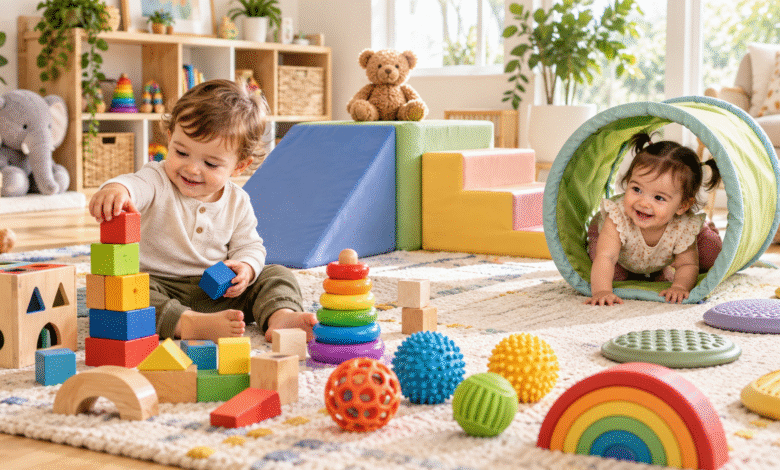
Motor development generally includes two connected areas: fine motor skills and gross motor skills. Fine motor skills involve smaller movements, particularly those controlled by the hands and fingers. Activities such as stacking blocks, turning pieces, drawing, grasping objects, and fitting shapes into openings help children practice hand control and coordination.
Gross motor skills involve larger movements and major muscle groups. Walking, climbing, crawling, balancing, jumping, and throwing all give toddlers opportunities to improve body control and coordination.
The two areas often work together. A toddler may crawl toward a toy, stand up, carry it, sit down, and then use their fingers to manipulate it. This combination of whole-body movement and precise hand movements is a natural part of active play. Choosing toys that encourage different types of movement can therefore create a more varied and engaging play experience.
How Climbing and Movement Toys Build Confidence
Active toys can give toddlers opportunities to practice balance, spatial awareness, coordination, and controlled movement. Soft climbing structures, tunnels, ramps, balance equipment, and other age-appropriate play sets encourage children to move their bodies in different ways.
For families looking for equipment designed around active exploration, Banasuper offers play options such as climbing sets, arches, tunnels, balance-focused equipment, and modular foam products. These types of toys can give children a safe environment in which to experiment with movement while developing physical confidence.
The goal is not to make every play session a structured workout. Instead, toddlers can decide how they want to interact with the equipment. One child may crawl through a tunnel repeatedly, while another may focus on climbing over a soft obstacle. Repetition gives children a chance to become more comfortable with movement and gradually develop greater control.
Why Sensory Play Matters for Toddlers
Sensory development is closely connected to movement. Toddlers learn about their surroundings through touch, sight, sound, body movement, and awareness of where their bodies are positioned in space.
Toys with different shapes, surfaces, textures, and physical characteristics can encourage children to explore these sensations naturally. Building, squeezing, pushing, pulling, carrying, crawling, and balancing all provide different types of sensory experiences.
Movement itself can also provide valuable sensory input. When a toddler climbs over a soft structure or balances on a low surface, they have to pay attention to changes in body position and movement. This encourages them to understand how their bodies interact with the environment.
For parents, sensory play does not have to involve complicated activities or specialized materials. Simple toys that encourage hands-on exploration can create meaningful opportunities for children to touch, move, experiment, and discover.
Choosing Toys That Encourage Open-Ended Play
One of the biggest advantages of open-ended toys is that they can be used in multiple ways. Instead of having one fixed purpose, a climbing block, soft play piece, tunnel, or modular cushion can become part of many different games.
A toddler might use a soft block as an obstacle, a step, a seat, or part of a pretend-play structure. This flexibility encourages children to make decisions and experiment with their own ideas. It also allows the same toy to remain interesting as their abilities change.
Open-ended play can support physical development while also encouraging creativity and early problem-solving. A child may discover that moving one piece changes the way they can climb over another, or that arranging blocks differently creates a new pathway.
The best developmental toys are therefore not necessarily the most complicated ones. A simple design that encourages children to move, manipulate, imagine, and repeat can provide meaningful value over time.
Creating a Balanced Play Environment
A toddler does not need a room filled with toys to benefit from play. A thoughtful selection of age-appropriate options can provide opportunities for active movement, fine motor practice, creativity, and sensory exploration.
Parents can combine active toys with quieter activities. After climbing, crawling, or balancing, a child might sit down to build with blocks, turn pages in a book, draw, or explore a simple puzzle. This creates natural changes between whole-body movement and focused hand activity.
Safety should always remain part of the decision-making process. Toys should be appropriate for the child’s age and abilities, and parents should follow manufacturer safety recommendations. Young children also need supervision around climbing equipment and any toys that could present hazards.
Most importantly, developmental play should remain enjoyable. Children develop at different rates, so toys should provide opportunities to practice rather than create pressure to reach a particular milestone.
Conclusion
Toddler play is much more than a way to keep children occupied. Everyday activities such as climbing, crawling, balancing, stacking, building, and exploring textures can give children opportunities to strengthen coordination and understand how their bodies interact with the world.
Fine motor activities help children develop control of their hands and fingers, while gross motor play supports balance, movement, strength, and body awareness. Sensory experiences add another important dimension by allowing toddlers to explore touch, movement, space, and physical cause and effect.
For parents, the most useful approach is often to provide a safe and varied environment where children can explore at their own pace. Toys that encourage movement and open-ended discovery can remain valuable as a toddler’s abilities grow. With thoughtful choices and plenty of opportunities for active play, ordinary playtime can become an important part of a child’s early physical, sensory, social, and cognitive development.