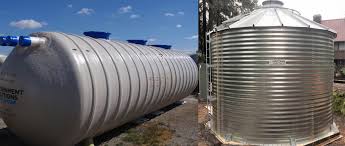
Rainwater storage plays a key role in managing household and property water use. The design of the tank directly influences how effectively water is stored, maintained, and accessed over time. Round water tanks are widely used because their shape supports structural strength, efficient water movement, and reliable long-term performance.
For property owners looking to build a dependable rainwater system, exploring round water tanks helps identify options that balance durability, capacity, and ease of installation.
Even Pressure Distribution Improves Structural Strength
Water stored in a tank places constant outward pressure on the walls. In round water tanks, this pressure is distributed evenly across the entire surface.
This even distribution reduces the likelihood of stress points forming in specific areas. Tanks with flat sides or corners tend to concentrate pressure at edges, which can lead to deformation or long-term wear. A circular design avoids this by maintaining a continuous surface that shares the load evenly.
This structural advantage makes round tanks suitable for both residential and larger-scale storage applications where consistent performance is required.
Internal Water Movement Supports Cleaner Storage
Water movement inside the tank affects how sediment settles and how easy the system is to maintain. Round water tanks promote more consistent internal flow because there are no corners where water can stagnate.
In tanks with angular shapes, sediment can collect in low-flow areas, making cleaning more difficult and increasing the likelihood of uneven buildup. A circular design allows sediment to spread more evenly across the base, simplifying maintenance.
This supports cleaner storage conditions over time, particularly when combined with filtration and regular system checks.
Better Performance in Outdoor Conditions
Above-ground tanks are exposed to environmental factors such as wind, temperature changes, and sunlight. Round water tanks perform well in these conditions due to their curved shape.
Wind moves more smoothly around a circular structure, reducing pressure on the tank walls. Temperature-related expansion and contraction are also distributed evenly, helping maintain material stability.
For example, in open outdoor areas where wind exposure is higher, a round tank is less likely to experience concentrated stress compared to a flat-sided alternative. This contributes to long-term durability.
Practical Installation and Maintenance
Round water tanks are straightforward to install when placed on a stable base such as a concrete slab or compacted ground. Their even weight distribution helps prevent uneven settling, which can affect performance over time.
Maintenance is also simplified. Without corners, there are fewer areas where debris can collect heavily. This makes internal cleaning and inspection more manageable.
A complete rainwater system should include clean roof catchments, clear gutters, and effective filtration components. The tank design supports these elements by allowing easier access and maintenance.
Flexible Capacity for Different Applications
Round tanks are available in a wide range of sizes, making them suitable for various uses. Smaller tanks can support garden irrigation or basic household needs, while larger tanks are used for rural properties or high-volume storage.
The ability to choose different diameters and heights allows tanks to fit different spaces. For example, a narrow tank can be installed alongside a house, while a larger tank may be placed in an open area where capacity is the priority.
This flexibility allows property owners to match storage capacity with actual water usage requirements.
Supporting Overall System Performance
A rainwater tank operates as part of a larger system that includes gutters, filters, pumps, and overflow management. Round water tanks support these components by maintaining consistent internal pressure and predictable water flow.
This helps pumps operate more efficiently and reduces strain on fittings. Stable water movement also supports filtration systems, improving overall performance.
Selecting a well-designed tank contributes to the reliability of the entire system rather than just the storage component.
Suitable for Long-Term Water Storage
Rainwater is often stored for extended periods, particularly in areas with irregular rainfall. Round water tanks are well suited to this because they maintain structural integrity and stable storage conditions over time.
When combined with proper system design, including inlet screening and first-flush devices, the tank helps preserve water quality for longer periods.
This makes them suitable for applications such as irrigation, household water use, and rural operations where consistent supply is important.
A Reliable Choice for Rainwater Storage
Round water tanks provide a practical and reliable solution for rainwater storage. Their circular design supports structural strength, improves water movement, and performs well in outdoor environments.
For homeowners and property managers, these advantages contribute to a system that is easier to maintain and more consistent over time. By selecting the right tank and supporting components, it becomes possible to build a rainwater system that delivers dependable performance across a range of conditions while supporting efficient water use and reducing long-term reliance on mains water supplies in residential and rural settings.