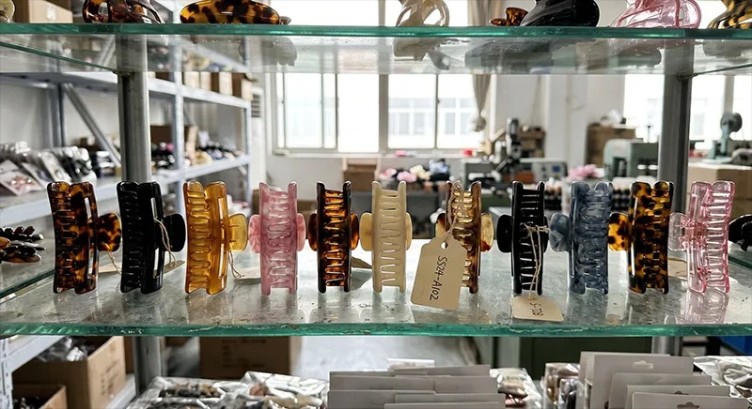
Hair clips are one of the fastest-growing segments in the accessories market, yet most consumers never think about what goes into making them. For the brands behind the product — from independent labels to global retailers — the material choice made at the factory level determines everything from retail pricing to customer retention.
Two materials dominate commercial hair clip production today: ABS plastic and cellulose acetate. Understanding the difference between them is not just a manufacturing detail — it is a brand strategy decision.
ABS Plastic: The Mass-Market Standard
ABS (acrylonitrile butadiene styrene) is the workhorse of the hair clip industry. It is lightweight, impact-resistant, inexpensive to mould and available in virtually any colour or surface finish. The vast majority of hair clips sold through mass-market retail, supermarkets and budget e-commerce listings are produced in ABS.
From a business perspective, ABS offers clear advantages. Injection moulding tooling is relatively low-cost, minimum order quantities can start from 500 to 1,000 pieces per design, and production turnaround is fast — typically 25 to 30 days for bulk orders. For brands entering the market at accessible price points, ABS is the logical starting material.
The trade-off is differentiation. Because ABS is so widely available and easy to produce, it is difficult to create a product that stands apart on a shelf full of near-identical competitors. This is where the second material enters the picture.
Cellulose Acetate: The Premium Alternative
Cellulose acetate is a semi-natural thermoplastic derived from wood pulp or cotton fibres. Unlike ABS, it is not injection-moulded — instead, it is cut from sheets, hand-shaped, tumble-polished or spray-coated, resulting in a denser, heavier product with a glass-like surface finish and natural translucency.
Each acetate sheet carries subtle variations in colour and pattern, meaning no two clips are perfectly identical. For fashion-forward brands and premium private label lines, this material characteristic is a selling point rather than a flaw. It signals craftsmanship and quality in a way that uniform plastic cannot.
The business trade-off is cost and complexity. Acetate clips typically carry a higher unit price, require more skilled finishing work and involve longer lead times — around 40 to 50 days from sample approval to delivery. Minimum order quantities, however, can actually be lower than ABS (often 300 to 500 pieces per SKU), making acetate surprisingly accessible for smaller brands testing premium positioning.
Why This Matters for Brand Builders
The material decision is ultimately a positioning decision. A brand targeting the value segment will build around ABS, optimising for volume, speed and margin. A brand targeting the mid-to-premium segment will lean into acetate, using material quality as a core differentiator.
Many successful hair accessory brands run both materials in parallel — ABS for their core everyday range and acetate for limited-edition or seasonal collections. This dual approach maximises market coverage without diluting brand perception at either end.
For founders and product managers evaluating manufacturing partners, the key question is whether a factory can handle both material streams with consistent quality control. A detailed comparison of hair clip manufacturers in China breaks down ten verified producers by capability, certification and material specialisation — useful for anyone in the early stages of supplier evaluation.
The Bigger Takeaway
Hair clips may seem like a simple product, but the supply chain decisions behind them are anything but. Material selection, factory capability, finishing quality and minimum order structures all compound to shape the final product and its market position.
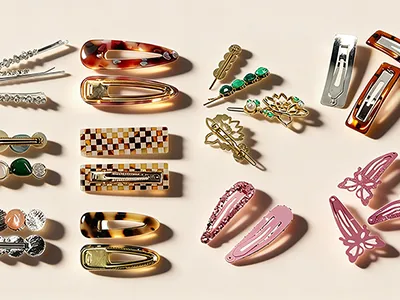
For a deeper look at how different clip types — from jaw clips and barrettes to snap clips and banana clips — differ in construction, material and intended market, this guide to hair clip types and materials provides a comprehensive reference covering both consumer and sourcing perspectives.
In a category where margins are tight and competition is fierce, the brands that understand their supply chain at the material level are the ones that build lasting customer loyalty.