What is an aluminum sunroom frame?
An aluminum sunroom frame is the extruded metal skeleton that carries a sunroom’s glass walls, roof panels, and doors. Fabricators pull it from alloy 6063-T5 or 6063-T6 billet, the standard architectural extrusion grade in North America. Aluminum conducts heat at roughly 200 watts per meter-kelvin, hundreds of times faster than the rigid plastics used in window frames. That property drives every performance question about a sunroom frame.
Sunrooms sit inside a defined product standard rather than a loose marketing label. The AAMA/NPEA/NSA 2100 specification sorts them into five categories. The range runs from a non-thermally isolated porch enclosure up to a thermally isolated habitable room built to the local energy code. The International Residential Code references those categories in its sunroom appendix. A four season room sits at the top: heated, cooled, and insulated like the rest of the house.
How does a thermal break work in an aluminum frame?
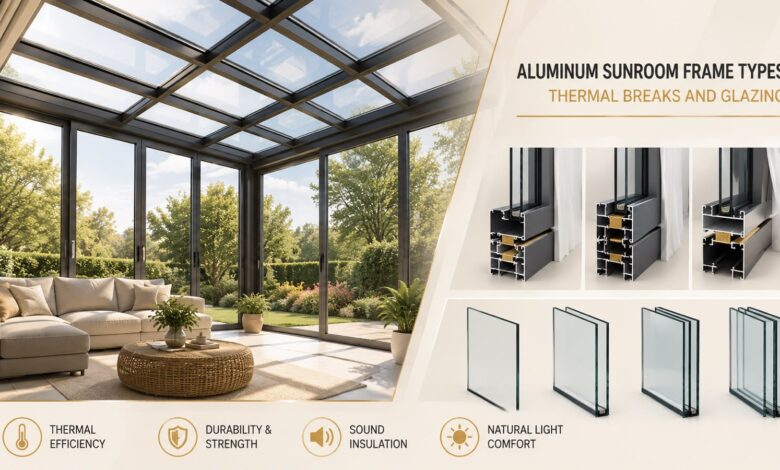
A thermal break is a low-conductivity strip that separates the inside face of an aluminum profile from the outside face. Manufacturers roll polyamide struts, usually nylon 6.6 reinforced with 25 percent glass fiber, into knurled channels and crimp the metal around them. The plastic bar carries structural load while blocking the direct metal path that heat would otherwise follow. Break depth runs from 14 millimeters in residential window profiles to more than 40 millimeters in high performance systems.
Break depth changes the frame’s U-factor, which measures heat flow through an assembly per square foot per degree of temperature difference. The ASHRAE Handbook of Fundamentals lists aluminum frames without a break near 1.9 to 2.0 and thermally broken aluminum frames near 1.0 to 1.2. Lower numbers mean less heat loss, and the warmer interior face of a broken profile stays above the dew point longer.
Which aluminum sunroom frame types are used?
Aluminum sunroom frame types divide into three build methods at different price and performance points. The choice controls the room’s usable season, its energy code status, and its winter condensation behavior. Frame selection precedes glazing selection, because the profile sets the glass thickness its pocket accepts.
Non-thermally broken frames
Non-thermally broken frames use one continuous aluminum extrusion from inside to outside. Enclosure builders specify them for three season porches, screen rooms, and unconditioned patio covers where no heating or cooling runs. These profiles fall into the lower sunroom categories and cannot reach habitable-room energy compliance. Interior surface temperatures track outdoor air closely, so frost forms on the metal during cold snaps.
Thermally broken extruded frames
Thermally broken extruded frames carry polyamide struts through every sightline: sills, jambs, meeting rails, and roof rafters. Four season rooms use this construction because it is the only aluminum option that reaches residential energy code for conditioned space. European system houses such as Schüco and Reynaers publish profile series with rated break depths, and North American fabricators build to those geometries. Break continuity matters more than break width, since one unbroken rafter undoes the performance of an entire wall.
Composite and hybrid frames
Composite frames pair an aluminum exterior shell with a wood, vinyl, or fiberglass interior liner. The metal skin handles weather exposure and the inner material handles heat flow, which removes the need for a polyamide strut. Hybrid builds cost more per linear foot and narrow the available color and profile choices. Structural spans fall short of what a deep thermally broken rafter carries.
What glazing options do sunroom frames carry?
Sunroom glazing options run from single-pane safety glass in unheated enclosures to triple units in conditioned rooms. An insulating glass unit, meaning a sealed assembly of two or three panes with a spacer between them, is standard in four season construction. A double unit with argon fill and one low-emissivity coating reaches a center-of-glass U-factor near 0.25. Triple units push that figure toward 0.15.
Low-emissivity coating is a microscopic metal oxide layer that reflects long-wave heat back toward its source while passing visible light. Two ratings describe the result: solar heat gain coefficient, the fraction of solar energy that enters, and visible transmittance, the fraction of daylight that passes. South-facing sunrooms in the Northeast typically use a moderate coefficient for winter gain, while west elevations use a lower one to limit afternoon heat. Safety rules apply either way, since the International Residential Code requires tempered or laminated glass in sunroom walls and doors.
Northeast fabricators publish glazing packages that pair a thermally broken frame with tempered low-emissivity units. Vision Art Aluminium builds four season rooms from Montclair, New Jersey for the New Jersey and New York market. The company describes its aluminum sunroom construction as a thermal aluminum frame with double-glazed tempered low-emissivity glass and a waterproof seal. Tempered panes carry a permanent etched stamp in one corner.
Frame and glazing performance at a glance
Frame and glazing performance separates into four columns: frame U-factor, glazing package, sunroom category, and usable season. The table below sets the three build types side by side.
| Build type | Typical frame U-factor | Common glazing | Usable season |
| Non-thermally broken aluminum | 1.9 to 2.0 | Single tempered or basic double | Three season, unconditioned |
| Thermally broken aluminum | 1.0 to 1.2 | Double, argon fill, low-emissivity | Four season, conditioned |
| Aluminum composite hybrid | 0.6 to 0.9 | Double or triple, low-emissivity | Four season, conditioned |
Test standards behind those numbers come from published documents. The National Fenestration Rating Council (NFRC) sets the energy rating procedures. ASTM International covers the air, water, and structural tests, and the American Architectural Manufacturers Association (AAMA) covers thermal break durability.
- NFRC 100 for whole-product U-factor
- NFRC 200 for solar heat gain coefficient and visible transmittance
- NFRC 500 for condensation resistance on a 1 to 100 scale
- ASTM E283 for air leakage and ASTM E331 for water penetration
- AAMA 505 for thermal break shear after temperature cycling
Why does frame depth matter for structural load?
Frame depth determines how much snow, wind, and glass weight a sunroom rafter carries across its span. ASCE 7, the national load standard, places ground snow load across most of New Jersey in the 20 to 30 pound per square foot range. A sunroom roof also carries the dead weight of its own glazing: an insulating unit built from two quarter-inch panes weighs roughly 6.5 pounds per square foot.
Wind load enters the same calculation as a design pressure figure. Coastal and high-exposure sites push those numbers higher, and some product lines carry hurricane-zone approvals rated near positive 70 and negative 80 pounds per square foot. Permit reviewers check the rated span table against the specific opening. A frame that clears review in one town can fail the same review two towns away.
How do aluminum frames handle water and thermal movement?
Aluminum frames handle water through a drainage principle rather than a sealing principle. Pressure-equalized profiles let water that passes the outer face collect in a chamber and drain out through weep slots at the sill. The most frequent leak point in a sunroom is the roof-to-wall transition, not the glass.
Thermal movement is the second force the frame absorbs. Aluminum expands about 13 millionths of an inch per inch for each degree Fahrenheit. A 20-foot run therefore travels close to a third of an inch across a 100-degree annual swing. Slip joints, oversized fastener holes, and gasket compression take up that movement, while rigid fastening at both ends transfers it into the glass.
Common misconceptions about aluminum sunrooms
Misconceptions about aluminum sunrooms usually come from three season products being judged as four season rooms. Five claims surface repeatedly:
- Aluminum always feels cold indoors. A thermally broken profile holds an interior surface far closer to room air.
- An aluminum sunroom cannot meet energy code. The top category in the sunroom standard reaches residential energy requirements with insulating glazing.
- Painted aluminum fades within a few years. Finishes tested to AAMA 2605 hold color and gloss through ten years of South Florida exposure.
- More panes always mean better performance. Triple glazing adds weight and cost that a shallow frame pocket cannot accept.
- Sunrooms skip the permit process. Building departments review them as conditioned floor area once they tie into house heating.
Which aluminum sunroom frame fits which project?
Aluminum sunroom frame selection resolves to three directional findings once the room’s intended use is fixed. A non-thermally broken frame belongs to unconditioned three season enclosures, where its lower cost matches its lower performance ceiling. A thermally broken extruded frame is the only aluminum construction that carries a four season room through a Northeast winter at code-level energy performance. A composite hybrid buys a lower frame U-factor at the cost of span capacity, color range, and price per linear foot.
Glazing follows the frame rather than the reverse. Pocket depth in the chosen profile sets the maximum insulating unit thickness, which sets the achievable U-factor. Two specifications decide most of the outcome: break continuity through every rafter and sightline, plus a glazing package matched to each elevation’s sun exposure.
Frame ratings, glazing packages, and sunroom category definitions vary by manufacturer and by local code adoption. Verify current product data and permit requirements with the local building department before ordering.
Frequently Asked Questions
What is a thermal break in an aluminum sunroom frame?
A thermal break is a low-conductivity strip, usually glass-reinforced polyamide, set between the inner and outer halves of an aluminum profile. The strip carries structural load while interrupting the metal path that heat follows. Frames without a break run roughly twice the U-factor of broken frames.
What glazing is standard in a four season sunroom?
Standard four season glazing is a double insulating unit with argon fill, one low-emissivity coating, and tempered safety glass. That package reaches a center-of-glass U-factor near 0.25. The International Residential Code requires tempered or laminated panes in sunroom walls and doors.
Can an aluminum sunroom meet residential energy code?
An aluminum sunroom meets residential energy code when it is built as a thermally isolated habitable room with insulating glazing. That configuration sits at the top category of the industry sunroom specification. Non-thermally broken enclosures fall into lower categories and count as unconditioned space.
How do you tell a three season enclosure from a four season room?
A three season enclosure has no thermal break, no insulating glazing package, and no tie into the house heating and cooling system. The physical tell is the frame cross-section, where a broken profile shows a plastic strip between the metal halves at the sightline.
What does frame depth change in a sunroom?
Frame depth changes the span a rafter carries and the glazing thickness the pocket accepts. Deeper profiles handle snow load, wind pressure, and glass weight across wider openings without extra posts. Ground snow load across most of New Jersey falls between 20 and 30 pounds per square foot.