What Is the Difference Between a 12-Valve and a 24-Valve Cummins — and Why Does That Choice Drive Every Other Decision in a Swap Build?

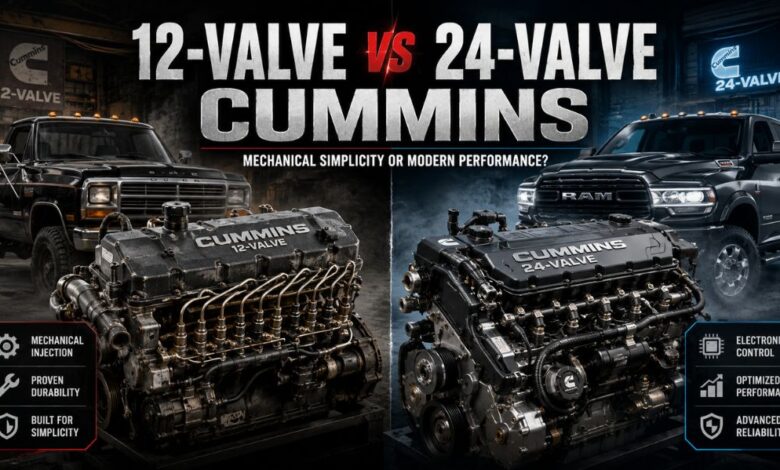
Few choices in the diesel swap world generate more passionate opinion, more forum debate, or more nuanced technical discussion than the question of which generation Cummins inline-six belongs in a build. The 12-valve — the first-generation 5.9-liter that arrived in Ram trucks in 1989 and continued through 1998 — and the 24-valve, which replaced it from 1998 through the common-rail era, represent not just different engineering solutions to the same problem but different philosophies about what makes a diesel engine excellent. And because every subsequent decision in a swap build flows from this foundational choice — fuel system, cooling, electronics integration, tuning approach, long-term reliability strategy — getting clear on the distinction between them is genuinely the right place to start.
The 12-valve: mechanical simplicity as a design virtue.
The 5.9-liter 12-valve — officially the Cummins B series, produced in collaboration with case-iron honesty and a P7100 injection pump — is, by any objective measure, one of the most mechanically straightforward diesel engines ever fitted to a production truck. It has no electronic controls governing its fuel delivery. The P7100 injection pump is a purely mechanical rotary pump that meters fuel to each cylinder through precisely timed mechanical actuation. There is no ECM interpreting sensor data and adjusting injection events. There is no common rail building pressure waiting to be triggered by solenoid valves. There is a pump, high-pressure lines, and injectors, all operating within a mechanical logic that a skilled diesel mechanic can understand, diagnose, and modify with conventional tools.
This mechanical simplicity is one of the primary reasons the 12-valve commands such loyal following in the swap community. A vehicle that depends on its engine exclusively in remote or austere environments — an overland rig, a farm truck, a military-application build — gains real resilience from an engine whose failure modes are diagnosable and repairable without electronic diagnostic equipment. The 12-valve doesn’t care about ECM compatibility, communication protocols, or CAN bus integration with a new chassis. It runs because a mechanical pump pushes fuel, and it keeps running as long as that pump is maintained.
For tuning, the mechanical advantage is equally real. Increasing fueling on a P7100 is a matter of physical adjustment — turning a screw, modifying the governor spring, installing an AFC housing. The results are immediate, predictable, and reversible. Builders chasing high horsepower numbers find the 12-valve’s mechanical tunability genuinely accommodating, though smoke output and thermal management become progressively significant as fueling increases beyond the stock calibration.
The 24-valve: capability and complexity in equal measure.
The 24-valve Cummins — introduced in 1998 and characterized by its VP44 rotary injection pump in early versions and common-rail injection in later iterations — represented a substantial step forward in power output, fuel efficiency, and emissions performance. The additional valvetrain complexity it implies in its name reflects the engine’s move toward better combustion efficiency: two intake and two exhaust valves per cylinder, improved cylinder filling, and cleaner combustion at higher loads.
The VP44 pump that powered first-generation 24-valve engines is electronically controlled — injection timing and duration are determined by the ECM, using input from the crankshaft position sensor, coolant temperature, throttle position, and other parameters. This electronic governance enables more precise fuel delivery across a wider range of operating conditions, contributing to improved driveability, better cold-start behavior, and reduced emissions relative to the mechanical 12-valve. It also introduces a dependency on electronics that changes the character of the engine significantly.
In a swap application, this electronic dependency creates integration work that the 12-valve doesn’t require. The VP44 needs an ECM and the sensor inputs that ECM expects. The ECM needs to communicate correctly with the chassis it is installed in, or the engine may run poorly, throw faults, or not run at all. For a builder installing a 24-valve in a non-Dodge chassis, resolving these integration requirements is a real engineering task, not a bolt-in exercise.
How the fuel system differs between the two platforms.
The fuel system requirements of each generation reflect their injection system fundamentally. Cummins engine fuel systems for the 12-valve are organized around supplying adequate volume and pressure to the P7100 — the pump does the work of building injection pressure internally, so the lift pump requirements and feed line specifications are relatively forgiving by diesel standards. Filter placement, line sizing, and lift pump capacity are the primary variables, and they are well-documented in the swap community.
The 24-valve with VP44 introduces additional sensitivity: the VP44 pump is lubricated by the fuel flowing through it, making fuel quality and filtration upstream of the pump directly consequential for pump longevity. VP44 failures are among the most commonly discussed reliability concerns in this generation, and a significant proportion trace to inadequate lift pump pressure or contaminated fuel reaching the pump. In a swap context, where the fuel routing is custom rather than factory-designed, getting these supply requirements right requires more deliberate engineering than the 12-valve demands.
Why the choice cascades through the entire build.
The 12-valve-versus-24-valve decision doesn’t just determine what injection pump sits under the valve cover. It determines the electronics integration strategy, the fuel system architecture, the tuning pathway, and the long-term maintenance and repair profile of the entire vehicle. A builder who values simplicity, mechanical reliability, and independence from electronics will find the 12-valve consistently rewarding. One who prioritizes maximum capability, driveability refinement, and modern power output will find the 24-valve’s additional complexity worth managing.
Neither engine is categorically better. Each is better for a specific kind of builder, a specific kind of build, and a specific set of priorities. Understanding the distinction — really understanding it, across fuel systems and electronics and tunability and long-term reliability — is what separates a swap that runs well for twenty years from one that spends its life half-finished in a garage.