Money laundering is not an abstract financial crime confined to shadowy back rooms. It happens on platforms used by millions of people every day, and two industries are at the center of this problem more than most: cryptocurrency exchanges and online gambling.
The reasons are structural, not coincidental. And for the businesses operating in these spaces, the consequences of ignoring that reality are growing more serious by the year.
The Money Laundering Problem of Crypto and Online Gambling
Both industries share characteristics that make them attractive to anyone seeking to disguise the origins of illegal funds. Crypto transactions can be pseudonymous, fast, cross-border, and difficult to reverse.
Online gambling platforms allow users to deposit funds, wager them, and withdraw winnings, effectively laundering dirty money through a legitimate-looking chain of transactions. High transaction volumes, international user bases, and the speed at which money moves through these systems create significant gaps in visibility. Criminals deliberately exploit those gaps with sophistication.
Also, unlike a traditional bank transfer, blockchain transactions do not automatically link to a verified identity. Many gambling platforms operate across multiple jurisdictions, fragmenting oversight and making coordinated enforcement harder. Add to this the prevalence of peer-to-peer exchanges, mixers, and anonymous wallets, and you have an environment where tracing the true source of funds becomes genuinely difficult without proper systems in place.
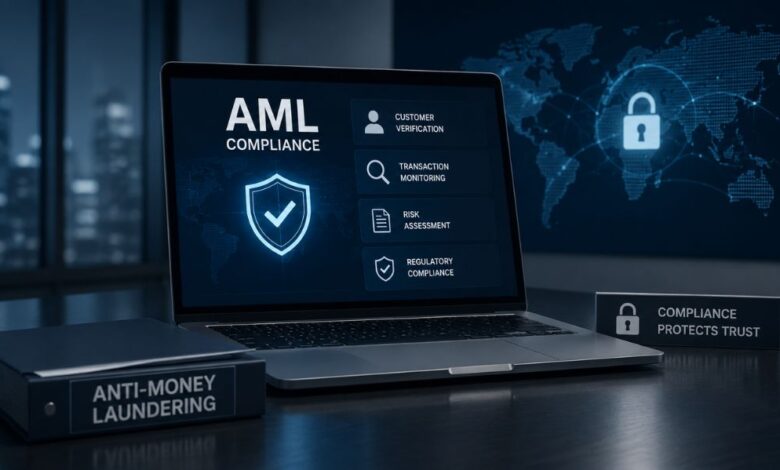
More and more reputable platforms operating in these niches have begun taking the necessary precautions to prevent such attempts, mostly by relying on high-quality AML screening software. These systems automate AML compliance by continuously screening both customers and business partners against global sanctions lists and reputational risk sources. The result is a real-time, structured layer of protection that removes the need for slow, error-prone manual checks.
Platforms that once treated AML checks as a box-ticking exercise are recognizing that ongoing, continuous screening is what actually prevents financial crime. A one-time check at onboarding is no longer sufficient when customer risk profiles can change overnight.
What the Law Requires
Regulatory frameworks across major jurisdictions have become increasingly specific about what crypto and gambling businesses must do. In the European Union, the Anti-Money Laundering Directives explicitly classify crypto asset service providers as obliged entities. This means they must conduct customer due diligence, monitor transactions, and report suspicious activity to financial intelligence units. Online gambling operators are similarly covered under EU AML law, with member states required to enforce these standards at the national level.
The United Kingdom has its own framework through the Proceeds of Crime Act and the Money Laundering Regulations. The Financial Conduct Authority supervises UK-registered crypto firms, and the Gambling Commission enforces AML obligations on licensed gambling operators.
The US takes a parallel approach through the Bank Secrecy Act, requiring FinCEN to register crypto exchanges as money services businesses and to require them to maintain full AML programs, including suspicious activity reporting.
The Core AML Obligations Every Platform Must Meet
At a practical level, AML compliance for crypto and gambling platforms comes down to several connected obligations.
Customer due diligence (commonly called KYC, or Know Your Customer) is the foundation. Platforms must verify users’ identities before they can transact, and for higher-risk customers, enhanced due diligence is required. This means gathering additional information, scrutinizing the source of funds, and applying closer ongoing monitoring.
Transaction monitoring is the next layer. Platforms need systems capable of identifying patterns that suggest money laundering, such as unusually large deposits, rapid fund movements, structuring behavior designed to avoid reporting thresholds, or transactions that do not match a customer’s stated profile.
Sanctions screening is equally critical. Businesses must ensure they are not providing services to individuals or entities on government sanctions lists, including politically exposed persons, designated terrorists, or companies subject to international restrictions.
However, this is not a one-time check. Sanctions lists are updated frequently, and a customer who was clean at onboarding may appear on a list months later. Continuous screening addresses this gap in a way that periodic manual checks simply cannot.
The Real Cost of Getting This Wrong
Non-compliance carries severe financial consequences. Regulatory fines in the crypto and gambling sectors have reached tens of millions of dollars in high-profile cases.
Beyond the monetary penalties, businesses face the loss of operating licenses, effectively a death sentence for a platform that depends on regulatory approval to function. Banking relationships can be withdrawn when financial institutions assess a business as too high-risk to maintain.
Reputational damage is harder to quantify but equally damaging. In industries where trust is already fragile, a compliance failure can permanently alter how a platform is perceived. The cost of preventing this (investing in proper screening, monitoring, and reporting infrastructure) is consistently lower than the cost of dealing with the fallout after the fact.
Building a Compliant Future in High-Risk Industries
Compliance is often framed as a constraint, but for platforms operating in crypto and online gambling, it is better understood as a competitive advantage. Businesses that demonstrate rigorous AML practices are more attractive to institutional partners, more likely to retain banking relationships, and better positioned to expand into regulated markets.
Regulators across the EU, UK, and US have signaled that enforcement will intensify, not ease, in the years ahead.
For any platform serious about this, the operational backbone matters enormously. A well-implemented compliance risk management platform brings together sanctions screening, PEP checks, transaction monitoring, and audit-ready reporting into a single platform, reducing operational burden while strengthening the overall compliance posture.
That kind of infrastructure is no longer optional for platforms operating in high-risk industries. It is the baseline standard that regulators, banking partners, and increasingly, customers themselves, expect to see. In essence, the platforms that will thrive are those that treat compliance as an operational priority rather than a legal formality.