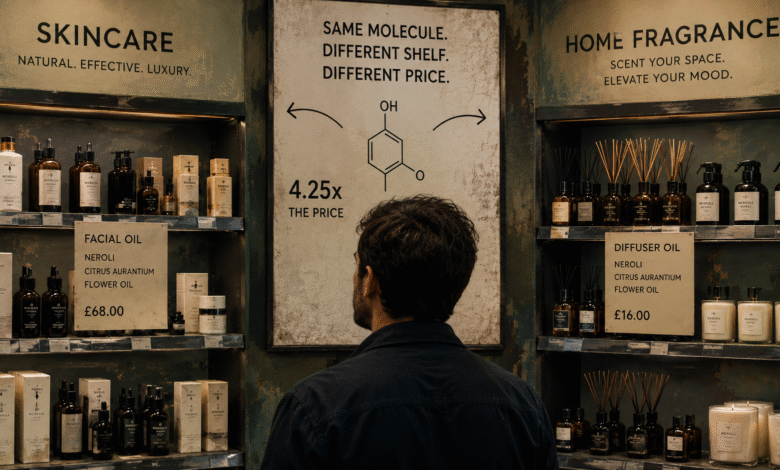
There is a quiet absurdity in the layout of most health and beauty retailers. On one side, essential oils marketed as skincare ingredients — serums, face oils, botanical extracts positioned as luxury cosmetic products at luxury cosmetic prices. Three aisles over, the same compounds appear as home fragrance components — diffuser oils, candle fragrances, room sprays. The molecule is identical. The markup reflects the shelf it landed on. The consumer who has noticed this is not a cynic. They are simply someone who has spent enough time reading ingredient lists to recognise the same name in two different contexts — and has drawn the obvious conclusion about what they are actually paying for when the price points diverge by a factor of four.
When the Ingredient Becomes the Product
The clean beauty movement started, ostensibly, as a conversation about what should not be in cosmetic products. It became, over time, something more interesting: a conversation about what actually is in them, and whether the consumer could engage with those ingredients directly rather than through the finished formulation that a brand had decided, for its own reasons, to build around them.
This shift from avoidance to engagement changed the nature of the consumer’s relationship with the ingredient. The buyer who avoids parabens is still a passive recipient of someone else’s formulation decisions. The buyer who seeks out specific botanical oils, understands their properties and incorporates them into their own routine has become something closer to a practitioner — someone with working knowledge of the materials rather than a preference about the label.
The home fragrance category went through a parallel development, largely independently and without much cross-pollination until recently. The consumer who started making their own candles discovered that the fragrance oils and essential oils they were working with were the same materials appearing in the beauty products they used. The boundary between the category where you apply something to your body and the category where you diffuse it into your living space turned out to be a retail convention rather than a chemical reality.
The Infrastructure of the Crossover
What made the convergence commercially visible was the development of a supply infrastructure that serves both categories without distinguishing between them. The specialist supplier of base oils, botanical extracts and fragrance compounds does not, in most cases, ask what the buyer intends to do with the material. The same rosehip oil goes into a face serum or a candle depending on what the buyer has in mind. The same lavender extract scents a skincare product or a room diffuser.
Consumers who have found their way to this infrastructure — through DIY cosmetics communities, through home fragrance forums, through the particular curiosity of someone who read enough ingredient lists to want to meet the ingredients directly — tend to experience it as a kind of revelation. The mystification that surrounds premium beauty pricing, the implication that the active ingredient in a fifty-pound face oil is something rare and technically complex, dissolves when you can order the same ingredient by the hundred millilitres from online stores for example: Bigvapoteur, that supply both home crafters and small-batch producers.
The Sensory Environment as a Single Design Problem
The more interesting development is not economic but aesthetic. The consumer who is sourcing their own skincare ingredients and their own home fragrance materials from the same supply chain starts to think about their body and their space as a single sensory environment — one that can be designed with the same intentionality, using some of the same materials, toward a coherent olfactory and tactile experience.
This is a different relationship with domestic space than the one most home fragrance marketing imagines. The consumer who buys a scented candle from a lifestyle brand is purchasing an atmosphere that someone else designed. The consumer who sources their own fragrance components and builds their own scent palette — for their skin, for their rooms, for different times of day and different moods — is the designer. The materials are the medium.
This shift in orientation has commercial implications that the market is still absorbing.
As Bigvapoteur points out: “The consumer who has moved into active design of their sensory environment is a different buyer from the one who purchases finished lifestyle products. They spend more, but differently — on materials rather than on branded formulations, on the components that allow them to create rather than on the objects that deliver someone else’s creation. The brands that have understood this and positioned themselves as suppliers of creative raw material rather than finished product have found an audience that the conventional home fragrance or beauty brand cannot easily reach”.
What the Shelf Division Costs
The retail convention of separating beauty ingredients from home fragrance components — of pricing the same molecule differently depending on which section of the store it appears in — is increasingly legible to the consumer who has done even modest research into what they are buying. This legibility is not yet universal, but it is spreading through the networks of consumers who share knowledge about ingredients, sourcing and the gap between what products cost to make and what they cost to buy.
The brands that will weather this transparency most effectively are not those that obscure the ingredient but those that are honest about what the premium is actually paying for — the formulation expertise, the stability testing, the sensory development that turns a raw material into a finished product that performs consistently. It is also a service that a growing number of consumers have decided they can, in whole or in part, perform themselves.