Learning a new language used to mean sitting in a classroom, memorizing verb charts, and hoping you would remember them the next day. Today, things look very different. Millions of people are picking up new languages on their phones, in short daily sessions, guided by artificial intelligence that adjusts to how they learn best.
If you have ever opened a learn spanish app on your morning commute or practiced a few phrases before bed, you have already experienced this shift firsthand. AI is not just making language learning more convenient. It is changing the entire process, from how lessons are built to how mistakes are corrected.
The Shift From Traditional Classrooms to Smart Apps
For decades, language education followed a fairly rigid pattern. A teacher would present grammar rules, students would practice with textbook exercises, and progress was measured through tests. This approach worked for some people, but it often left others frustrated, especially those who needed more repetition or a different pace than the rest of the class.
Apps changed the equation by putting control back in the learner’s hands. But early language apps were still fairly basic. They offered flashcards, quizzes, and pre-set lessons that everyone followed in the same order. What has really transformed the experience in recent years is artificial intelligence working quietly in the background, adjusting content based on how each person actually learns.
Why Personalization Matters So Much
No two learners are the same. Some people struggle with pronunciation but pick up vocabulary quickly. Others can read fluently but freeze up during conversation. Traditional courses rarely accounted for these differences, since one teacher could only do so much for a room full of students with different needs.
AI changes this by tracking individual performance in real time. If someone keeps mixing up verb tenses, the system quietly brings those tenses back into future lessons until they stick. If a learner already knows basic greetings, the app skips ahead instead of wasting their time. This kind of responsiveness is one of the biggest reasons a learn spanish app today feels so different from the language software of ten years ago.
How AI Actually Builds a Learning Path
Behind the scenes, these apps rely on data and pattern recognition to shape lessons. Every time a user answers a question, skips a word, or hesitates before responding, the app collects that information. Over time, it builds a picture of the learner’s strengths and weaknesses.
This is where machine learning comes in. Instead of following a fixed script, the app predicts what a learner is likely to forget and when. This idea is often called spaced repetition, and AI has made it far more precise. Rather than reviewing all vocabulary at the same interval, the system adjusts timing for each individual word based on how well the learner remembers it.
Speech Recognition and Real Conversation Practice
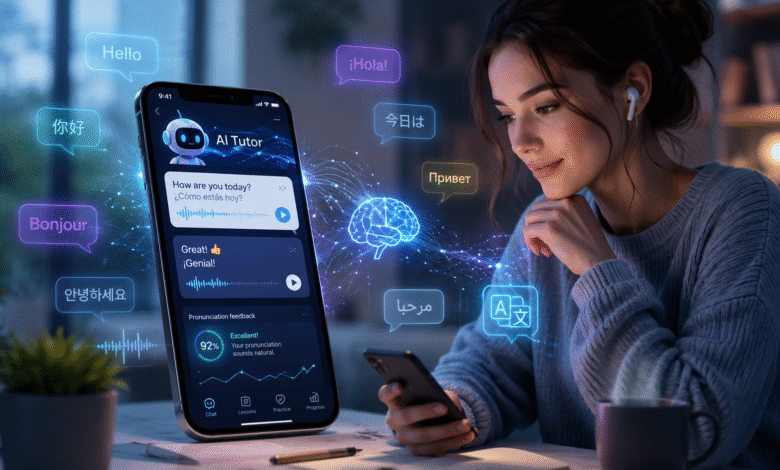
One of the hardest parts of learning a language is speaking it out loud, especially when there is no one around to correct you. AI-powered speech recognition has made a real difference here. These tools can now detect subtle differences in pronunciation and give instant feedback, something that used to require a patient human tutor sitting right next to you.
Some apps go a step further by simulating conversations. A learner might practice ordering food, asking for directions, or making small talk with an AI chatbot that responds naturally and corrects errors along the way. This kind of practice used to be hard to get without traveling abroad or hiring a private tutor. Now it is available anytime, right on a phone.
Making Mistakes Without Fear
Anyone who has learned a new language knows that fear of making mistakes can hold people back. Speaking in front of a classroom, worrying about being judged, can be uncomfortable enough to stop someone from practicing at all. AI-powered apps remove much of that pressure. There is no audience, no judgment, just a program quietly helping you improve.
This low-pressure environment encourages people to try more, fail more, and ultimately learn faster. When someone uses a learn spanish app during a quiet moment at home, they can repeat a phrase as many times as needed without feeling embarrassed. That freedom to experiment is a quiet but powerful part of why these tools work so well for so many people.
Gamification and Staying Motivated
Consistency is one of the biggest challenges in language learning. It is easy to start with enthusiasm and lose motivation after a few weeks. AI-driven apps often use gamification, streak tracking, achievement badges, and friendly reminders, to keep learners engaged over the long run.
What makes this more effective than older reward systems is that AI can time these nudges intelligently. Instead of sending a generic reminder every day, some apps notice patterns in when a person is most likely to study and send prompts accordingly. This small adjustment can make a noticeable difference in how long someone sticks with their learning routine.
The Role of Natural Language Processing
Natural language processing, often shortened to NLP, is another piece of this puzzle. It allows apps to understand written and spoken input in a way that feels closer to how humans process language. Instead of just checking if an answer matches an exact phrase, NLP can recognize different valid ways of saying the same thing.
This matters because language is flexible. There are usually several correct ways to express an idea, and older systems often penalized learners for phrasing something differently than expected. With NLP, apps can accept natural variations, which makes the learning experience feel less rigid and more like an actual conversation.
Balancing Technology With Human Connection
While AI has clearly improved how people learn languages, it is worth remembering that technology works best as a support tool rather than a complete replacement for human interaction. Speaking with native speakers, joining conversation groups, or even traveling to a country where the language is spoken still offers something an app cannot fully replicate.
Many learners find that combining AI-powered practice with real human conversation gives the best results. The app builds vocabulary, corrects pronunciation, and reinforces grammar, while human interaction adds cultural context and spontaneity that no algorithm can fully predict.
Conclusion
Language learning technology is still evolving quickly. As AI models continue to improve, apps are likely to become even better at understanding context, humor, and regional dialects. Future versions may offer even more realistic conversation simulations or adjust to emotional cues, like recognizing when a learner is frustrated and slowing down the pace.
What remains constant is the core idea behind all of this progress: making language learning feel personal, approachable, and less intimidating. Technology has not replaced the human desire to connect through language. It has simply given people more ways to get there, one lesson, one conversation, and one small daily habit at a time.