Picking a skip bin size feels like it should be straightforward. You look at what needs to go, you pick a number that sounds about right, and you book it. Then the project gets underway, the bin fills up faster than expected, and you’re on the phone arranging a second one while the project is already halfway through and the driveway is still full of debris.
It happens constantly, and it almost always comes down to the same thing: the estimate was based on what was visible before the project started, without accounting for everything that would be uncovered, removed, or generated once the work was actually underway. A bit of thinking before booking, using a more systematic approach than a visual guess, produces a considerably better outcome.
Why the Cubic Metre Number Doesn’t Tell You Much on Its Own
The standard way skip bins are sized is in cubic metres, and for most people who haven’t spent time thinking about what a cubic metre actually looks like in practice, this number is nearly meaningless. A two cubic metre bin and a six cubic metre bin don’t map onto anything intuitive, which is why most people end up guessing rather than calculating.
The more useful way to think about skip bin sizing is in terms of what the project is and what it typically generates, using comparisons that make the abstract number real. A cubic metre of general household waste looks roughly like the contents of a large wardrobe. Two cubic metres is approximately what you’d fit in a small garden shed. Six cubic metres is the equivalent of roughly three to four large trailer loads.
These comparisons aren’t precise, but they’re considerably more useful than trying to visualise a number of cubic metres in isolation, and they give a starting point for thinking about whether the project is a small bin job, a medium bin job, or something larger.
How to Actually Calculate What Your Project Will Generate
The most reliable approach to skip bin sizing starts with a walkthrough of the project rather than a guess from the front door. Going through each area of the project and making a list of what will actually be removed, not just what’s obviously visible, produces a much more accurate estimate than a general impression of the space.
Understanding how to calculate skip bin requirement for project comes down to a few practical steps. First, list everything that’s definitely going: the items you can see that are earmarked for disposal. Second, add everything that will be generated by the work itself, the packaging from new materials, the offcuts, the dust and debris that comes from demolition or construction work. Third, and this is where most people underestimate, add what you’re likely to find once you open things up. Walls, floors, and garden beds consistently contain surprises that weren’t in the original calculation.
Once you have a list, group it roughly by size. Large items like furniture, appliances, and doors have obvious dimensions that can be estimated directly. Medium items like boxes, bags, and smaller fixtures can be estimated in groups. And the loose material, garden waste, soil, demolition debris, fills whatever space remains and is the hardest to estimate without experience.
The most reliable rule of thumb for adjusting the estimate is to add between twenty and thirty percent to whatever your initial calculation produces. Projects almost always generate more than the first estimate, and the cost of that buffer, in the form of a slightly larger bin, is almost always less than the cost of a second booking.
Why Weight Matters as Much as Volume
Volume is only half of the sizing equation, and for building and renovation projects in particular, the weight half is often more important. Every skip bin has a weight limit as well as a volume, and heavy materials can reach that limit long before the bin looks anywhere near full.
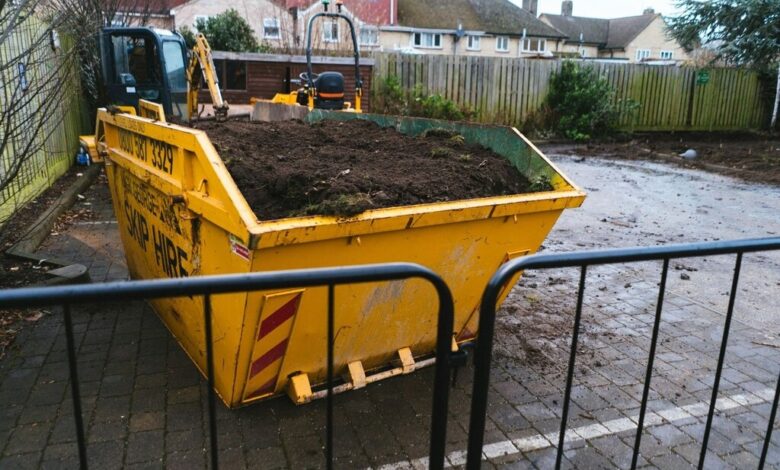
Soil is the most common culprit. A bin that looks a third full of soil may already be at its weight limit, leaving a bin that appears to have plenty of space but can’t legally take any more material. The same applies to concrete, bricks, tiles, and rubble, all of which are significantly denser than general household waste and fill a bin’s weight capacity much faster than its visual capacity.
For projects generating significant quantities of heavy material, the solution is either to choose a bin specifically rated for heavy materials, which come with higher weight allowances, or to keep heavy and light materials separate and dispose of them through different bins or collection methods. A mixed bin loaded with both soil and general household waste often ends up being an inefficient use of both the weight and volume capacity.
The Projects That Consistently Surprise People
Certain project types generate more waste than almost anyone estimates accurately the first time, and knowing which ones they are helps with planning even before the walkthrough.
Bathroom renovations are at the top of the list. The visible items, a vanity, a toilet, some tiles, seem manageable. What gets underestimated is the volume of the tiles themselves once removed, the cement board behind them, the old waterproofing, and the plumbing fittings. A standard bathroom renovation generates considerably more than it looks like it should from the outside.
Roof space and under-house clear-outs are the other category that consistently catches people out. These spaces have often been accumulating things for decades, and the volume of what comes out bears very little relationship to what was visible from the access hatch. A half-day clear-out of a roof space can easily fill a medium bin on its own.
Garden overhauls underperform initial estimates for a different reason: the weight of soil and root systems. A garden bed that looks like a small amount of material contains a surprising volume of compacted soil and roots once excavated, and the weight of that material reaches a bin’s limit faster than the volume does.
Why Ten Minutes of Planning Saves Considerably More Later
The skip bin sizing decision takes about ten minutes to get right and considerably longer to fix if it goes wrong. A second bin booking mid-project means a phone call, a wait for delivery, a project that’s stalled in the interim, and a final bill that’s higher than it needed to be. None of those things happen when the original estimate was accurate.
The approach isn’t complicated: walk through the project, list what’s coming out, add what the work will generate, factor in what might be found once things are opened up, add a buffer, and check whether the project involves heavy materials that might hit a weight limit before a volume one. That sequence takes less time than most people spend choosing which bin provider to use, and it produces a considerably better outcome than estimating by feel and hoping for the best.