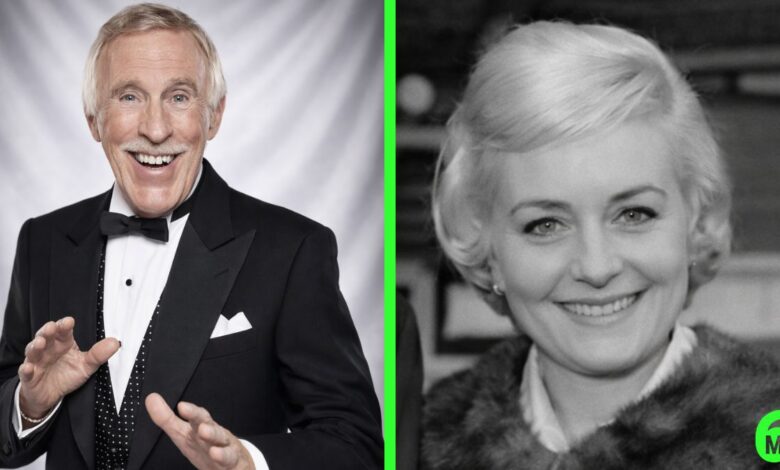
Few figures loom as large in British popular culture as Bruce Forsyth. For decades, he was a constant presence on television and stage—quick-witted, impeccably dressed, and seemingly tireless in his devotion to entertainment. Programmes such as Sunday Night at the London Palladium and Strictly Come Dancing made him a household name and an emblem of British showbusiness longevity.
Yet behind this very public career stood a woman whose life followed a very different arc. Penny Calvert, Forsyth’s first wife, shared his early years in theatre, his rise to fame, and the challenges that came with it. Unlike her former husband, Calvert did not seek a public platform in later life. Her story is therefore not one of celebrity in the conventional sense, but of proximity to fame—and the deliberate choice, or quiet necessity, of privacy. This article explores Penny Calvert’s life using verifiable public facts, while analysing what her largely private existence reveals about partnership, family, and the unseen foundations of public success.
Profile Summary
| Detail | Information |
|---|---|
| Full Name | Penny Calvert |
| Relationship | First wife of Bruce Forsyth |
| Marriage Period | 1953–1973 |
| Profession | Dancer |
| Birth | 1930, Derriaghy, County Antrim, Northern Ireland |
| Children | Three daughters (with Bruce Forsyth) |
| Public Profile | Very limited; no sustained media presence |
| Later Residence | Care home in Kent (later years) |
| Health (Later Life) | Dementia (publicly reported) |
| Death | 2014 |
| Social Media Presence | None |
Who Is Penny Calvert?
Penny Calvert was a professional dancer whose life intersected with British entertainment history at a formative moment. She met Bruce Forsyth in 1947 while both were working as dancers at London’s Windmill Theatre, a venue famous for nurturing talent during and after the Second World War. Their relationship developed before Forsyth became a national figure, placing Calvert at the very beginning of his long ascent.
Her significance lies not in individual celebrity, but in context. She was part of the labour and discipline of mid-20th-century theatre, and later the stabilising presence in the domestic life of a man whose career demanded constant public performance. Calvert’s story is therefore inseparable from Forsyth’s early professional years and from the family they built together.
The Private Life of Penny Calvert
Public records and reliable reporting make one fact abundantly clear: Penny Calvert lived most of her adult life away from the media spotlight. Unlike many partners of famous entertainers, she did not cultivate interviews, memoirs, or public commentary about her marriage. This absence is itself revealing. In an era when celebrity culture was becoming increasingly intrusive, Calvert maintained a low profile, even after her marriage ended.
Analytically, this privacy suggests a clear boundary between personal life and public spectacle. Forsyth’s career thrived on visibility, but Calvert’s life demonstrates that proximity to fame does not automatically produce a public identity. Her restraint contrasts sharply with the modern expectation that all associated figures become content for public consumption.
Early Life and Background of Penny Calvert
career. What dance career? What is verifiably known about Penny Calvert’s early life is modest but meaningful. Born in 1930 in Derriaghy, County Antrim, she grew up in Northern Ireland before pursuing a professional career in dance. This alone places her among a generation of women who entered the performing arts at a time when such careers required resilience, mobility, and physical discipline.
Dance training in the 1940s was rigorous and often unforgiving. Calvert’s eventual employment at the Windmill Theatre indicates a high level of skill and professionalism. While personal details about her upbringing remain private, her documented work places her firmly within Britain’s post-war entertainment workforce.
Marriage and Partnership with Bruce Forsyth
Penny Calvert married Bruce Forsyth in 1953, when his career was gaining momentum but had not yet reached its peak. Their marriage lasted 20 years and coincided with his transition from dancer and variety performer to national television star.
Publicly, they appeared together during Forsyth’s early rise, but Calvert did not assume a performative role as a celebrity spouse. The marriage ended in divorce in 1973, reportedly due to Forsyth’s infidelity—an aspect he later acknowledged openly. What stands out, however, is the absence of public acrimony. In later years, Forsyth spoke with respect about Calvert, and their relationship evolved into one marked by civility rather than conflict.
Penny Calvert’s Role Behind the Scenes
Because Calvert avoided public commentary, her role must be understood through context rather than conjecture. Forsyth’s career in the 1950s and 1960s involved extensive travel, rehearsals, and performance schedules. Maintaining family stability under such conditions required adaptability and emotional labour.
Calvert’s behind-the-scenes role was not publicly narrated, but its effects are observable in outcomes: a long marriage during formative career years and three children raised amid increasing fame. This suggests a partnership where domestic continuity balanced professional volatility—an often-unacknowledged dynamic in entertainment history.
Family Life: Raising the Next Generation
Together, Penny Calvert and Bruce Forsyth had three daughters. They were raised largely away from intense media scrutiny, particularly by modern standards. This relative normality is noteworthy given Forsyth’s fame.
After the divorce, Calvert remained central to her daughters’ lives, while Forsyth continued to support his family. The sustained family bonds, even after marital separation, reflect a shared commitment to parenting that endured beyond personal differences.
Philanthropy and Community Engagement
There is no verified public record of Penny Calvert engaging in organised philanthropy under her own name. Rather than inventing such activity, it is more accurate to note her absence from public charitable campaigns. This absence does not imply disengagement; instead, it reflects a private approach to life that avoided public attribution.
Forsyth himself was involved in charitable causes later in life, particularly related to health and entertainment. Calvert’s quiet profile suggests that if she contributed to community or charitable efforts, she did so privately—consistent with her overall pattern of discretion.
The Power of Privacy: Influence Without Publicity
Penny Calvert’s life illustrates a broader cultural phenomenon: influence exercised without visibility. Her decision—or necessity—to remain private stands in contrast to the contemporary merging of personal life and media presence.
Analytically, her story challenges assumptions that public relevance requires public exposure. Calvert’s influence existed within family, partnership, and personal relationships rather than headlines. This form of impact is harder to quantify, but no less real.
Public Curiosity and Misconceptions About Penny Calvert
Public curiosity about Penny Calvert often arises from her association with Bruce Forsyth, particularly following revelations about their divorce. A common misconception is that her obscurity equates to insignificance. In reality, her limited public footprint reflects her choices, circumstances, and the norms of her era.
It is also important to avoid retroactively imposing modern celebrity expectations on a woman whose adult life unfolded long before social media and constant coverage. Her silence is not a void, but a boundary.
Legacy and Future
Penny Calvert died in 2014 after living with dementia in her later years. Forsyth remained a regular visitor during this period, underscoring the enduring respect between them. Her legacy is therefore not found in awards or public accolades, but in relationships sustained over decades.
She represents a generation whose contributions were often domestic, supportive, and private—yet foundational to public success stories that followed.
Conclusion
Penny Calvert’s life offers a counter-narrative to celebrity culture. As the first wife of Bruce Forsyth, she shared the formative years of a major public career while choosing, or accepting, a life largely beyond public view. Her story is defined by professionalism, discretion, and continuity rather than spectacle. In examining her life carefully and factually, we see that impact does not always announce itself. Sometimes it resides quietly, shaping outcomes without ever seeking recognition.
Read this too:Mike Hollingsworth and Anne Diamond: A Study in Partnership, Privacy, and Life Beyond the Spotlight
(FAQs)
- Who was Penny Calvert?
She was a professional dancer and the first wife of Bruce Forsyth. - When did Penny Calvert marry Bruce Forsyth?
They married in 1953. - How did Penny Calvert and Bruce Forsyth meet?
They met in 1947 while working as dancers at the Windmill Theatre in London. - How many children did they have together?
They had three daughters. - Why did Penny Calvert and Bruce Forsyth divorce?
Their divorce in 1973 was reportedly due to Forsyth’s infidelity. - Did Penny Calvert remarry after the divorce?
There is no verified public record confirming a remarriage. - Where did Penny Calvert live in her later years?
She lived in a care home in Kent. - Did Bruce Forsyth remain in contact with Penny Calvert?
Yes, he visited her regularly until her death in 2014.